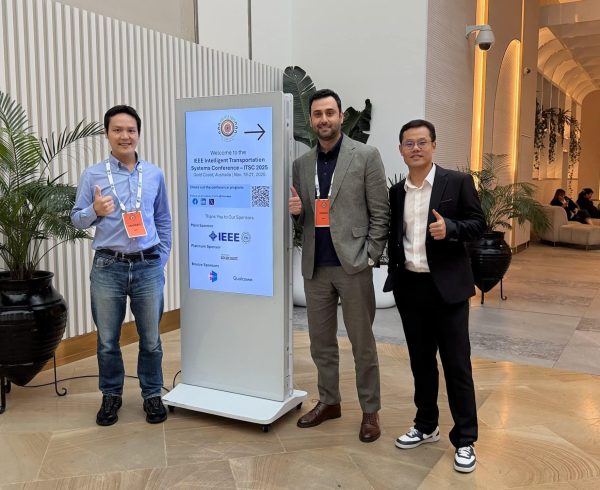
The 29th IEEE International Conference on Intelligent Transportation Systems (IEEE ITSC 2026), the flagship conference of the IEEE Intelligent Transportation Systems Society, was held from September 15 to 18, 2026 in Naples, Italy. The venue was the Stazione Marittima, the cruise terminal on the port, with Castel Nuovo on one side and the ferries to Capri on the other, and about 1,100 registered participants moving between its sixteen parallel rooms for four days. From Tsukada Lab, three papers appear in the proceedings, and Assoc. Prof. Manabu Tsukada gave a keynote at the DriveX workshop and an invited talk at workshop W19, which he also helped organize.

The Conference at a Glance
Figures announced at the opening ceremony give a sense of the scale. ITSC 2026 received 1,664 submissions from 4,388 authors. Regular papers, invited session papers, a new industry track, journal paper presentations and late-breaking posters were reviewed in two months by 282 associate editors and 3,570 reviewers, at 3.05 reviews per paper, with double-blind review introduced this year for regular and invited session papers. The acceptance rate for those tracks was 49.9%. The resulting programme ran in 16 parallel rooms: 4 plenary lectures, 28 workshops, 7 tutorial sessions, 147 technical sessions, 831 presentations, 3 poster sessions and 3 live demonstrations. Participants came from five continents, with Europe at 46.4%, Asia-Pacific at 37.1% and North America at 14.3%.

Workshops: DriveX Keynote and W19
The workshop and tutorial day on September 15 was the busiest day for the lab.
In the morning, Tsukada gave an invited talk at W19, “Human-Centered Intervention and Cooperative Autonomy Across Mobility Domains: Bridging Ground Vehicles and Aerospace Systems”, a workshop he co-organized with colleagues from JAXA, the University of Surrey, the University of Tsukuba and other institutions. The talk, Cooperative Intelligence Across Mobility Domains: From V2X Communication to Human-Agent Interaction, was followed by a panel discussion on what ground vehicles and aerospace systems can learn from each other about human intervention and cooperative autonomy.

In the afternoon, Tsukada gave a keynote at DriveX, the 7th Workshop on Foundation Models for V2X-based Cooperative Autonomous Driving, held in the Perseide Room. The talk, Agentic AI for Cooperative Autonomous Driving: Human Interaction, VLA, and V2X, connected the lab’s work on V2X communication, vision-language-action models and human-agent interaction, and drew on the V2X end-to-end simulator and field experiments at Kashiwa-no-ha as well as the lab’s work on the Autonomous Driving AI Challenge. The workshop closed with an eight-person panel discussion.


Papers from the Lab
Three papers from the lab and its collaborations are in the ITSC 2026 proceedings.
Yu Asabe presented At the Limits: Sim-to-Real and Community Lessons from the Autonomous Driving AI Challenge in the session “Automated Vehicles at the Limits: Lessons and Opportunities from the Racetrack”. The paper reports what the Autonomous Driving AI Challenge has taught us about closing the gap between simulation and the real vehicle, and about running a competition as a research community.

Sibing Yang and co-authors contributed Collaborative Semantic Occupancy Prediction with Probabilistic Gaussian, on cooperative perception in which several vehicles share a probabilistic Gaussian representation of semantic occupancy. Yun Li and co-authors contributed An Open-Source Modular Benchmark for Diffusion-Based Motion Planning in Closed-Loop Autonomous Driving, which breaks a diffusion planner out of a single frozen graph into modules so that the denoising loop, the solver and the number of steps can be inspected and changed, and validates it closed-loop in AWSIM.
Awards and the Wider Programme
The IEEE ITSS and ITSC award ceremony was held inside the plenary, in front of the whole conference. Among the recipients was Prof. Arnaud de La Fortelle, recognized for his contributions to the theoretical foundations of cooperative driving; he is a long-standing collaborator of the lab and served as General Chair of the CIV Summer School that the lab hosted in Miyazaki two weeks earlier. The programme also featured an IEEE ITSS and ITE joint forum, a YP & WIE workshop, a 3-Minute Thesis competition and an AWS-powered Smart Mobility Data Challenge hackathon with 70 teams.

Beyond the Sessions
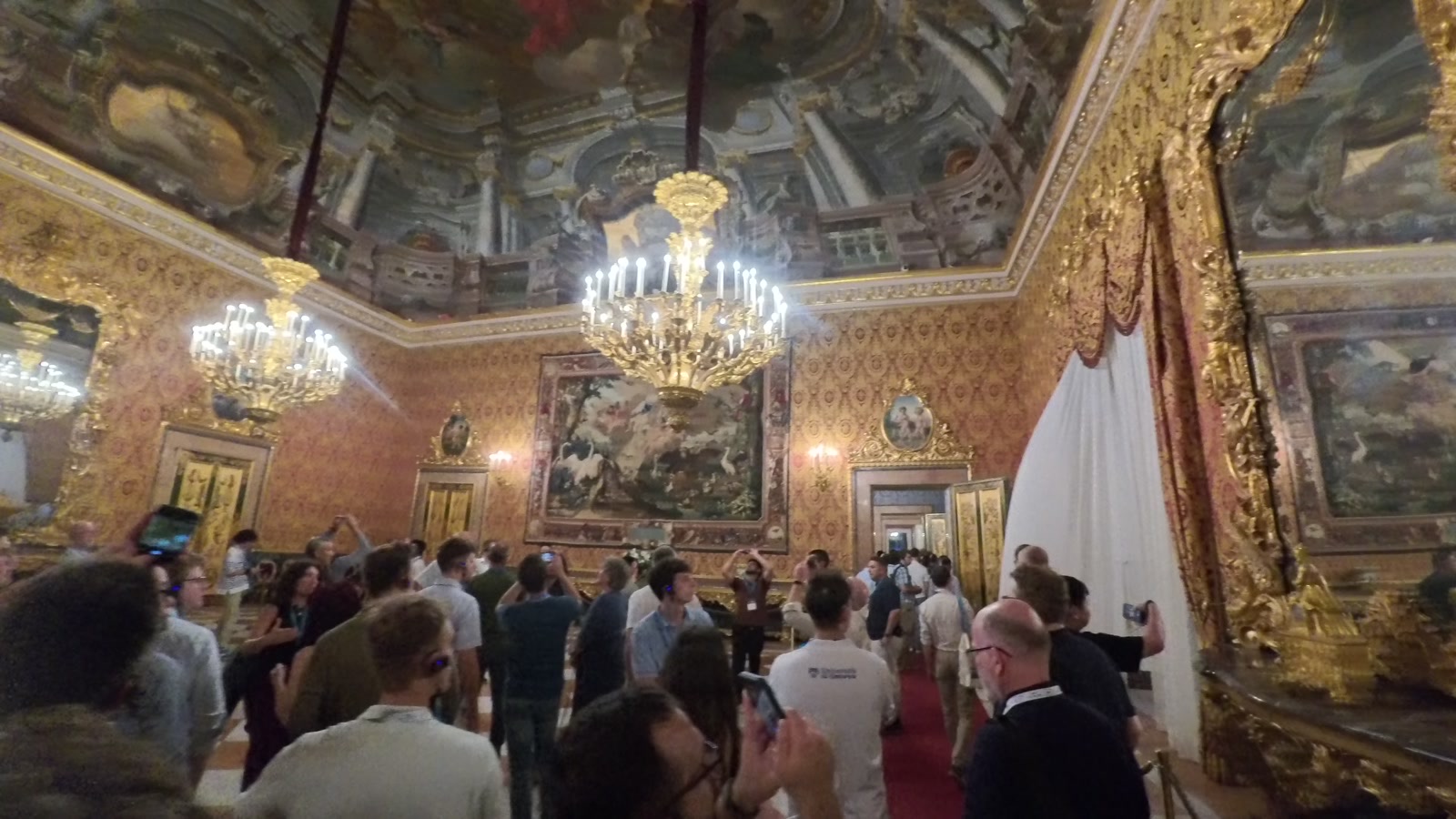
ITSC 2026 put an unusual amount of care into its social programme. The welcome reception, “Royal Welcome”, was held at the Royal Palace of Naples on Piazza del Plebiscito, with the guests walked through the royal apartments as part of the evening. The gala dinner, “Under the Neapolitan Stars”, took place at a seaside venue in Bacoli on the coast of the Phlegraean Fields, with the conference logo projected onto the cliff above the beach and a live band that kept going well past midnight. In between there was a YP & WIE guided walking tour through the historic centre, ending with Neapolitan street food.


Publications and Presentations
Conference website: https://ieee-itsc.org/2026/
DriveX workshop: https://drivex-workshop.github.io/itsc2026/