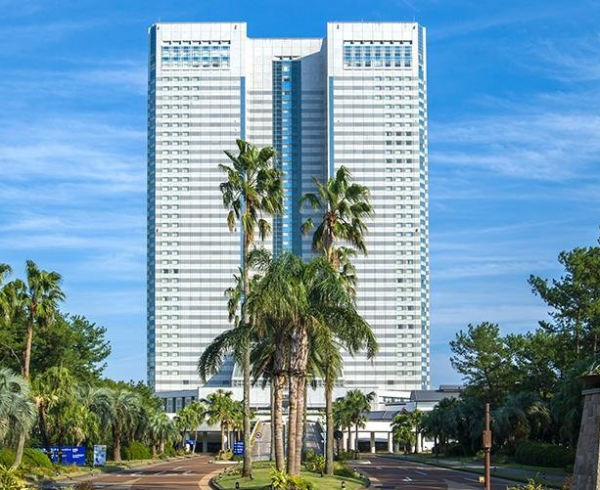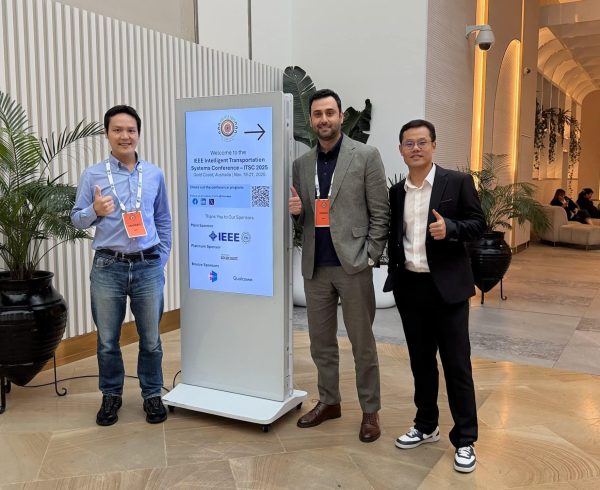
The 6th Summer School on Cooperative Interacting Vehicles (CIV 2026) was held from August 31 to September 4, 2026 at the Phoenix Seagaia Resort in Miyazaki, Japan. It was the first time the school has taken place in Asia, and Tsukada Lab served as the local host. Thirty-eight participants from 19 institutions in five countries (Japan, Germany, Switzerland, Taiwan and France), representing more than ten nationalities, spent five days together on the Pacific coast of Kyushu.
CIV is an intensive five-day programme for PhD students, early-career researchers and young industry professionals. This year’s themes were Cooperative Perception and Motion Planning, Implicit and Explicit Interaction, and Modeling and Data-Driven Methods, including AI and foundation models.
Lectures
Fourteen lectures from academia and industry were given over the four days:
- Prof. Chi-Sheng (Daniel) Shih (National Taiwan University): Buying Time for Cooperative Driving: Latency Compensation and QoS-Aware 5G-TSN Networking for Connected Vehicles
- Prof. Celimuge Wu (The University of Electro-Communications): Semantic Communication System for Remote Driving
- Dr. Bo Qian (The University of Tokyo): From Traffic Lights to Collision-Free Coordination: V2X Scheduling for Automated Vehicles at Unsignalized Intersections
- Prof. Arnaud de La Fortelle (General Chair): Can AI Learn to Cooperate? What We Can Prove, What We Cannot Yet Define
- Automotive Edge Computing Consortium (AECC): Industry Perspectives on Cooperative Interactive Vehicles
- Dr. Wencan Mao (National Institute of Informatics): Capacity Planning for Vehicular Fog Computing
- Daniel Maksimovski (Technische Hochschule Ingolstadt, CARISSMA): Priority-Based Cooperative Maneuver Coordination for Connected and Automated Vehicles
- Vishal Chauhan (The University of Tokyo): Who Goes First? Reducing Pedestrian Decision-Making Burden with Infrastructure-Side eHMI in Shared Spaces
- Yun Li (The University of Tokyo): Toward Safe and Real-Time Generative Models for Autonomous Driving: VLA and Diffusion Planning
- Prof. Zhi Liu (The University of Electro-Communications): Tackling Corner Cases in Autonomous Driving: A Hierarchical Policy Network of Arbiter and Experts
- Prof. Alexander Carballo (Gifu University): Self-Driving under Adverse Weather Conditions: Sensor Performance, Robust Perception, and Enhancement Techniques
- Ryohsuke Mitsudome (TIER IV): Autoware: Building Cooperative Autonomy through Open Source
- Dr. Ehsan Javanmardi (The University of Tokyo): Toward Safer Connected Mobility: Advances in Cooperative Autonomous Driving
- Abhishek Dinkar Jagtap (Technische Hochschule Ingolstadt): Beyond Validation: Understanding and Managing Uncertainty in Connected and Automated Driving
Posters, Data Hackathon and Hands-on
Participants presented their own research in poster sessions on the first two afternoons, which continued over snacks and drinks and into the evening discussions. On Day 3, a data hackathon put everyone to work on real cooperative-driving recordings: an unprotected-right-turn dataset recorded by Tsukada Lab on the Kashiwa Campus of the University of Tokyo, and a second set recorded in Reims, France. Teams had to find the risky or operationally relevant manoeuvres in the recordings, encode them as reusable detectors, and then transfer their detectors to a recording with a different sensor configuration before a hard noon deadline. The afternoon closed with a hands-on session led by Prof. Carballo on a portable LiDAR and sensor kit. The final day was devoted to an interactive breakout session and the presentation of its results.
Beyond the Lecture Room
The week also had its social side: a welcome reception with teppanyaki, a Japanese dinner at which the lecturers received their certificates of appointment, an izakaya evening in downtown Miyazaki, a barbecue, a discovery tour of the area, and, for the early risers, sunrise walks along the beach in front of the resort.
A short video of the week is on the lab’s Instagram and YouTube:
Organization
CIV 2026 was jointly organized by the University of Tokyo, Mines Paris – PSL, the Karlsruhe Institute of Technology, UC Berkeley and the German University in Cairo. Prof. Arnaud de La Fortelle served as General Chair, with Prof. Christoph Stiller, Assoc. Prof. Manabu Tsukada, Prof. Scott Moura, Dr. Catherine Elias and Dr. Matthieu Carré on the organizing committee. The school was supported by the IEEE Intelligent Transportation Systems Society and the Miyazaki Prefectural Tourism Association, with additional support from Heex Technologies.
From Tsukada Lab, Dr. Bo Qian, Dr. Ehsan Javanmardi, Vishal Chauhan and Yun Li gave lectures, and lab members took part as participants and poster presenters. We thank all lecturers, participants and everyone who helped with the local arrangements for making the first Asian edition of CIV a success.
Official website: https://civ-summerschool.org/
Announcement (May 2026): Announcement: Cooperative Interactive Vehicles (CIV) Summer School 2026