
DispatchRAG: Grounding Emergency Dispatch Decisions in Real-World Protocols from Traffic Accident Video
Best Paper AwardAsia Pacific Signal and Information Processing Association Annual Summit and Conference (APSIPA ASC 2026), Bangkok, Thailand, 2026年11月9日
3行要約
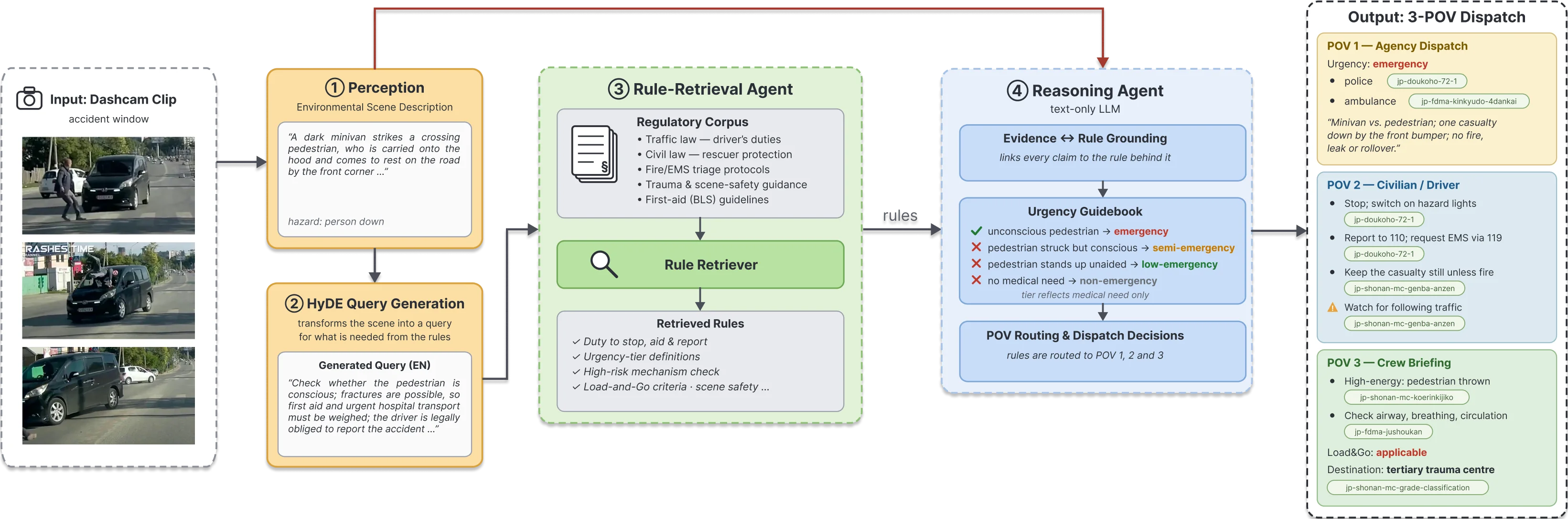
- DispatchRAGはドラレコ映像から必要な緊急サービスと出動の緊急度を提案する。
- 映像で観測できる事実と判断を分け、根拠となる日本の法令や救急ルールを検索・引用する。
- 事故映像の評価で過剰出動を抑え、出動機関の特定でF1値0.86を得た。
論文の図
アブストラクト(原文)
Assessing the severity of a traffic accident scenario is important to decide which emergency service to dispatch. Missing an ambulance dispatch on a pedestrian accident is a fatal issue that can lead to death. Recently, Vision-Language Models (VLMs) have been a promising tool for accident reasoning, yet many VLMs are not grounded in real-life accident response protocols, making them not usable in accident severity assessment off-the-shelf. We introduced DispatchRAG, an accident assessor and dispatcher framework grounded in real-life Japanese traffic-accident response protocols, designed to enhance VLMs to generate an appropriate emergency response during an emergency scenario. Utilizing a RAG-based retrieval mechanism to retrieve the most relevant accident protocol and an LLM-powered reasoner to suggest the most proper response. To support evaluation, we introduce Accident Dispatch Dataset, a comprehensive dataset of accident assessment and emergency response according to Japanese accident response protocols adapted from the MM-AU dataset. We validate our framework on the Accident Dispatch Dataset, showing strong performance across various accident scenarios compared to the baseline VLM, pointing toward integration in autonomous vehicles that can automatically report both their own and nearby accidents.
関連ニュース
引用方法
M. S. Adhipradhana, E. Javanmardi, N. Bao, and M. Tsukada, “DispatchRAG: Grounding Emergency Dispatch Decisions in Real-World Protocols from Traffic Accident Video,” in Asia Pacific Signal and Information Processing Association Annual Summit and Conference (APSIPA ASC 2026), Bangkok, Thailand, 2026.
BibTeX
@inproceedings{Adhipradhana2026,
  title         = {DispatchRAG: Grounding Emergency Dispatch Decisions in Real-World Protocols from Traffic Accident Video},
  author        = {Muhammad Sulthan Adhipradhana and Ehsan Javanmardi and Naren Bao and Manabu Tsukada},
  url           = {https://arxiv.org/abs/2607.23132 https://adhipradhana.github.io/DispatchRAG/},
  year          = {2026},
  date          = {2026-11-09},
  urldate       = {2026-11-09},
  booktitle     = {Asia Pacific Signal and Information Processing Association Annual Summit and Conference (APSIPA ASC 2026)},
  address       = {Bangkok, Thailand},
  abstract      = {Assessing the severity of a traffic accident scenario is important to decide which emergency service to dispatch. Missing an ambulance dispatch on a pedestrian accident is a fatal issue that can lead to death. Recently, Vision-Language Models (VLMs) have been a promising tool for accident reasoning, yet many VLMs are not grounded in real-life accident response protocols, making them not usable in accident severity assessment off-the-shelf. We introduced DispatchRAG, an accident assessor and dispatcher framework grounded in real-life Japanese traffic-accident response protocols, designed to enhance VLMs to generate an appropriate emergency response during an emergency scenario. Utilizing a RAG-based retrieval mechanism to retrieve the most relevant accident protocol and an LLM-powered reasoner to suggest the most proper response. To support evaluation, we introduce Accident Dispatch Dataset, a comprehensive dataset of accident assessment and emergency response according to Japanese accident response protocols adapted from the MM-AU dataset. We validate our framework on the Accident Dispatch Dataset, showing strong performance across various accident scenarios compared to the baseline VLM, pointing toward integration in autonomous vehicles that can automatically report both their own and nearby accidents.},
  note          = {Best Paper Award},
  keywords      = {Award, Other},
  pubstate      = {published},
  tppubtype     = {inproceedings}
}