
Sharing Positions over Commodity Cellular: A Preliminary Field Study on an Autonomous Racing Kart Testbed
IEEE 24th Consumer Communications & Networking Conference (CCNC 2027), Work in Progress (WiP), Las Vegas, NV, USA, 2027年1月9日
論文の図
アブストラクト
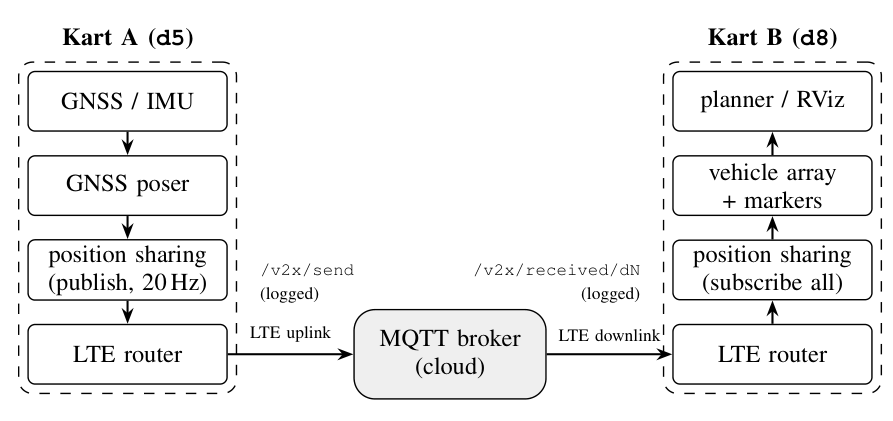
協調走行には周辺車両の位置を把握する必要があるが、研究・教育用プラットフォームの多くにとって、V2X専用無線機の導入は依然として難しい。本研究では、シミュレーション、電動レーシングカート、OTAを用いた開発サイクルについて先に報告したオープンなsim-to-real自動運転レース用テストベッドを拡張し、一般に利用できるLTE回線とパブリッシュ/サブスクライブ型のブローカーを介して複数車両が位置を共有できるようにした。複数チームが参加した実走行イベントで、4台の車両がGNSS位置を20 Hzで配信した際の予備計測結果を報告する。各リンクの両端の記録を含む2台のカートのrosbagを用い、双方向の通信記録を組み合わせて時計を同期せずに片道遅延を推定し、GNSS時刻を基準に推定値を検証した。中央値は、アプリケーション層で測ったネットワーク遅延が104 ms、GNSSタイムスタンプを起点とするエンドツーエンド遅延が132 msであった。観測した低速域では、遅延に起因する位置誤差は速度に比例して増大し、等速外挿によりその中央値は約8分の1になった。一方、このイベントで支配的であったのは通信の可用性である。複数のリンクで同時に生じた通信断は計測時間の24%に及び、その大半は1台のカートの接続で発生した。通信が滞った接続では、滞留していた最大75秒前のメッセージが配信された。これらの結果を次期テストベッドの設計に反映する。
引用方法
Y. Asabe, E. Javanmardi, M. Tsukada, and H. Esaki, “Sharing Positions over Commodity Cellular: A Preliminary Field Study on an Autonomous Racing Kart Testbed,” in IEEE 24th Consumer Communications & Networking Conference (CCNC 2027), Work in Progress (WiP), Las Vegas, NV, USA, 2027.
BibTeX
@inproceedings{Asabe2027,
  title         = {Sharing Positions over Commodity Cellular: A Preliminary Field Study on an Autonomous Racing Kart Testbed},
  author        = {Yu Asabe and Ehsan Javanmardi and Manabu Tsukada and Hiroshi Esaki},
  year          = {2027},
  date          = {2027-01-09},
  urldate       = {2027-01-09},
  booktitle     = {IEEE 24th Consumer Communications & Networking Conference (CCNC 2027), Work in Progress (WiP)},
  address       = {Las Vegas, NV, USA},
  abstract      = {Cooperative driving needs vehicles to know where their neighbors are, yet dedicated V2X radios remain out of reach for most research and education platforms. We extend an open sim-to-real autonomous racing testbed, whose simulation, EV racing karts, and OTA-based development loop we described previously, with multi-vehicle position sharing over commodity LTE and a publish/subscribe broker. We report preliminary measurements from a multi-team field event with four vehicles publishing GNSS positions at 20 Hz. Using the rosbags of two karts, which log both ends of each link, we estimate one-way latency without clock synchronization by combining the two traffic directions, and check the estimate against GNSS time. The median application-level network latency is 104 ms and the median end-to-end latency, from the GNSS timestamp, is 132 ms. At the low speeds observed, the resulting position error grows linearly with speed, and constant-velocity extrapolation reduces its median by about 8×. However, in this event availability, not latency, dominated: shared outages, most of them on one kart's connection, covered 24 % of the time, and stalled connections delivered backlogs of messages up to 75 s old. These findings set the testbed's next iteration.},
  keywords      = {ITS},
  pubstate      = {published},
  tppubtype     = {inproceedings}
}