
Limitations and Future Aspects of Communication Costs in Federated Learning: A Survey
Sensors, vol. 23, no. 17, 2023年8月23日
3行要約
- 分散した参加者が行う連合学習で、通信コストを削減する研究を整理する。
- モデル更新、圧縮、エッジとクラウドの資源管理、参加端末の選択を取り上げる。
- 通信効率を高めるための課題と今後の研究方向を示す。
論文の図
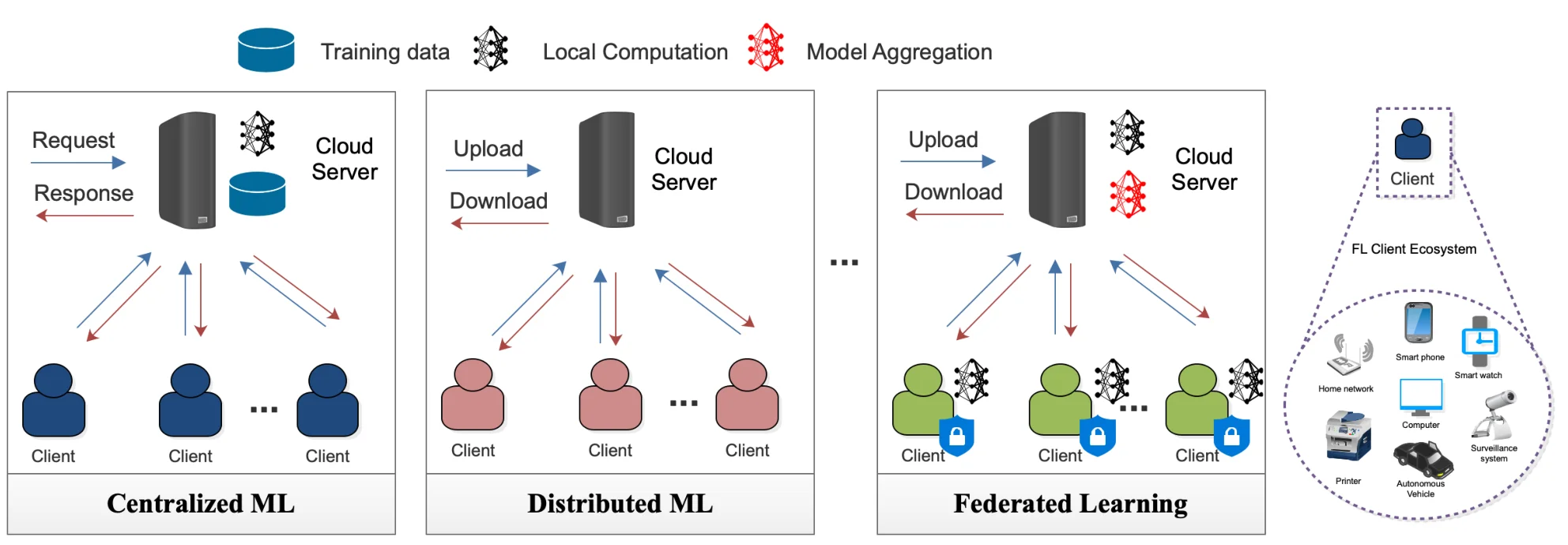
アブストラクト(原文)
This paper explores the potential for communication-efficient federated learning (FL) in modern distributed systems. FL is an emerging distributed machine learning technique that allows for distributed training of a single machine learning model across multiple geographically distributed clients. This paper surveys the various approaches to communication-efficient FL, including model updates, compression techniques, resource management for edge and cloud, and client selection. We also review the various optimization techniques associated with communication-efficient FL, such as compression schemes and structured updates. Finally, we highlight the current research challenges and discuss the potential future directions for communication-efficient FL.
関連する研究・ソフトウェア
引用方法
M. Asad, S. Shaukat, D. Hu, Z. Wang, E. Javanmardi, J. Nakazato, and M. Tsukada, “Limitations and Future Aspects of Communication Costs in Federated Learning: A Survey,” Sensors, vol. 23, no. 17, 2023, doi: 10.3390/s23177358.
BibTeX
@article{Asad2023b,
  title         = {Limitations and Future Aspects of Communication Costs in Federated Learning: A Survey},
  author        = {Muhammad Asad and Saima Shaukat and Dou Hu and Zekun Wang and Ehsan Javanmardi and Jin Nakazato and Manabu Tsukada},
  doi           = {10.3390/s23177358},
  issn          = {1424-8220},
  year          = {2023},
  date          = {2023-08-23},
  urldate       = {2023-08-23},
  journal       = {Sensors},
  volume        = {23},
  number        = {17},
  abstract      = {This paper explores the potential for communication-efficient federated learning (FL) in modern distributed systems. FL is an emerging distributed machine learning technique that allows for distributed training of a single machine learning model across multiple geographically distributed clients. This paper surveys the various approaches to communication-efficient FL, including model updates, compression techniques, resource management for edge and cloud, and client selection. We also review the various optimization techniques associated with communication-efficient FL, such as compression schemes and structured updates. Finally, we highlight the current research challenges and discuss the potential future directions for communication-efficient FL.},
  keywords      = {Other},
  pubstate      = {published},
  tppubtype     = {article}
}