
Secure and Efficient Blockchain-based Federated Learning Approach For VANETs
IEEE Internet of Things Journal, vol. 11, pp. 9047–9055, 2024年3月1日
DOI: 10.1109/JIOT.2023.3322221
3行要約
- 連合学習の処理を車両に分散し、車両ネットワークの通信負荷を抑える。
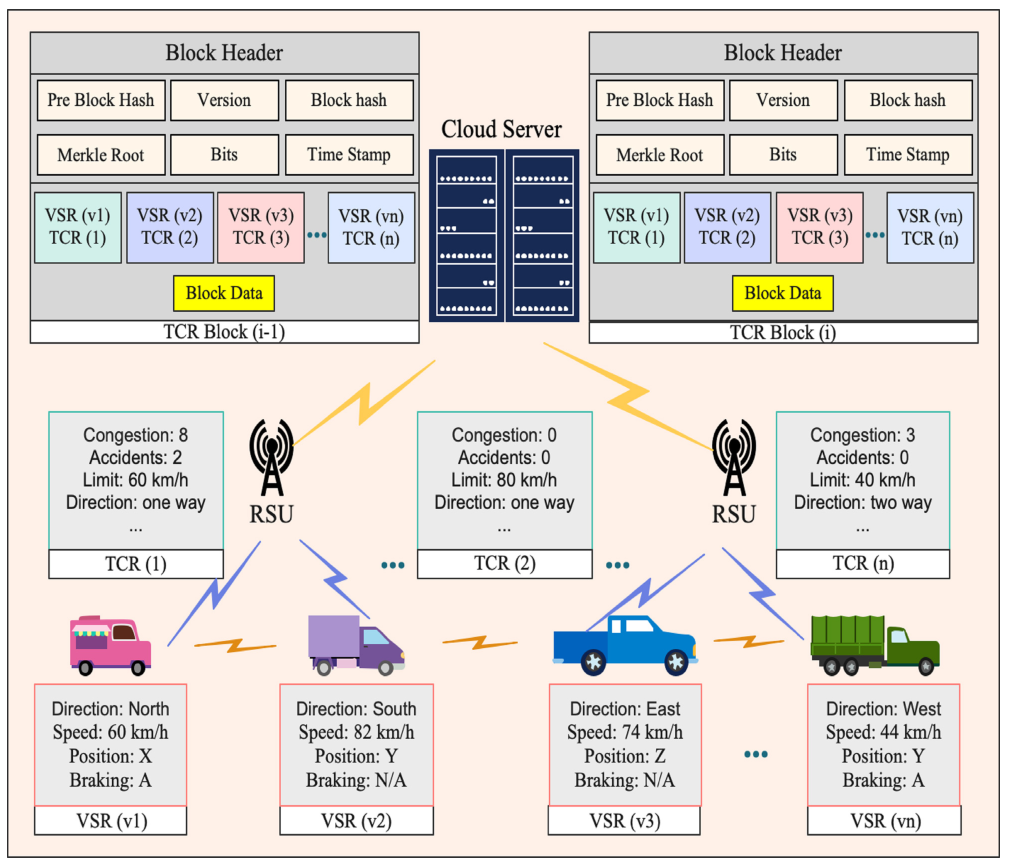
- 車両・路側機・クラウド間の通信をブロックチェーンで管理する。
- 共有する学習情報の機密性を守るため、準同型暗号を用いる。
論文の図
アブストラクト(原文)
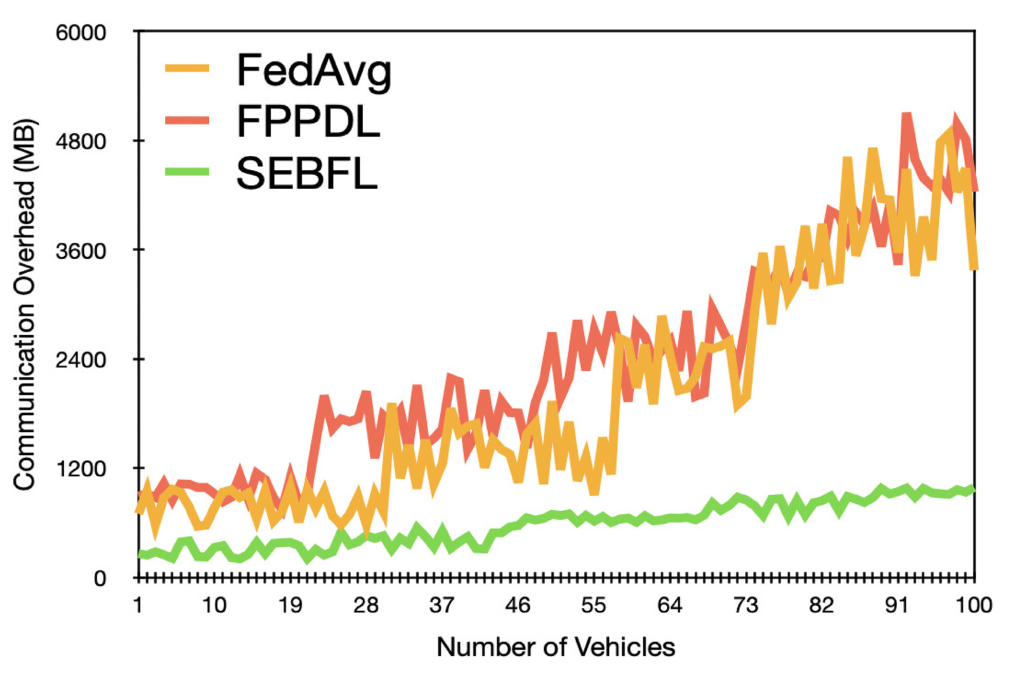
The rapid increase in the number of connected vehicles on roads has made Vehicular Ad-hoc Networks (VANETs) an attractive target for malicious actors. As a result, VANETs require secure data transmission to maintain the network’s integrity. Federated Learning (FL) has been proposed as a secure data-sharing method for VANETs, but it is limited in its ability to protect sensitive data. This paper proposes integrating Blockchain technology into FL to provide an additional layer of security for VANETs. In particular, we propose a Secure and Efficient Blockchain-based FL (SEBFL) approach to ensure communication efficiency and data privacy in VANETs. To this end, we use the FL model for VANETs, where computation tasks are decomposed from a base station to individual vehicles. This effectively reduces the congestion delay and communication overhead. Integrating blockchain with the FL model provides a reliable and secure data communication system between vehicles, roadside units, and a cloud server. Additionally, we use a Homomorphic Encryption System (HES) that effectively preserves the confidentiality and credibility of vehicles. Besides, the proposed SEBFL leverages the asynchronous FL model, minimizing the long delay while avoiding possible threats and attacks using HES. The experiment results show the proposed SEBFL achieves 0.87% accuracy while a model inversion attack and 0.86% accuracy while a membership inference attack.
関連する研究・ソフトウェア
引用方法
M. Asad, S. Shaukat, E. Javanmardi, J. Nakazato, N. Bao, and M. Tsukada, “Secure and Efficient Blockchain-based Federated Learning Approach For VANETs,” IEEE Internet of Things Journal, vol. 11, pp. 9047–9055, 2024, doi: 10.1109/JIOT.2023.3322221.
BibTeX
@article{Asad2024,
  title         = {Secure and Efficient Blockchain-based Federated Learning Approach For VANETs},
  author        = {Muhammad Asad and Saima Shaukat and Ehsan Javanmardi and Jin Nakazato and Naren Bao and Manabu Tsukada},
  doi           = {10.1109/JIOT.2023.3322221},
  issn          = {2327-4662},
  year          = {2024},
  date          = {2024-03-01},
  urldate       = {2023-10-05},
  journal       = {IEEE Internet of Things Journal},
  volume        = {11},
  issue         = {5},
  pages         = {9047--9055},
  abstract      = {The rapid increase in the number of connected vehicles on roads has made Vehicular Ad-hoc Networks (VANETs) an attractive target for malicious actors. As a result, VANETs require secure data transmission to maintain the network’s integrity. Federated Learning (FL) has been proposed as a secure data-sharing method for VANETs, but it is limited in its ability to protect sensitive data. This paper proposes integrating Blockchain technology into FL to provide an additional layer of security for VANETs. In particular, we propose a Secure and Efficient Blockchain-based FL (SEBFL) approach to ensure communication efficiency and data privacy in VANETs. To this end, we use the FL model for VANETs, where computation tasks are decomposed from a base station to individual vehicles. This effectively reduces the congestion delay and communication overhead. Integrating blockchain with the FL model provides a reliable and secure data communication system between vehicles, roadside units, and a cloud server. Additionally, we use a Homomorphic Encryption System (HES) that effectively preserves the confidentiality and credibility of vehicles. Besides, the proposed SEBFL leverages the asynchronous FL model, minimizing the long delay while avoiding possible threats and attacks using HES. The experiment results show the proposed SEBFL achieves 0.87% accuracy while a model inversion attack and 0.86% accuracy while a membership inference attack.},
  keywords      = {ITS},
  pubstate      = {published},
  tppubtype     = {article}
}