
Optimizing Pedestrian Decision-Making: Leveraging Smart Pole Interaction Unit for Autonomous Vehicle-to-Pedestrian Communication
Master Thesis, Graduate School of Information Science and Technology, The University of Tokyo, 2023年9月30日
3行要約
- 横断時にスマートポールの合図で車載表示を補う方法を検証する。
- 一方向と双方向の交通条件で、歩行者の判断と負担を調べた。
- 双方向から車が来て歩行者が止まる場面では、ポールを加えると反応時間が従来条件から21%改善した。
論文の図
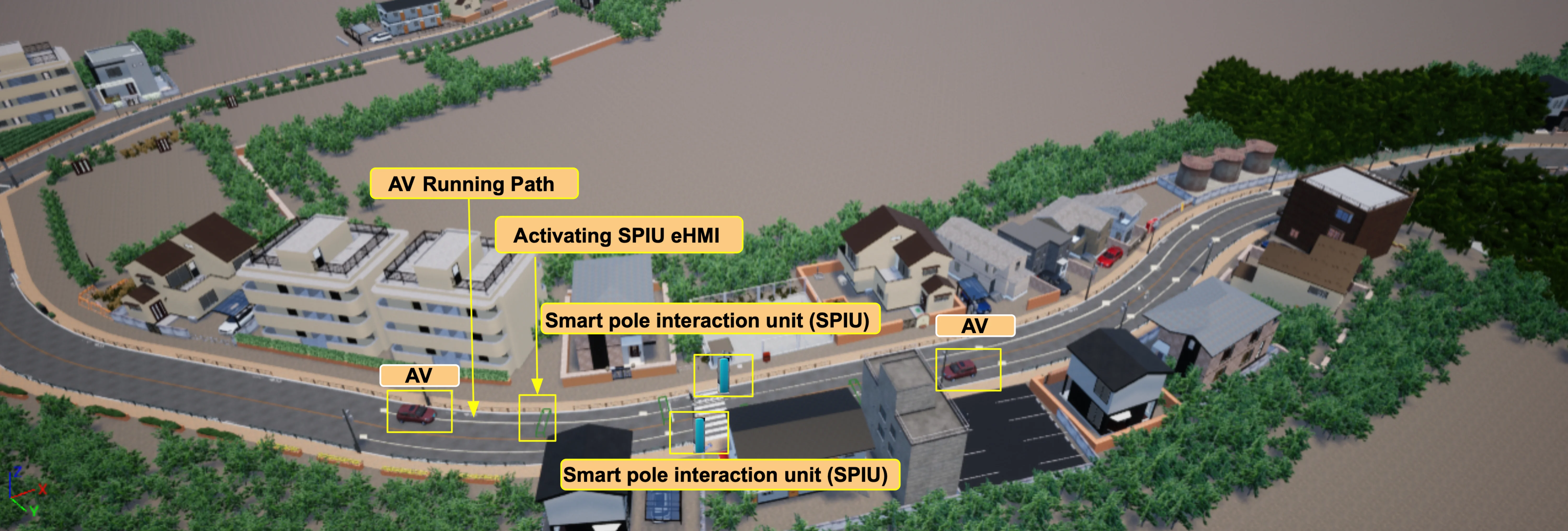
アブストラクト(原文)
Ensuring pedestrian safety remains critical in a world where autonomous vehicles (AVs) and pedestrians coexist. At the same time, AVs exhibit commendable performance on traditional roads with established traffic infrastructure. AVs need to modify their functionality and interactions to suit the unique characteristics of shared spaces, which differ significantly from conventional roads. The concept of shared spaces, often called naked streets, lacks traditional traffic cues, posing challenges in conveying AVs intentions to pedestrians. But, AVs need to be socially acceptable in such environments. Moreover, limited research has been conducted in this specific context of shared spaces with multiple AVs, as past studies have primarily focused on traditional road crossings with one AV interaction scenarios. This research introduces a novel solution to address right-of-way and accessibility issues in shared spaces by proposing the adoption of a smart pole interaction unit (SPIU). Additionally, the study evaluates the results of integrating an external Human Machine Interface (eHMI) on AVs and SPIU to enhance crosswalk pedestrian safety. The study demonstrates the efficacy of the SPIU in improving pedestrian safety through simulation scenarios that contrast 1-way and 2-way traffic situations with and without SPIU and eHMI integration. In the 1-way scenario, only one AV approaches, whereas in the 2-way scenario, multiple AVs approach simultaneously. Realistic virtual settings are created using the unreal engine open-source platform, and the proposed systems are evaluated through participants using HTC vive pro 2 headsets. We conducted a paired t-test for statistical analysis and observed a significant improvement (p = 0.001) when utilizing AV eHMI with SPIU in the case of 1-way stop, 2-way pass and 2-way stop scenarios. However, when examining the 1-way pass scenario, the advantage of SPIU could not be statistically distinguished. The findings reveal that the SPIU significantly enhances pedestrians understanding of AVs approaching intentions in both 1-way and 2-way scenarios, leading to quicker decision-making and reduced cognitive load. Remarkably, with the SPIU addition with the eHMI on vehicles, the participants experienced a noteworthy 21% improvement in response time compared to the baseline, signifying substantial efficiency gains when pedestrians need to stop in 2-way stop. Even in the 1-way pass scenario, there was a modest yet positive 2.19% improvement in response time, highlighting the benefits of SPIU in enhancing interaction dynamics. The most significant improvement of 9.12%, 18.757% was observed in the 2-way pass, 1-way stop scenario, indicating the superior effectiveness of SPIU in 2-way scenarios, 1-way scenarios. Therefore, these valuable insights shed light on augmenting pedestrian safety in shared spaces with AVs and lay the groundwork for the practical implementation of SPIU to enhance interactions between AVs and pedestrian.
引用方法
V. Chauhan, “Optimizing Pedestrian Decision-Making: Leveraging Smart Pole Interaction Unit for Autonomous Vehicle-to-Pedestrian Communication,” in Master Thesis, Graduate School of Information Science and Technology, The University of Tokyo, 2023.
BibTeX
@mastersthesis{Chauhan2023b,
  title         = {Optimizing Pedestrian Decision-Making: Leveraging Smart Pole Interaction Unit for Autonomous Vehicle-to-Pedestrian Communication},
  author        = {Vishal Chauhan},
  year          = {2023},
  date          = {2023-09-30},
  school        = {Master Thesis, Graduate School of Information Science and Technology, The University of Tokyo},
  abstract      = {
    Ensuring pedestrian safety remains critical in a world where autonomous vehicles (AVs) and pedestrians coexist. At the same time, AVs exhibit commendable performance on traditional roads with established traffic infrastructure. AVs need to modify their functionality and interactions to suit the unique characteristics of shared spaces, which differ significantly from conventional roads. The concept of shared spaces, often called naked streets, lacks traditional traffic cues, posing challenges in conveying AVs intentions to pedestrians. But, AVs need to be socially acceptable in such environments. Moreover, limited research has been conducted in this specific context of shared spaces with multiple AVs, as past studies have primarily focused on traditional road crossings with one AV interaction scenarios.

    This research introduces a novel solution to address right-of-way and accessibility issues in shared spaces by proposing the adoption of a smart pole interaction unit (SPIU). Additionally, the study evaluates the results of integrating an external Human Machine Interface (eHMI) on AVs and SPIU to enhance crosswalk pedestrian safety. The study demonstrates the efficacy of the SPIU in improving pedestrian safety through simulation scenarios that contrast 1-way and 2-way traffic situations with and without SPIU and eHMI integration. In the 1-way scenario, only one AV approaches, whereas in the 2-way scenario, multiple AVs approach simultaneously. Realistic virtual settings are created using the unreal engine open-source platform, and the proposed systems are evaluated through participants using HTC vive pro 2 headsets.

    We conducted a paired t-test for statistical analysis and observed a significant improvement (p = 0.001) when utilizing AV eHMI with SPIU in the case of 1-way stop, 2-way pass and 2-way stop scenarios. However, when examining the 1-way pass scenario, the advantage of SPIU could not be statistically distinguished. The findings reveal that the SPIU significantly enhances pedestrians understanding of AVs approaching intentions in both 1-way and 2-way scenarios, leading to quicker decision-making and reduced cognitive load. Remarkably, with the SPIU addition with the eHMI on vehicles, the participants experienced a noteworthy 21% improvement in response time compared to the baseline, signifying substantial efficiency gains when pedestrians need to stop in 2-way stop. Even in the 1-way pass scenario, there was a modest yet positive 2.19% improvement in response time, highlighting the benefits of SPIU in enhancing interaction dynamics. The most significant improvement of 9.12%, 18.757%  was observed in the 2-way pass, 1-way stop scenario, indicating the superior effectiveness of SPIU in 2-way scenarios, 1-way scenarios.

    Therefore, these valuable insights shed light on augmenting pedestrian safety in shared spaces with AVs and lay the groundwork for the practical implementation of SPIU to enhance interactions between AVs and pedestrian.
  },
  keywords      = {Thesis},
  pubstate      = {published},
  tppubtype     = {mastersthesis}
}