
A Silent Negotiator? Cross-cultural VR Evaluation of Smart Pole Interaction Units in Dynamic Shared Spaces
ACM Symposium on Virtual Reality Software and Technology (VRST 2025), Montreal, Canada, 2025年11月12日
GitHub(コード)DOI: 10.1145/3756884.3765991
3行要約
- 没入型VRで、歩行者と自動運転車のすれ違いを支援するスマートポールを評価する。
- 遮蔽、複数台の車両、配送ロボットを含む共有空間の場面を扱う。
- 路側表示と車外表示が反応時間や受容性に与える影響を、文化圏の異なる参加者で比較した。
論文の図
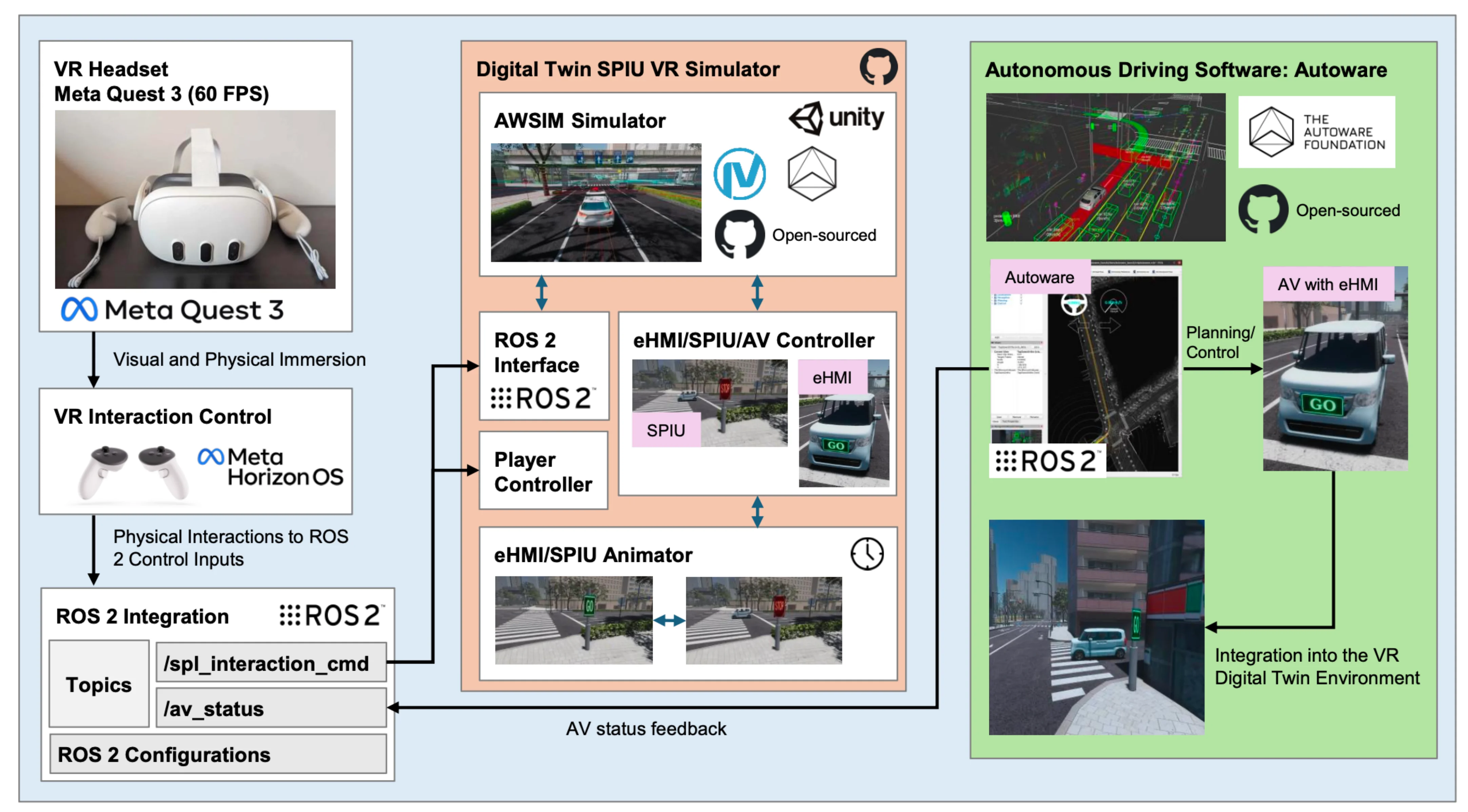
アブストラクト(原文)
As autonomous vehicles (AVs) enter pedestrian-centric environments, existing vehicle-mounted external human–machine interfaces (eHMIs) often fall short in shared spaces due to line-of-sight limitations, inconsistent signaling, and increased cognitive burden on pedestrians. To address these challenges, we introduce the Smart Pole Interaction Unit (SPIU), an infrastructure-based eHMI that decouples intent signaling from vehicles and provides context-aware, elevated visual cues. We evaluate SPIU using immersive VR-AWSIM simulations in four high-risk urban scenarios: four-way intersections, autonomous mixed traffic, blindspots, and nighttime crosswalks. The experiment was developed in Japan and replicated in Norway, where forty participants engaged in 32 trials each under both SPIU-present and SPIU-absent conditions. Behavioral (response time) and subjective (acceptance scale) data were collected. Results show that SPIU significantly improves pedestrian decision-making, with reductions ranging from 40% to over 80% depending on scenario and cultural context, particularly in complex or low-visibility scenarios. Cross-cultural analyses highlight SPIU's adaptability across differing urban and social contexts. We release our open-source Smartpole-VR-AWSIM framework to support reproducibility and global advancement of infrastructure-based eHMI research through reproducible and immersive behavioral studies.
コード
関連する研究・ソフトウェア
関連ニュース
引用方法
V. Chauhan, A. Anubhav, R. Sidhu, Y. Asabe, K. Tanaka, C.-M. Chang, X. Su, E. Javanmardi, T. Igarashi, A. Orsholits, K. Fujiwara, and M. Tsukada, “A Silent Negotiator? Cross-cultural VR Evaluation of Smart Pole Interaction Units in Dynamic Shared Spaces,” in ACM Symposium on Virtual Reality Software and Technology (VRST 2025), Montreal, Canada, 2025, doi: 10.1145/3756884.3765991.
BibTeX
@inproceedings{Chauhan2025b,
  title         = {A Silent Negotiator? Cross-cultural VR Evaluation of Smart Pole Interaction Units in Dynamic Shared Spaces},
  author        = {Vishal Chauhan and Anubhav Anubhav and Robin Sidhu and Yu Asabe and Kanta Tanaka and Chia-Ming Chang and Xiang Su and Ehsan Javanmardi and Takeo Igarashi and Alex Orsholits and Kantaro Fujiwara and Manabu Tsukada},
  url           = {https://github.com/tlab-wide/Smartpole-VR-AWSIM.git},
  doi           = {10.1145/3756884.3765991},
  year          = {2025},
  date          = {2025-11-12},
  urldate       = {2025-11-12},
  booktitle     = {ACM Symposium on Virtual Reality Software and Technology (VRST 2025)},
  address       = {Montreal, Canada},
  abstract      = {As autonomous vehicles (AVs) enter pedestrian-centric environments, existing vehicle-mounted external human–machine interfaces (eHMIs) often fall short in shared spaces due to line-of-sight limitations, inconsistent signaling, and increased cognitive burden on pedestrians. To address these challenges, we introduce the Smart Pole Interaction Unit (SPIU), an infrastructure-based eHMI that decouples intent signaling from vehicles and provides context-aware, elevated visual cues. We evaluate SPIU using immersive VR-AWSIM simulations in four high-risk urban scenarios: four-way intersections, autonomous mixed traffic, blindspots, and nighttime crosswalks. The experiment was developed in Japan and replicated in Norway, where forty participants engaged in 32 trials each under both SPIU-present and SPIU-absent conditions. Behavioral (response time) and subjective (acceptance scale) data were collected. Results show that SPIU significantly improves pedestrian decision-making, with reductions ranging from 40% to over 80% depending on scenario and cultural context, particularly in complex or low-visibility scenarios. Cross-cultural analyses highlight SPIU's adaptability across differing urban and social contexts. We release our open-source Smartpole-VR-AWSIM framework to support reproducibility and global advancement of infrastructure-based eHMI research through reproducible and immersive behavioral studies.},
  keywords      = {ITS},
  pubstate      = {published},
  tppubtype     = {inproceedings}
}