
Reinforcement Learning Based Optimal Camera Placement for Depth Observation of Indoor Scenes
IEEE International Conference on Networking, Sensing and Control (ICNSC 2021), Xiamen, China, 2021年12月3日
arXivDOI: 10.1109/ICNSC52481.2021.9702214
3行要約
- 屋内の事前モデルがない場面で、深度カメラの配置を決める強化学習手法を提案した。
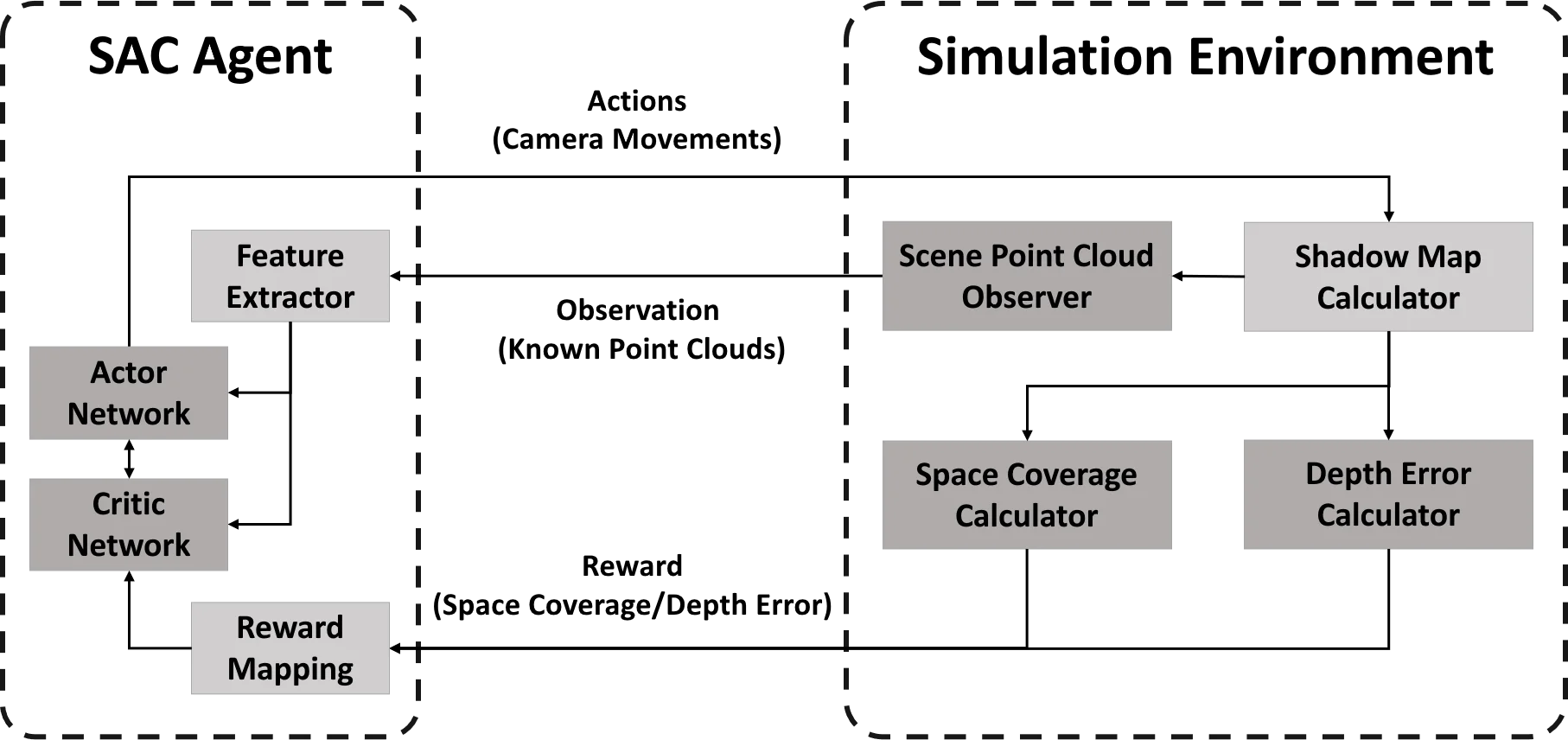
- シミュレーターはシャドウマップを用いて観測を評価し、Soft Actor-Criticのエージェントは観測点群から特徴を抽出する。
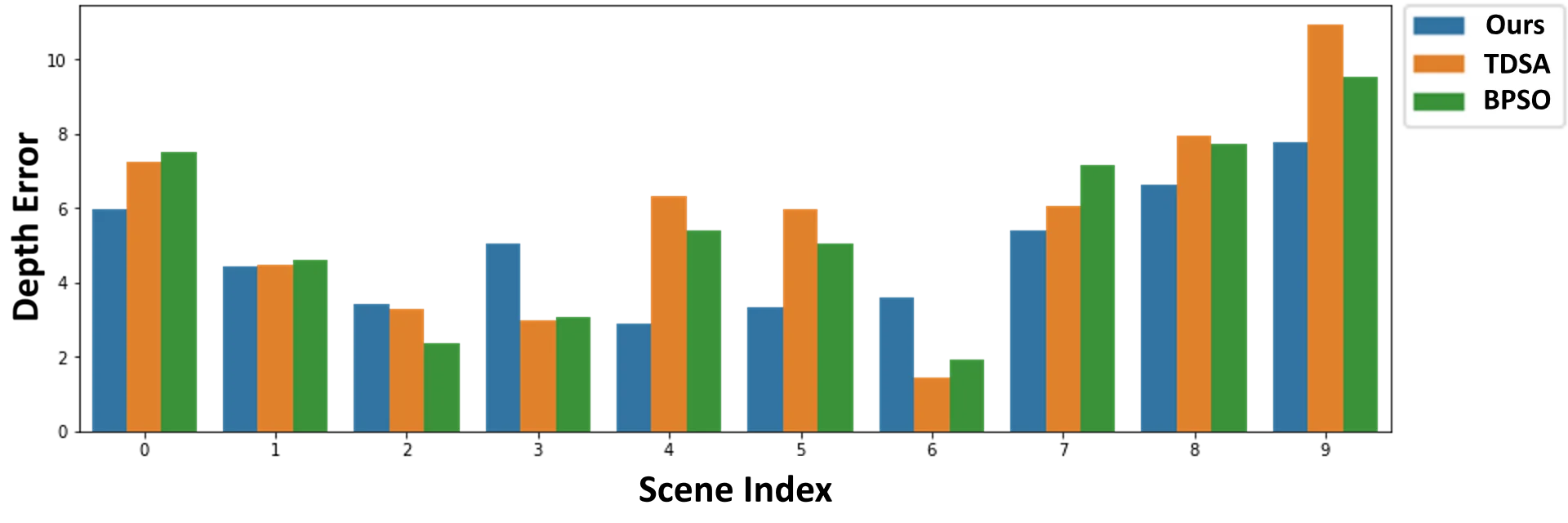
- 10の試験場面のうち7場面で奥行き観測誤差を下げ、全場面の合計誤差は比較手法の90%未満だった。
論文の図
アブストラクト(原文)
Exploring the most task-friendly camera setting–-optimal camera placement (OCP) problem–-in tasks that use multiple cameras is of great importance. However, few existing OCP solutions specialize in depth observation of indoor scenes, and most versatile solutions work offline. To this problem, an OCP online solution to depth observation of indoor scenes based on reinforcement learning is proposed in this paper. The proposed solution comprises a simulation environment that implements scene observation and reward estimation using shadow maps and an agent network containing a soft actor-critic (SAC)-based reinforcement learning backbone and a feature extractor to extract features from the observed point cloud layer-by-layer. Comparative experiments with two state-of-the-art optimization-based offline methods are conducted. The experimental results indicate that the proposed system outperforms seven out of ten test scenes in obtaining lower depth observation error. The total error in all test scenes is also less than 90% of the baseline ones. Therefore, the proposed system is more competent for depth camera placement in scenarios where there is no prior knowledge of the scenes or where a lower depth observation error is the main objective.
引用方法
Y. Chen, M. Tsukada, and H. Esaki, “Reinforcement Learning Based Optimal Camera Placement for Depth Observation of Indoor Scenes,” in IEEE International Conference on Networking, Sensing and Control (ICNSC 2021), Xiamen, China, 2021, doi: 10.1109/ICNSC52481.2021.9702214.
BibTeX
@inproceedings{Chen2021,
  title         = {Reinforcement Learning Based Optimal Camera Placement for Depth Observation of Indoor Scenes},
  author        = {Yichuan Chen and Manabu Tsukada and Hiroshi Esaki},
  url           = {https://arxiv.org/abs/2110.11106},
  doi           = {10.1109/ICNSC52481.2021.9702214},
  year          = {2021},
  date          = {2021-12-03},
  urldate       = {2021-12-03},
  booktitle     = {IEEE International Conference on Networking, Sensing and Control (ICNSC 2021)},
  address       = {Xiamen, China},
  abstract      = {Exploring the most task-friendly camera setting---optimal camera placement (OCP) problem---in tasks that use multiple cameras is of great importance. However, few existing OCP solutions specialize in depth observation of indoor scenes, and most versatile solutions work offline. To this problem, an OCP online solution to depth observation of indoor scenes based on reinforcement learning is proposed in this paper. The proposed solution comprises a simulation environment that implements scene observation and reward estimation using shadow maps and an agent network containing a soft actor-critic (SAC)-based reinforcement learning backbone and a feature extractor to extract features from the observed point cloud layer-by-layer. Comparative experiments with two state-of-the-art optimization-based offline methods are conducted. The experimental results indicate that the proposed system outperforms seven out of ten test scenes in obtaining lower depth observation error. The total error in all test scenes is also less than 90% of the baseline ones. Therefore, the proposed system is more competent for depth camera placement in scenarios where there is no prior knowledge of the scenes or where a lower depth observation error is the main objective.},
  keywords      = {SDM},
  pubstate      = {published},
  tppubtype     = {inproceedings}
}