
Blockage-Aware Non-stationary Dynamic Bandit for User Association in mmWave V2X Networks
IEEE Global Communications Conference (GLOBECOM 2026), Macau, China, 2026年12月7日
3行要約
- BANDは、一時的にミリ波が遮蔽される環境で基地局の選択を適応させる。
- 分散型バンディットに変化点検知と遮蔽判定を組み合わせ、チャネル状態情報なしで動作する。
- シミュレーションでは文脈付きバンディットに比べ、リグレットが44%減り、通信レートが27.3%向上した。
論文の図
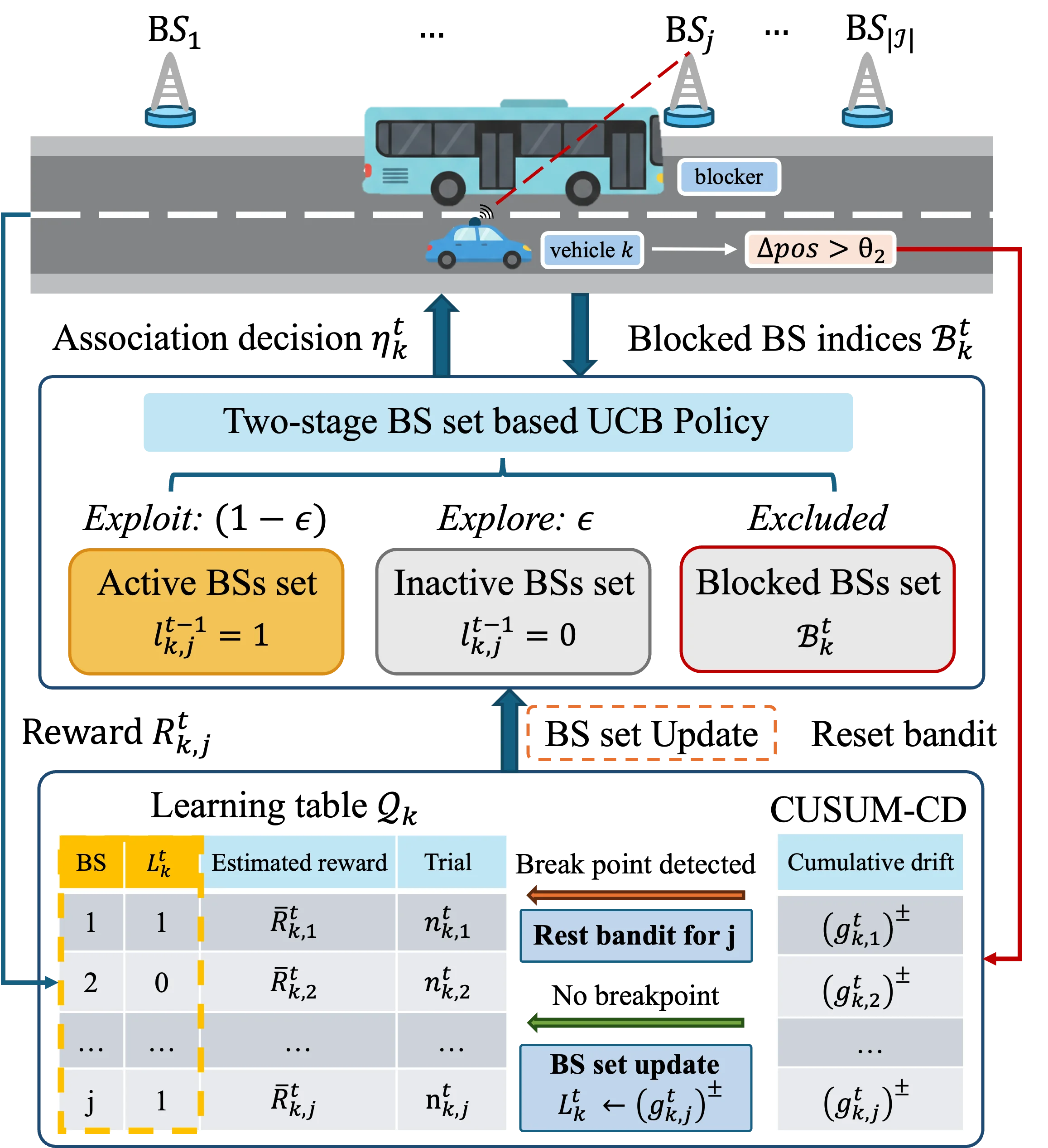
アブストラクト(原文)
In millimeter-wave (mmWave) vehicular networks, dense base station (BS) deployments and dynamic blockages introduce severe non-stationarity into the user association (UA), posing a critical mobility management challenge that hinders rapid and effective UA decisions. Traditional Multi-Armed Bandit (MAB) frameworks assume stationary reward distributions and fail to handle the rapid context-reward mapping shifts caused by vehicle mobility and transient blockages. To address this, we propose Blockage-Aware Non-stationary Dynamic Bandit (BAND), a fully distributed, Channel state information (CSI)-free mobility management framework for mmWave vehicular networks, formulating UA as a non-stationary contextual bandit problem and enables online adaptive optimization without requiring central coordination or offline training. BAND employs a cumulative sum-based change detection (CUSUM-CD) to dynamically narrow the active BS set, reducing exploration overhead while tracking reward distribution shifts. Proactive blockage detections suppress transient signal degradation in reward estimation. Simulations demonstrate over 44% regret reduction and up to 27.3% network communication rate improvement over hypercube-based contextual bandit baselines, with robustness validated across varying blockage rates and network configurations.
引用方法
W. Chi and M. Tsukada, “Blockage-Aware Non-stationary Dynamic Bandit for User Association in mmWave V2X Networks,” in IEEE Global Communications Conference (GLOBECOM 2026), Macau, China, 2026.
BibTeX
@inproceedings{Chi2026b,
  title         = {Blockage-Aware Non-stationary Dynamic Bandit for User Association in mmWave V2X Networks},
  author        = {Weiqi Chi and Manabu Tsukada},
  url           = {https://arxiv.org/abs/2606.08118},
  year          = {2026},
  date          = {2026-12-07},
  urldate       = {2026-12-07},
  booktitle     = {IEEE Global Communications Conference (GLOBECOM 2026)},
  address       = {Macau, China},
  abstract      = {In millimeter-wave (mmWave) vehicular networks, dense base station (BS) deployments and dynamic blockages introduce severe non-stationarity into the user association (UA), posing a critical mobility management challenge that hinders rapid and effective UA decisions. Traditional Multi-Armed Bandit (MAB) frameworks assume stationary reward distributions and fail to handle the rapid context-reward mapping shifts caused by vehicle mobility and transient blockages. To address this, we propose Blockage-Aware Non-stationary Dynamic Bandit (BAND), a fully distributed, Channel state information (CSI)-free mobility management framework for mmWave vehicular networks, formulating UA as a non-stationary contextual bandit problem and enables online adaptive optimization without requiring central coordination or offline training. BAND employs a cumulative sum-based change detection (CUSUM-CD) to dynamically narrow the active BS set, reducing exploration overhead while tracking reward distribution shifts. Proactive blockage detections suppress transient signal degradation in reward estimation. Simulations demonstrate over 44% regret reduction and up to 27.3% network communication rate improvement over hypercube-based contextual bandit baselines, with robustness validated across varying blockage rates and network configurations.},
  keywords      = {ITS},
  pubstate      = {published},
  tppubtype     = {inproceedings}
}