
A multipath redundancy communication framework for enhancing 5G mobile communication quality
Computer Communications, pp. 108157, 2025年4月23日
Web サイトDOI: 10.1016/j.comcom.2025.108157
3行要約
- 低遅延のリアルタイム配信を支えるため、複数のモバイル経路を冗長に利用する。
- 2回線でパケットを送り、WebRTCの輻輳制御を妨げずに重複を処理する。
- 走行車両での実験では、既存方式よりパケット損失が減り配信ビットレートが向上した。
論文の図
アブストラクト(原文)
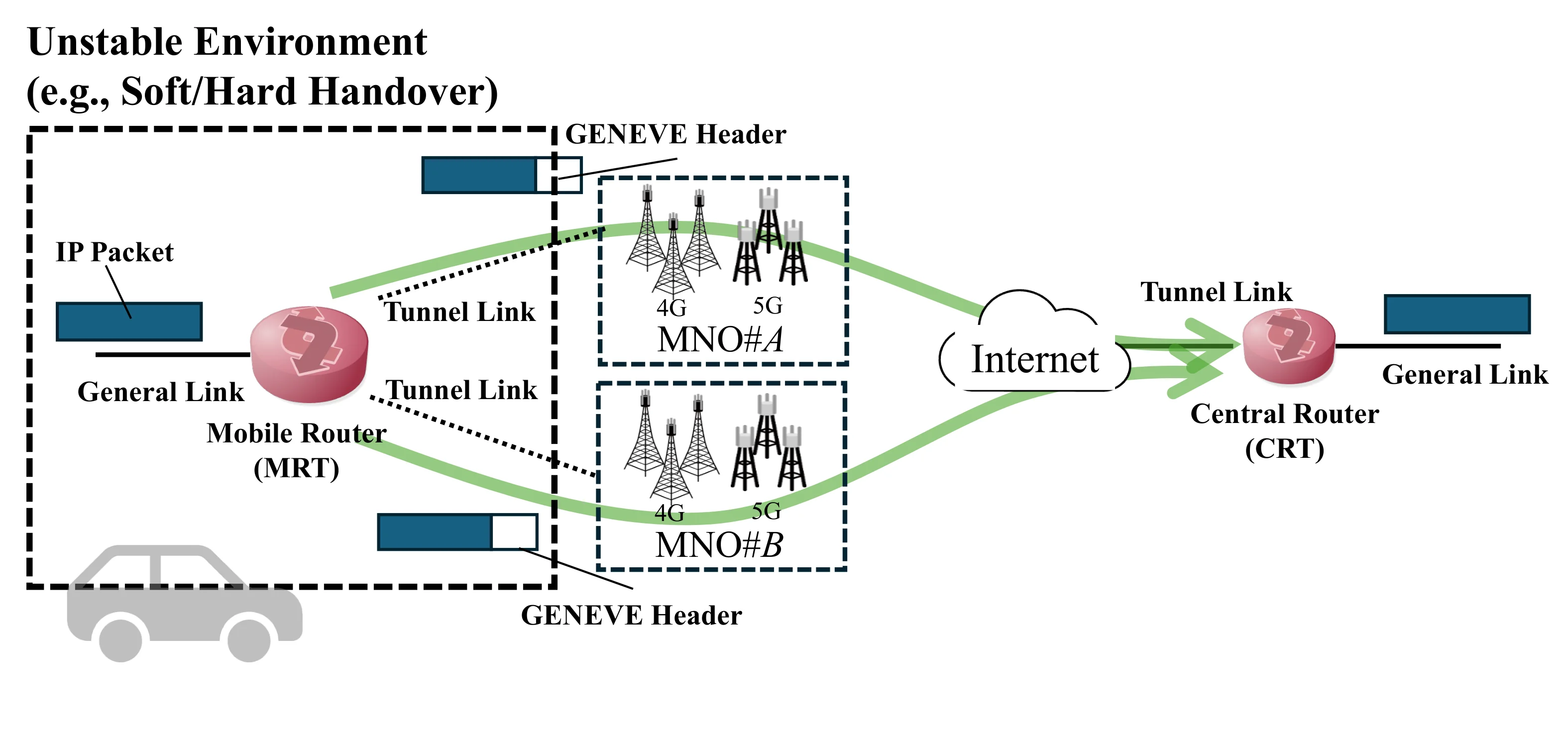
As networks increasingly become the backbone of modern society, the demands placed on them by various applications have become more complex. In particular, the demand for high-capacity, low-latency services such as real-time streaming is increasing every year. Although 5G has been deployed to meet these needs, its effectiveness can vary significantly by location and time, and sometimes falls short of requirements. Traditionally, much of the research to improve communication stability has focused on TCP-based systems, which do not translate well to real-time UDP streaming applications. To address the above challenges, we propose a multipath redundant communication framework designed to improve the quality of real-time media streaming. This framework has been tested using multipath redundant communication over two mobile networks with a moving vehicle in an urban environment. Using a real-time streaming application based on WebRTC, our framework demonstrates a significant reduction in packet loss and an increase in bitrate, outperforming existing multipath redundant communication systems without interfering with the application’s congestion control mechanisms.
関連する研究・ソフトウェア
引用方法
K. Ito, J. Nakazato, R. Fontugne, M. Tsukada, and H. Esaki, “A multipath redundancy communication framework for enhancing 5G mobile communication quality,” Computer Communications, pp. 108157, 2025, doi: 10.1016/j.comcom.2025.108157.
BibTeX
@article{ITO2025108157,
  title         = {A multipath redundancy communication framework for enhancing 5G mobile communication quality},
  author        = {Koki Ito and Jin Nakazato and Romain Fontugne and Manabu Tsukada and Hiroshi Esaki},
  url           = {https://www.sciencedirect.com/science/article/pii/S0140366425001148},
  doi           = {10.1016/j.comcom.2025.108157},
  issn          = {0140-3664},
  year          = {2025},
  date          = {2025-04-23},
  urldate       = {2025-04-23},
  journal       = {Computer Communications},
  pages         = {108157},
  abstract      = {As networks increasingly become the backbone of modern society, the demands placed on them by various applications have become more complex. In particular, the demand for high-capacity, low-latency services such as real-time streaming is increasing every year. Although 5G has been deployed to meet these needs, its effectiveness can vary significantly by location and time, and sometimes falls short of requirements. Traditionally, much of the research to improve communication stability has focused on TCP-based systems, which do not translate well to real-time UDP streaming applications. To address the above challenges, we propose a multipath redundant communication framework designed to improve the quality of real-time media streaming. This framework has been tested using multipath redundant communication over two mobile networks with a moving vehicle in an urban environment. Using a real-time streaming application based on WebRTC, our framework demonstrates a significant reduction in packet loss and an increase in bitrate, outperforming existing multipath redundant communication systems without interfering with the application’s congestion control mechanisms.},
  keywords      = {ITS},
  pubstate      = {published},
  tppubtype     = {article}
}