
PrefDrive: Enhancing Autonomous Driving through Preference-Guided Large Language Models
36th IEEE Intelligent Vehicles Symposium (IV 2025), Cluj-Napoca, Romania, 2025年6月22日
GitHub(コード)Web サイトWeb サイトDOI: 10.1109/IV64158.2025.11097672
3行要約
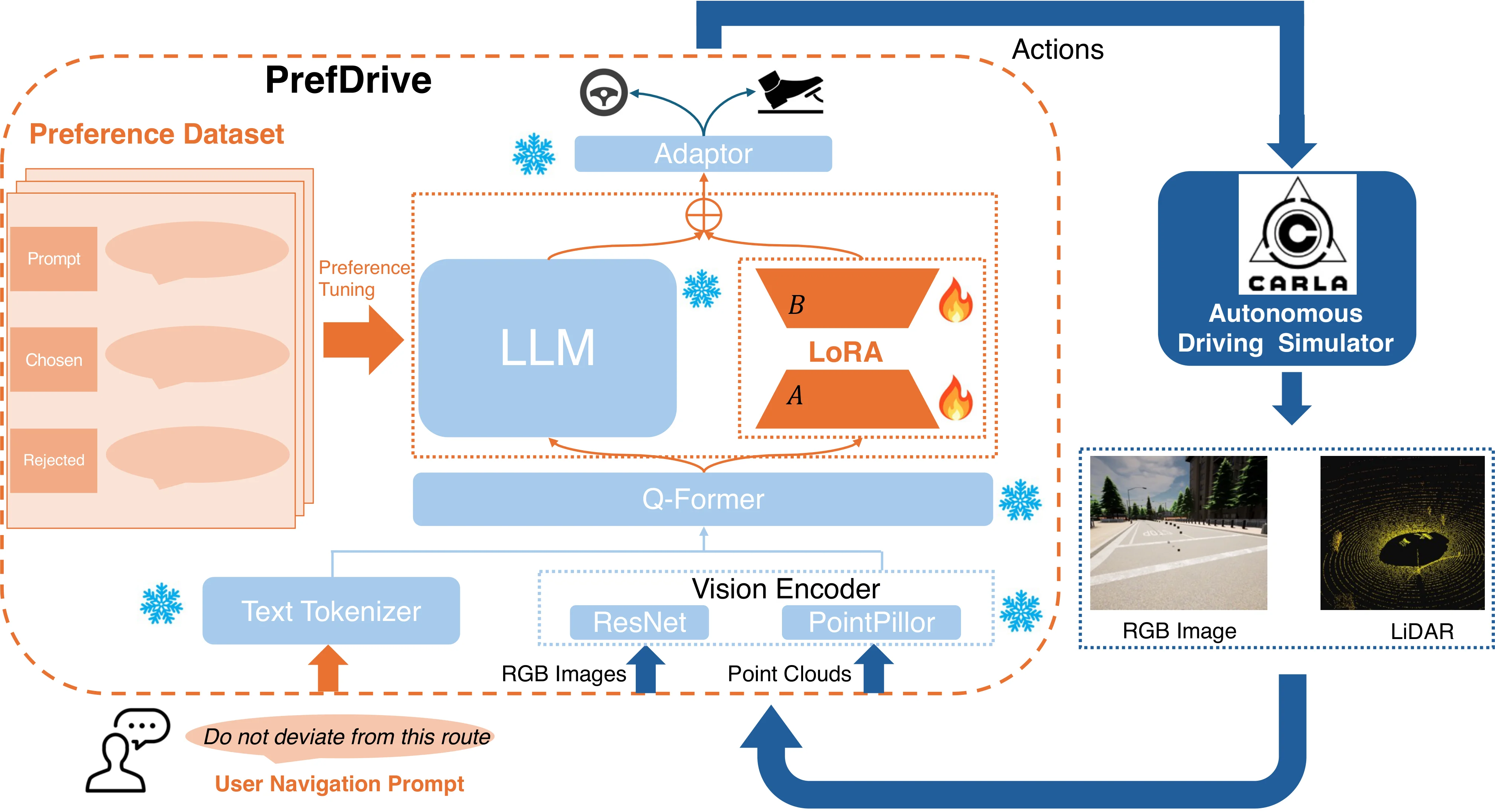
- PrefDriveは言語モデルを使い、運転判断を望ましい行動や運用ルールに整合させる。
- マルチモーダル認識と直接選好最適化を組み合わせ、選好注釈付きデータセットを用いる。
- CARLAでは調整後に交通違反が減り、経路完走率が向上した。
論文の図
アブストラクト(原文)
This paper presents PrefDrive, a novel framework that integrates driving preferences into autonomous driving models through large language models (LLMs). While recent advances in LLMs have shown promise in autonomous driving, existing approaches often struggle to align with specific driving behaviors (e.g., maintaining safe distances, smooth acceleration patterns) and operational requirements (e.g., traffic rule compliance, route adherence). We address this challenge by developing a preference learning framework that combines multimodal perception with natural language understanding. Our approach leverages Direct Preference Optimization (DPO) to fine-tune LLMs efficiently on consumer-grade hardware, making advanced autonomous driving research more accessible to the broader research community. We introduce a comprehensive dataset of 74,040 sequences, carefully annotated with driving preferences and driving decisions, which, along with our trained model checkpoints, will be made publicly available to facilitate future research. Through extensive experiments in the CARLA simulator, we demonstrate that our preference-guided approach significantly improves driving performance across multiple metrics, including distance maintenance and trajectory smoothness. Results show up to 28.1% reduction in traffic rule violations and 8.5% improvement in navigation task completion while maintaining appropriate distances from obstacles. The framework demonstrates robust performance across different urban environments, showcasing the effectiveness of preference learning in autonomous driving applications.
動画
コード
関連する研究・ソフトウェア
関連ニュース
引用方法
Y. Li, E. Javanmardi, S. Thompson, K. Katsumata, A. Orsholits, and M. Tsukada, “PrefDrive: Enhancing Autonomous Driving through Preference-Guided Large Language Models,” in 36th IEEE Intelligent Vehicles Symposium (IV 2025), Cluj-Napoca, Romania, 2025, doi: 10.1109/IV64158.2025.11097672.
BibTeX
@inproceedings{Li2025c,
  title         = {PrefDrive: Enhancing Autonomous Driving through Preference-Guided Large Language Models},
  author        = {Yun Li and Ehsan Javanmardi and Simon Thompson and Kai Katsumata and Alex Orsholits and Manabu Tsukada},
  url           = {https://github.com/LiYun0607/PrefDrive/ https://huggingface.co/liyun0607/PrefDrive https://huggingface.co/datasets/liyun0607/PrefDrive},
  doi           = {10.1109/IV64158.2025.11097672},
  year          = {2025},
  date          = {2025-06-22},
  urldate       = {2025-06-22},
  booktitle     = {36th IEEE Intelligent Vehicles Symposium (IV 2025)},
  address       = {Cluj-Napoca, Romania},
  abstract      = {This paper presents PrefDrive, a novel framework that integrates driving preferences into autonomous driving models through large language models (LLMs). While recent advances in LLMs have shown promise in autonomous driving, existing approaches often struggle to align with specific driving behaviors (e.g., maintaining safe distances, smooth acceleration patterns) and operational requirements (e.g., traffic rule compliance, route adherence). We address this challenge by developing a preference learning framework that combines multimodal perception with natural language understanding. Our approach leverages Direct Preference Optimization (DPO) to fine-tune LLMs efficiently on consumer-grade hardware, making advanced autonomous driving research more accessible to the broader research community. We introduce a comprehensive dataset of 74,040 sequences, carefully annotated with driving preferences and driving decisions, which, along with our trained model checkpoints, will be made publicly available to facilitate future research. Through extensive experiments in the CARLA simulator, we demonstrate that our preference-guided approach significantly improves driving performance across multiple metrics, including distance maintenance and trajectory smoothness. Results show up to 28.1% reduction in traffic rule violations and 8.5% improvement in navigation task completion while maintaining appropriate distances from obstacles. The framework demonstrates robust performance across different urban environments, showcasing the effectiveness of preference learning in autonomous driving applications.},
  keywords      = {ITS, Software-Data},
  pubstate      = {published},
  tppubtype     = {inproceedings}
}