
To Route or to Adapt? Multi-Expert Diffusion Planners in Unseen Regions
Conference on Robot Learning (CoRL 2026), Austin, Texas, USA, 2026年11月9日
3行要約
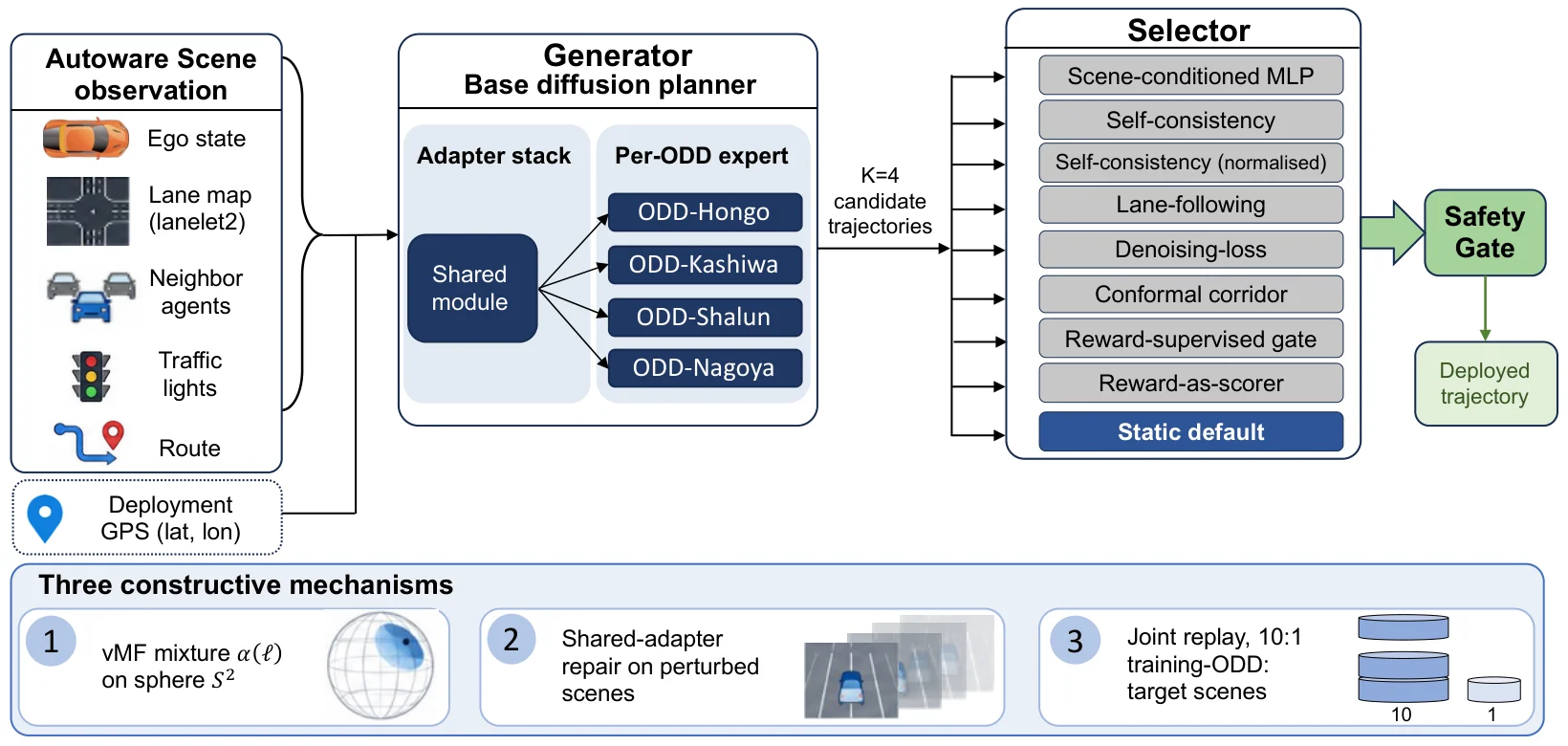
- 学習済みの拡散プランナを選択する方式で、未知地域に走行を移せるかを検証する。
- 愛知の3地図では、8種類の切り替え方式が地理的に近い単一の専門モデルを使う基準を上回らなかった。
- 対象地域の20シーンで追加学習すると軌道誤差が減り、リプレイは元の地域での性能低下を抑えた。
論文の図
アブストラクト(原文)
Diffusion trajectory planners with domain-specific experts face a practical question in unseen regions: can they rely on selecting among existing experts, or must the planner itself adapt? We study this question using a planner with a shared adapter and per-domain expert adapters. Across three real-world held-out maps, none of eight test-time routing schemes improves the fleet-mean lateral offset over the static default, which uses the same expert for every scene. Even an oracle that selects the best expert for each scene reduces the mean offset by only 0.9 m. In contrast, reward-based fine-tuning on just 20 target-region scenes yields substantially larger gains. On matched evaluation slices, joint replay achieves a fleet-mean offset of 6.9 m, compared with 12.4 m for the static default. Comparisons under the same target-region training budget show that target-region training drives the improvement, while replaying training scenes limits forgetting on the original ODDs. On nuPlan, fine-tuning across training cities also improves open-loop offsets, although closed-loop performance deteriorates. Further diagnostics reveal that two test-time adaptation baselines achieve low offsets by producing degenerate trajectories. These results show the limited headroom for selecting among existing experts and the greater open-loop gains available from adapting the planner.
コード
関連する研究・ソフトウェア
引用方法
Y. Li, E. Javanmardi, S. Thompson, J. Gong, Q. Zhang, Z. Zeng, S. Liu, P. Wang, Y. Zhang, and M. Tsukada, “To Route or to Adapt? Multi-Expert Diffusion Planners in Unseen Regions,” in Conference on Robot Learning (CoRL 2026), Austin, Texas, USA, 2026.
BibTeX
@inproceedings{Li2026e,
  title         = {To Route or to Adapt? Multi-Expert Diffusion Planners in Unseen Regions},
  author        = {Yun Li and Ehsan Javanmardi and Simon Thompson and Jiachen Gong and Qunli Zhang and Zifan Zeng and Shiming Liu and Peng Wang and Yidu Zhang and Manabu Tsukada},
  url           = {https://arxiv.org/abs/2610.31095 https://github.com/tlab-wide/RouteOrAdapt},
  year          = {2026},
  date          = {2026-11-09},
  urldate       = {2026-11-09},
  booktitle     = {Conference on Robot Learning (CoRL 2026)},
  address       = {Austin, Texas, USA},
  abstract      = {Diffusion trajectory planners with domain-specific experts face a practical question in unseen regions: can they rely on selecting among existing experts, or must the planner itself adapt? We study this question using a planner with a shared adapter and per-domain expert adapters. Across three real-world held-out maps, none of eight test-time routing schemes improves the fleet-mean lateral offset over the static default, which uses the same expert for every scene. Even an oracle that selects the best expert for each scene reduces the mean offset by only 0.9 m. In contrast, reward-based fine-tuning on just 20 target-region scenes yields substantially larger gains. On matched evaluation slices, joint replay achieves a fleet-mean offset of 6.9 m, compared with 12.4 m for the static default. Comparisons under the same target-region training budget show that target-region training drives the improvement, while replaying training scenes limits forgetting on the original ODDs. On nuPlan, fine-tuning across training cities also improves open-loop offsets, although closed-loop performance deteriorates. Further diagnostics reveal that two test-time adaptation baselines achieve low offsets by producing degenerate trajectories. These results show the limited headroom for selecting among existing experts and the greater open-loop gains available from adapting the planner.},
  keywords      = {CRONOS},
  pubstate      = {published},
  tppubtype     = {inproceedings}
}