
Safety Tunnel-Based Model Predictive Path-Planning Controller with Potential Functions for Emergency Navigation
IEEE Transactions on Intelligent Transportation Systems, vol. 24, pp. 3974–3985, 2023年4月1日
DOI: 10.1109/TITS.2022.3229699
3行要約
- 緊急時には局所解によって狭い通路が塞がれ、ポテンシャル場で経路を生成できなくなることがある。
- シグモイド曲線に基づく安全通路をモデル予測制御の制約として使い、緊急走行の経路を生成する。
- 報告された試験では、ヨー方向の振動の振幅と周期が減少した。
論文の図
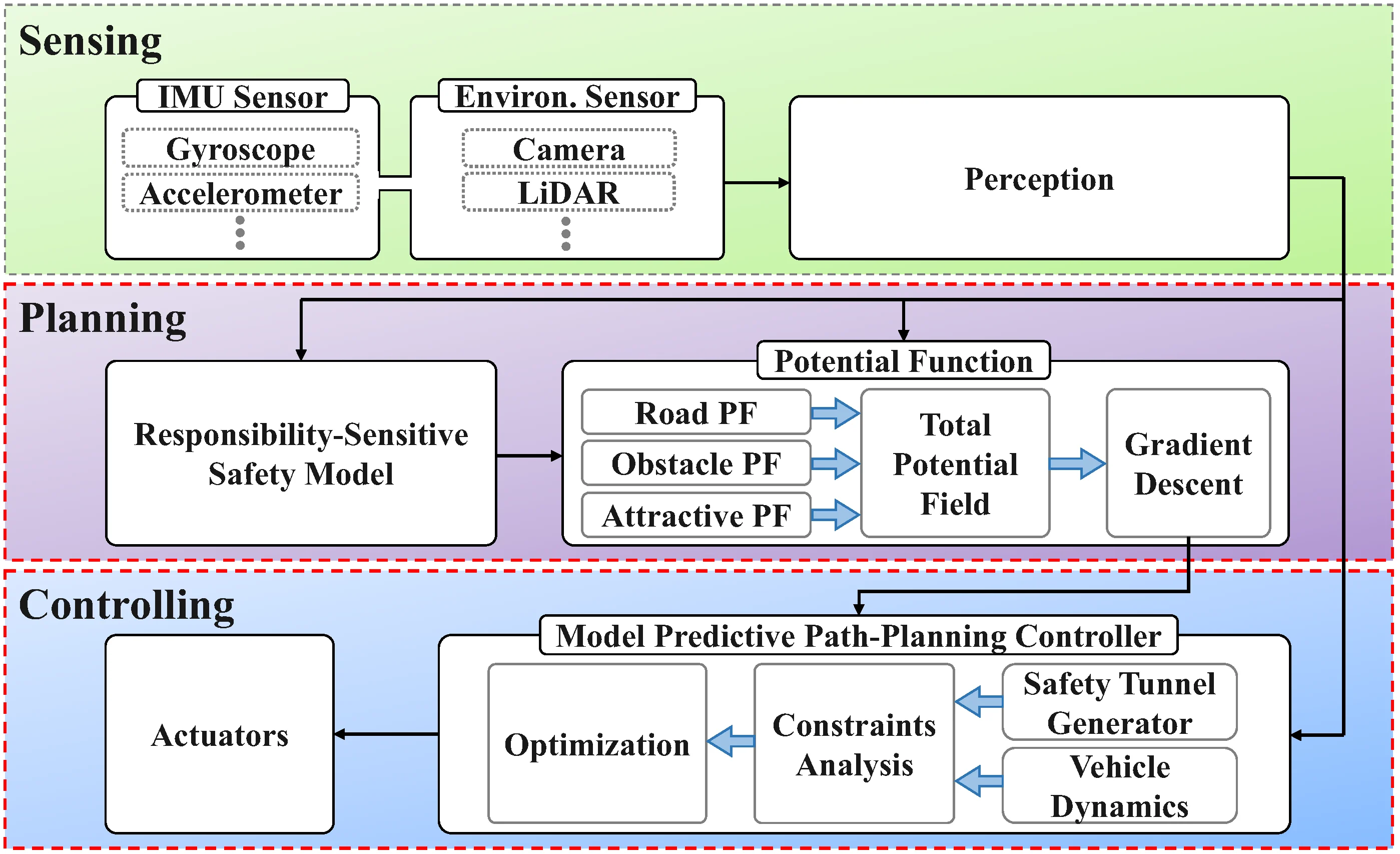
アブストラクト(原文)
The potential functions (PFs) have generally shown good performances in real-time path planning with computation efficiency conforming to the requirements of lower control systems in autonomous driving. However, several inherent limitations exist in using the PFs, including a local minimum in specific scenarios and no passage between closely spaced obstacles. Recent studies have focused on conventional scenarios where PFs are assumed to work normally, without malfunctioning, occurring during perilous situations. Therefore, we propose a specific safety tunnel (ST)-based model predictive controller (MPC) combined with PFs (PF-STMPC) to handle path-planning in extreme-emergency traffic scenarios (e.g., emergency braking and lane-changing obstacles). To further guarantee driving safety, we improve PFs with the responsibility-sensitive safety (RSS) model that accurately calculates the minimum safe longitudinal and lateral distances. Furthermore, a sigmoid-based ST is designed for emergency navigation if the PFs fail to plan a safe path due to the aforementioned inherent limitations, enabling the controller with planning functionality if necessary. The ST is embedded in the MPC-based tracking controller as a safe constraint sensitive to surrounding environments (e.g., road structure and obstacles). The proposed PF-STMPC was co-simulated using MATLAB/Simulink and CarSim Simulator under the constant speed condition. Compared with the state-of-the-art method, the proposed method demonstrated better performance in finding a safe path and eliminating severe yawing of the ego-vehicle (82.8% less in sideslip yawing amplitude and 57.7% shorter in the oscillation period of yaw angle) when facing traffic emergencies.
引用方法
P. Lin, Y. S. Quan, J. H. Yang, C. C. Chung, and M. Tsukada, “Safety Tunnel-Based Model Predictive Path-Planning Controller with Potential Functions for Emergency Navigation,” IEEE Transactions on Intelligent Transportation Systems, vol. 24, pp. 3974–3985, 2023, doi: 10.1109/TITS.2022.3229699.
BibTeX
@article{Lin2022e,
  title         = {Safety Tunnel-Based Model Predictive Path-Planning Controller with Potential Functions for Emergency Navigation},
  author        = {Pengfei Lin and Ying Shuai Quan and Jin Ho Yang and Chung Choo Chung and Manabu Tsukada},
  doi           = {10.1109/TITS.2022.3229699},
  issn          = {1524-9050},
  year          = {2023},
  date          = {2023-04-01},
  urldate       = {2023-04-01},
  journal       = {IEEE Transactions on Intelligent Transportation Systems},
  volume        = {24},
  issue         = {4},
  pages         = {3974--3985},
  abstract      = {The potential functions (PFs) have generally shown good performances in real-time path planning with computation efficiency conforming to the requirements of lower control systems in autonomous driving. However, several inherent limitations exist in using the PFs, including a local minimum in specific scenarios and no passage between closely spaced obstacles. Recent studies have focused on conventional scenarios where PFs are assumed to work normally, without malfunctioning, occurring during perilous situations. Therefore, we propose a specific safety tunnel (ST)-based model predictive controller (MPC) combined with PFs (PF-STMPC) to handle path-planning in extreme-emergency traffic scenarios (e.g., emergency braking and lane-changing obstacles). To further guarantee driving safety, we improve PFs with the responsibility-sensitive safety (RSS) model that accurately calculates the minimum safe longitudinal and lateral distances. Furthermore, a sigmoid-based ST is designed for emergency navigation if the PFs fail to plan a safe path due to the aforementioned inherent limitations, enabling the controller with planning functionality if necessary. The ST is embedded in the MPC-based tracking controller as a safe constraint sensitive to surrounding environments (e.g., road structure and obstacles). The proposed PF-STMPC was co-simulated using MATLAB/Simulink and CarSim Simulator under the constant speed condition. Compared with the state-of-the-art method, the proposed method demonstrated better performance in finding a safe path and eliminating severe yawing of the ego-vehicle (82.8% less in sideslip yawing amplitude and 57.7% shorter in the oscillation period of yaw angle) when facing traffic emergencies.},
  keywords      = {ITS},
  pubstate      = {published},
  tppubtype     = {article}
}