
ComLLM: Towards A General Large Language Model for Semantic-Aware Network Optimization
IEEE Network, 2026年7月21日
DOI: 10.1109/MNET.2026.3716787
3行要約
- ComLLMは言語モデルの推論でサービス要件を解釈し、ネットワーク最適化に使う。
- 組み込みの予測モデルを呼び出し、予測結果を資源配分の判断に反映する。
- エッジ計算の事例では、通信レート予測と自動運転車のタスク割り当てを組み合わせ、遅延と収益の目標を扱った。
論文の図
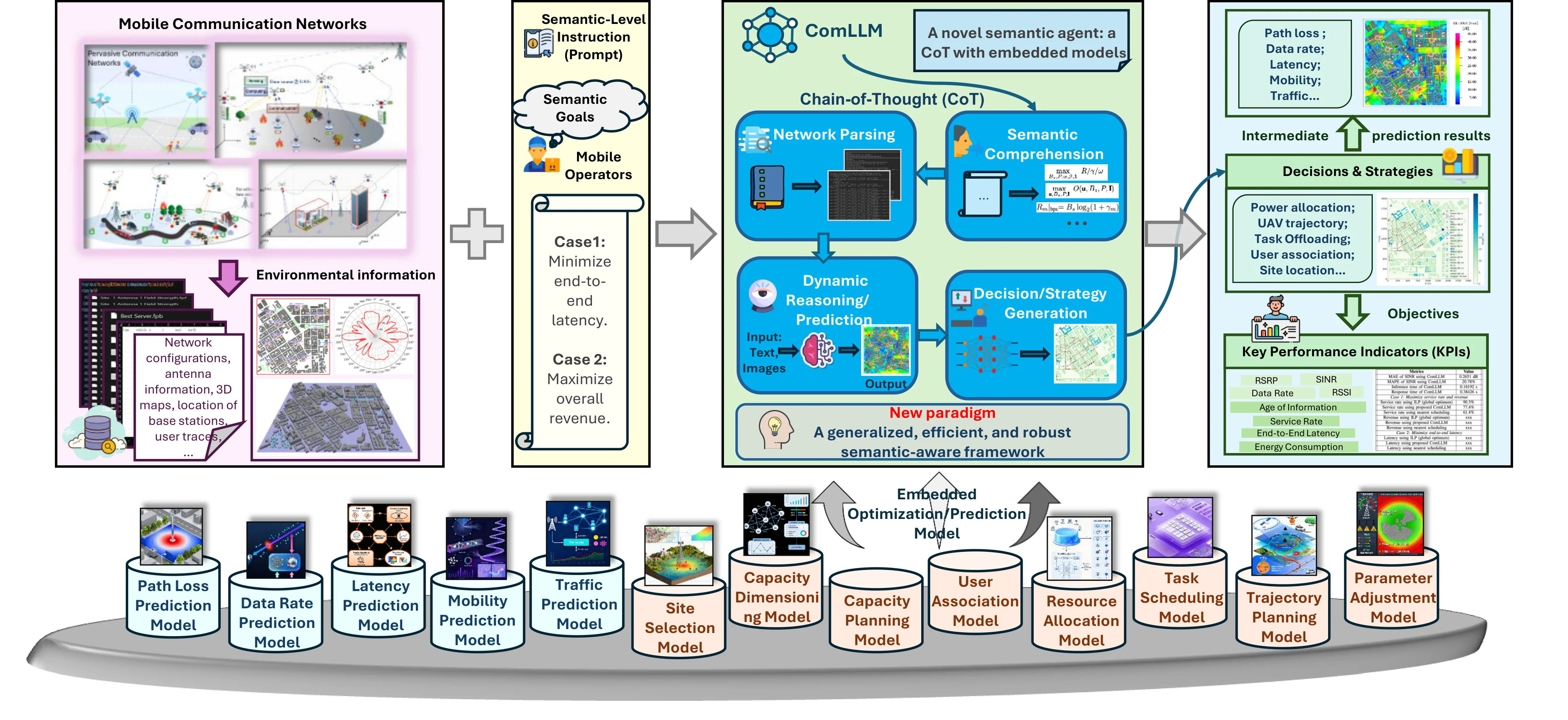
アブストラクト(原文)
Optimization, which lies at the core of network operations, is usually associated with extensive expert knowledge and manual overhead, which impedes its efficient implementation. To address this issue, this study illustrates the potential of a paradigm shift from algorithmic solvers to semantic agents for network optimization. Specifically, we envision a generalized Large Language Model (LLM)-based framework, called ComLLM, for addressing fundamental problems in mobile communication networks. Without explicit mathematical problem formulation, ComLLM can understand the semantic context (i.e., high-level, human-interpretable goals and constraints) and autonomously call incorporated prediction modules to generate adaptive optimization decisions. A case study on mobile edge computing demonstrates that ComLLM effectively performs joint data transmission rate prediction and autonomous vehicle task scheduling. ComLLM can be used for minimizing end-to-end latency or maximizing revenue. Furthermore, the paper provides insights into ComLLM and discusses open challenges.
引用方法
W. Mao, Q. Zhou, Y. Liang, Y. Liu, W. Huangfu, M. Tsukada, J. Crowcroft, and Y. Ji, “ComLLM: Towards A General Large Language Model for Semantic-Aware Network Optimization,” IEEE Network, 2026, doi: 10.1109/MNET.2026.3716787.
BibTeX
@article{Mao2026,
  title         = {ComLLM: Towards A General Large Language Model for Semantic-Aware Network Optimization},
  author        = {Wencan Mao and Quanxi Zhou and Yilei Liang and Yaxi Liu and Wei Huangfu and Manabu Tsukada and Jon Crowcroft and Yusheng Ji},
  doi           = {10.1109/MNET.2026.3716787},
  issn          = {0890-8044},
  year          = {2026},
  date          = {2026-07-21},
  urldate       = {2026-07-21},
  journal       = {IEEE Network},
  abstract      = {Optimization, which lies at the core of network operations, is usually associated with extensive expert knowledge and manual overhead, which impedes its efficient implementation. To address this issue, this study illustrates the potential of a paradigm shift from algorithmic solvers to semantic agents for network optimization. Specifically, we envision a generalized Large Language Model (LLM)-based framework, called ComLLM, for addressing fundamental problems in mobile communication networks. Without explicit mathematical problem formulation, ComLLM can understand the semantic context (i.e., high-level, human-interpretable goals and constraints) and autonomously call incorporated prediction modules to generate adaptive optimization decisions. A case study on mobile edge computing demonstrates that ComLLM effectively performs joint data transmission rate prediction and autonomous vehicle task scheduling. ComLLM can be used for minimizing end-to-end latency or maximizing revenue. Furthermore, the paper provides insights into ComLLM and discusses open challenges.},
  keywords      = {Other},
  pubstate      = {published},
  tppubtype     = {article}
}