
Feature-based Vehicle Identification Framework for Optimization of Collective Perception Messages in Vehicular Networks
IEEE Transactions on Vehicular Technology, vol. 72, pp. 2120–2129, 2023年2月1日
3行要約
- 協調認識メッセージの頻度や重複が増えると、車両ネットワークが混雑する。
- 画像の特徴でコネクテッド車両を識別し、メッセージの生成数と頻度を調整する。
- Carteryシミュレータで、チャネル使用率、周囲の認識率、メッセージ生成を従来法と比較した。
論文の図
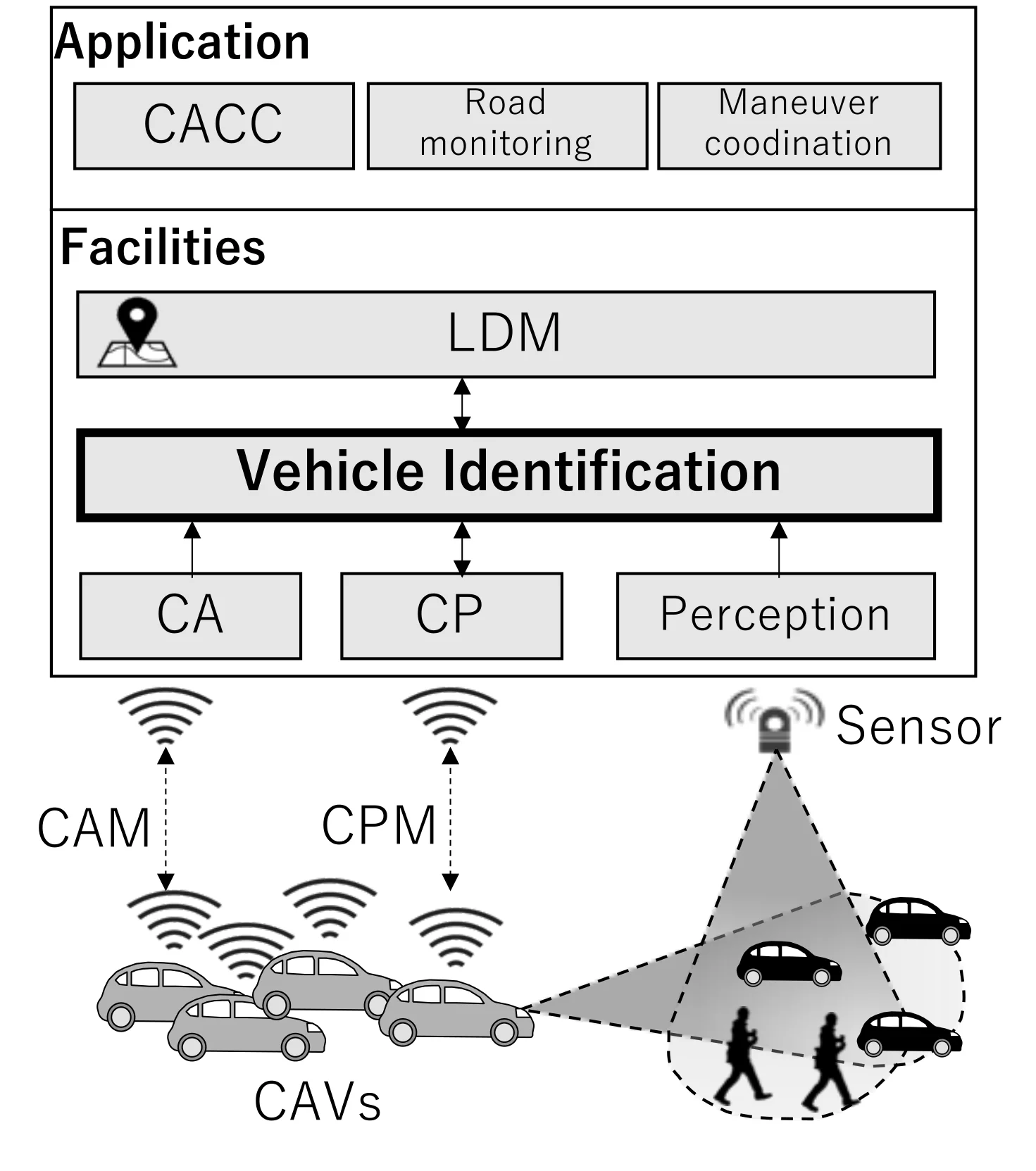
アブストラクト(原文)
The world is moving towards a fully connected digital world, where objects produce and consume data, at a sultry pace. Autonomous vehicles will play a key role in bolstering the digitization of the world. These connected vehicles must communicate timely data with their surrounding objects and road participants to fully and accurately understand their environments and eventually operate smoothly. As a result, the hugely exchanged data would scramble the network traffic that, at a given point, would no longer increase the awareness level of the vehicle. In this paper, we propose a vision-based approach to identify connected vehicles and use it to optimize the exchange of collective perception messages (CPMs), in terms of both the CPM generation frequency and the number of generated CPMs. To validate our proposed approach, we created a Cartery framework that integrates SUMO, Carla, and OMNeT++. We also compared our solution with both baselines and European Telecommunications Standards Institute solutions, considering three main KPIs: the channel busy ratio, environmental awareness, and the CPM generation frequency. Simulation results show that our proposed solution exhibits the best trade-off between the network load and situational awareness.
引用方法
H. Masuda, O. E. Marai, M. Tsukada, T. Taleb, and H. Esaki, “Feature-based Vehicle Identification Framework for Optimization of Collective Perception Messages in Vehicular Networks,” IEEE Transactions on Vehicular Technology, vol. 72, pp. 2120–2129, 2023, doi: 10.1109/TVT.2022.3211852.
BibTeX
@article{Masuda2022,
  title         = {Feature-based Vehicle Identification Framework for Optimization of Collective Perception Messages in Vehicular Networks},
  author        = {Hidetaka Masuda and Oussama El Marai and Manabu Tsukada and Tarik Taleb and Hiroshi Esaki},
  doi           = {10.1109/TVT.2022.3211852},
  isbn          = {0018-9545},
  year          = {2023},
  date          = {2023-02-01},
  urldate       = {2022-10-04},
  journal       = {IEEE Transactions on Vehicular Technology},
  volume        = {72},
  issue         = {2},
  pages         = {2120--2129},
  abstract      = {The world is moving towards a fully connected digital world, where objects produce and consume data, at a sultry pace. Autonomous vehicles will play a key role in bolstering the digitization of the world. These connected vehicles must communicate timely data with their surrounding objects and road participants to fully and accurately understand their environments and eventually operate smoothly. As a result, the hugely exchanged data would scramble the network traffic that, at a given point, would no longer increase the awareness level of the vehicle. In this paper, we propose a vision-based approach to identify connected vehicles and use it to optimize the exchange of collective perception messages (CPMs), in terms of both the CPM generation frequency and the number of generated CPMs. To validate our proposed approach, we created a Cartery framework that integrates SUMO, Carla, and OMNeT++. We also compared our solution with both baselines and European Telecommunications Standards Institute solutions, considering three main KPIs: the channel busy ratio, environmental awareness, and the CPM generation frequency. Simulation results show that our proposed solution exhibits the best trade-off between the network load and situational awareness.},
  keywords      = {ITS},
  pubstate      = {published},
  tppubtype     = {article}
}