
You Share Beliefs, I Adapt: Progressive Heterogeneous Collaborative Perception
International Conference on Computer Vision (ICCV 2025), Honolulu, Hawaii, USA, 2025年10月19日
Web サイトarXivGitHub(コード)DOI: 10.1109/ICCV51701.2025.02555
3行要約
- PHCPは新たな相手が異なるセンサやモデル構造を使う場合にも、協調認識を可能にする。
- 相手から受け取る少量のラベルなしデータで段階的に自己学習し、特徴を適応させる。
- 認識モデルを共同で再学習せず、新たなエージェントを加えられる。
論文の図
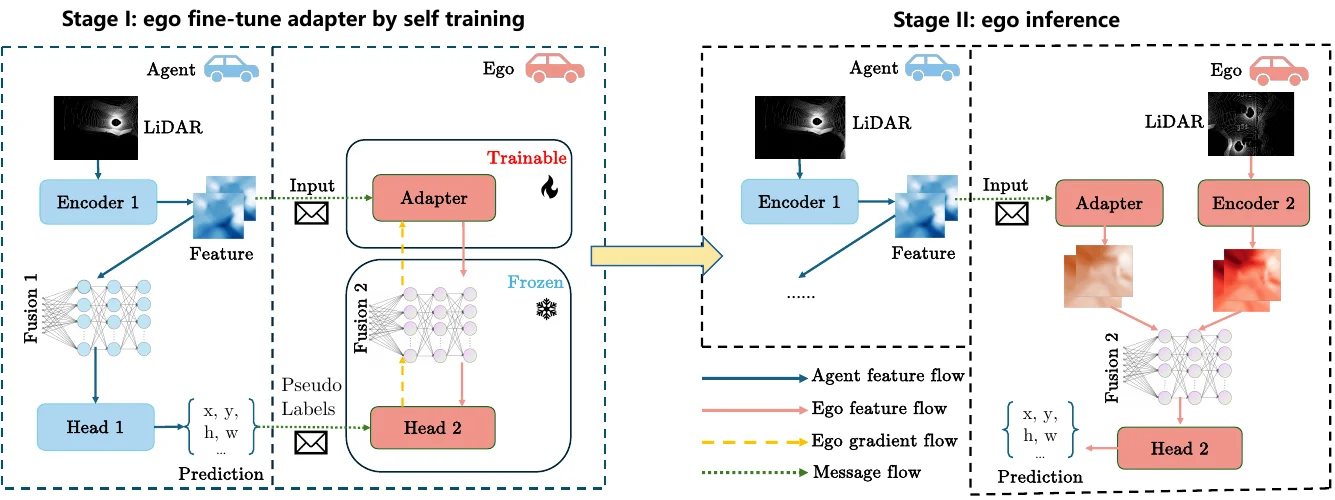
アブストラクト(原文)
Collaborative perception enables vehicles to overcome individual perception limitations by sharing information, allowing them to see further and through occlusions. In real-world scenarios, models on different vehicles are often heterogeneous due to manufacturer variations. Existing methods for heterogeneous collaborative perception address this challenge by fine-tuning adapters or the entire network to bridge the domain gap. However, these methods are impractical in real-world applications, as each new collaborator must undergo joint training with the ego vehicle on a dataset before inference, or the ego vehicle stores models for all potential collaborators in advance. Therefore, we pose a new question: Can we tackle this challenge directly during inference, eliminating the need for joint training? To answer this, we introduce Progressive Heterogeneous Collaborative Perception (PHCP), a novel framework that formulates the problem as few-shot unsupervised domain adaptation. Unlike previous work, PHCP dynamically aligns features by self-training an adapter during inference, eliminating the need for labeled data and joint training. Extensive experiments on the OPV2V dataset demonstrate that PHCP achieves strong performance across diverse heterogeneous scenarios. Notably, PHCP achieves performance comparable to SOTA methods trained on the entire dataset while using only a small amount of unlabeled data.
コード
関連する研究・ソフトウェア
関連ニュース
引用方法
H. Si, E. Javanmardi, and M. Tsukada, “You Share Beliefs, I Adapt: Progressive Heterogeneous Collaborative Perception,” in International Conference on Computer Vision (ICCV 2025), Honolulu, Hawaii, USA, 2025, doi: 10.1109/ICCV51701.2025.02555.
BibTeX
@inproceedings{Si2025,
  title         = {You Share Beliefs, I Adapt: Progressive Heterogeneous Collaborative Perception},
  author        = {Hao Si and Ehsan Javanmardi and Manabu Tsukada},
  url           = {https://sihaoo1.github.io/PHCP_Page/ https://arxiv.org/abs/2509.09310 https://github.com/sihaoo1/PHCP},
  doi           = {10.1109/ICCV51701.2025.02555},
  year          = {2025},
  date          = {2025-10-19},
  urldate       = {2025-10-19},
  booktitle     = {International Conference on Computer Vision (ICCV 2025)},
  address       = {Honolulu, Hawaii, USA},
  abstract      = {Collaborative perception enables vehicles to overcome individual perception limitations by sharing information, allowing them to see further and through occlusions. In real-world scenarios, models on different vehicles are often heterogeneous due to manufacturer variations. Existing methods for heterogeneous collaborative perception address this challenge by fine-tuning adapters or the entire network to bridge the domain gap. However, these methods are impractical in real-world applications, as each new collaborator must undergo joint training with the ego vehicle on a dataset before inference, or the ego vehicle stores models for all potential collaborators in advance. Therefore, we pose a new question: Can we tackle this challenge directly during inference, eliminating the need for joint training? To answer this, we introduce Progressive Heterogeneous Collaborative Perception (PHCP), a novel framework that formulates the problem as few-shot unsupervised domain adaptation. Unlike previous work, PHCP dynamically aligns features by self-training an adapter during inference, eliminating the need for labeled data and joint training. Extensive experiments on the OPV2V dataset demonstrate that PHCP achieves strong performance across diverse heterogeneous scenarios. Notably, PHCP achieves performance comparable to SOTA methods trained on the entire dataset while using only a small amount of unlabeled data.},
  keywords      = {CRONOS, ITS},
  pubstate      = {published},
  tppubtype     = {inproceedings}
}