
Digital Twin Based Open Platform for IoT Offloading Control: Enabling System Transparency and User Participation
International Conference on Intelligent Computing and its Emerging Applications (ICEA 2024), Tokyo, Japan, pp. 63–68, 2024年11月28日
3行要約
- WebベースのデジタルツインからIoT処理のオフロードを管理する。
- 通信状況とデータ量に応じて、学習モデルがエッジとクラウドの処理先を選ぶ。
- 人物検知の事例では、処理先の選択精度が線形回帰で73.9%、決定木回帰で95.7%だった。
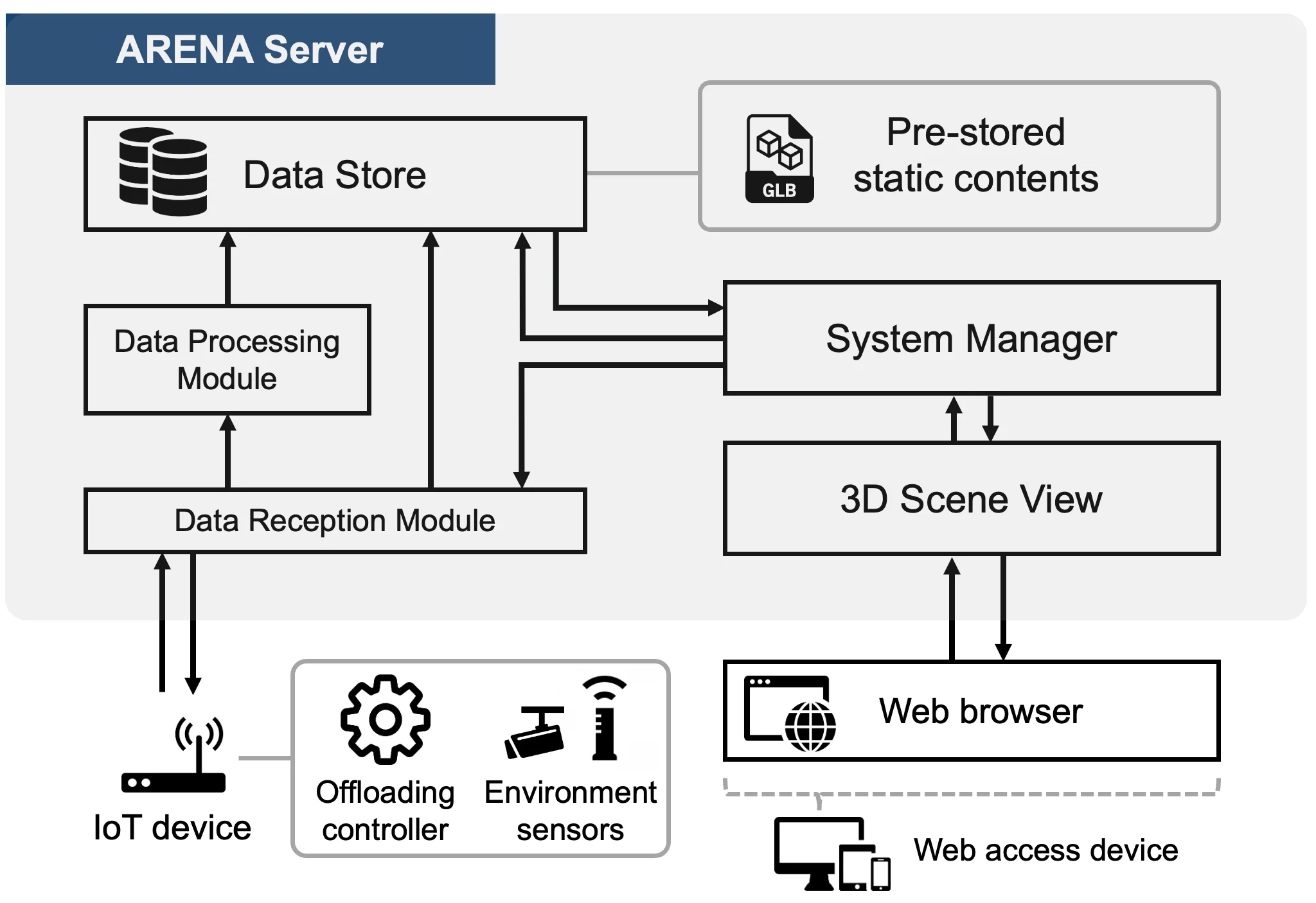
論文の図
アブストラクト(原文)
In the integrated infrastructure of Society 5.0, efficiently managing complex IoT (Internet of Things) systems is crucial. IoT devices frequently encounter limitations like limited network bandwidth, storage, and processing power, which lead to data congestion and reliance on cloud computing. Recent advancements in edge computing have emphasized hybrid offloading methods. Despite these technological strides, managing IoT systems still presents significant challenges. Typically, these systems are complex and closed, making it difficult for non-specialists to engage with and manage them effectively. This complexity is contrary to the principles of open platforms, which aim to democratize access and control, allowing a broader range of stakeholders to participate in system management. In this paper, we propose a novel system that integrates IoT offloading with a digital twin (DT) on an open web platform, enhancing both the transparency and the inclusivity of IoT system management. The system utilizes a machine learning model to dynamically select the most efficient data processing routes—either edge or cloud—based on real-time network conditions and data volume. Our case study, focused on person detection, employed linear regression and decision tree regression to optimize offloading decisions, achieving accuracies of 73.9 % and 95.7 % respectively. This setup not only demonstrated the effectiveness of the proposed system in real-world scenarios but also highlighted its capability to provide seamless integration and control through a DT interface, thus making complex IoT systems more accessible and manageable.
引用方法
Y. Sugizaki, J. Nakazato, and M. Tsukada, “Digital Twin Based Open Platform for IoT Offloading Control: Enabling System Transparency and User Participation,” in International Conference on Intelligent Computing and its Emerging Applications (ICEA 2024), Tokyo, Japan, 2024, doi: 10.1145/3732437.3732770.
BibTeX
@inproceedings{Sugizaki2024,
  title         = {Digital Twin Based Open Platform for IoT Offloading Control: Enabling System Transparency and User Participation},
  author        = {Yusuke Sugizaki and Jin Nakazato and Manabu Tsukada},
  doi           = {10.1145/3732437.3732770},
  year          = {2024},
  date          = {2024-11-28},
  urldate       = {2024-11-28},
  booktitle     = {International Conference on Intelligent Computing and its Emerging Applications (ICEA 2024)},
  pages         = {63--68},
  address       = {Tokyo, Japan},
  abstract      = {In the integrated infrastructure of Society 5.0, efficiently managing complex IoT (Internet of Things) systems is crucial. IoT devices frequently encounter limitations like limited network bandwidth, storage, and processing power, which lead to data congestion and reliance on cloud computing. Recent advancements in edge computing have emphasized hybrid offloading methods. Despite these technological strides, managing IoT systems still presents significant challenges. Typically, these systems are complex and closed, making it difficult for non-specialists to engage with and manage them effectively. This complexity is contrary to the principles of open platforms, which aim to democratize access and control, allowing a broader range of stakeholders to participate in system management. In this paper, we propose a novel system that integrates IoT offloading with a digital twin (DT) on an open web platform, enhancing both the transparency and the inclusivity of IoT system management. The system utilizes a machine learning model to dynamically select the most efficient data processing routes—either edge or cloud—based on real-time network conditions and data volume. Our case study, focused on person detection, employed linear regression and decision tree regression to optimize offloading decisions, achieving accuracies of 73.9 % and 95.7 % respectively. This setup not only demonstrated the effectiveness of the proposed system in real-world scenarios but also highlighted its capability to provide seamless integration and control through a DT interface, thus making complex IoT systems more accessible and manageable.},
  keywords      = {SDM},
  pubstate      = {published},
  tppubtype     = {inproceedings}
}