
Design of Digital Twin Architecture for 3D Audio Visualization in AR
The 2nd Annual IEEE International Conference on Metaverse Computing, Networking, and Applications (MetaCom 2024), Hong Kong, China, 2024年8月12日
DOI: 10.1109/MetaCom62920.2024.00044
3行要約
- 音楽を立体的に表現するためのデジタルツインの構成を設計した。
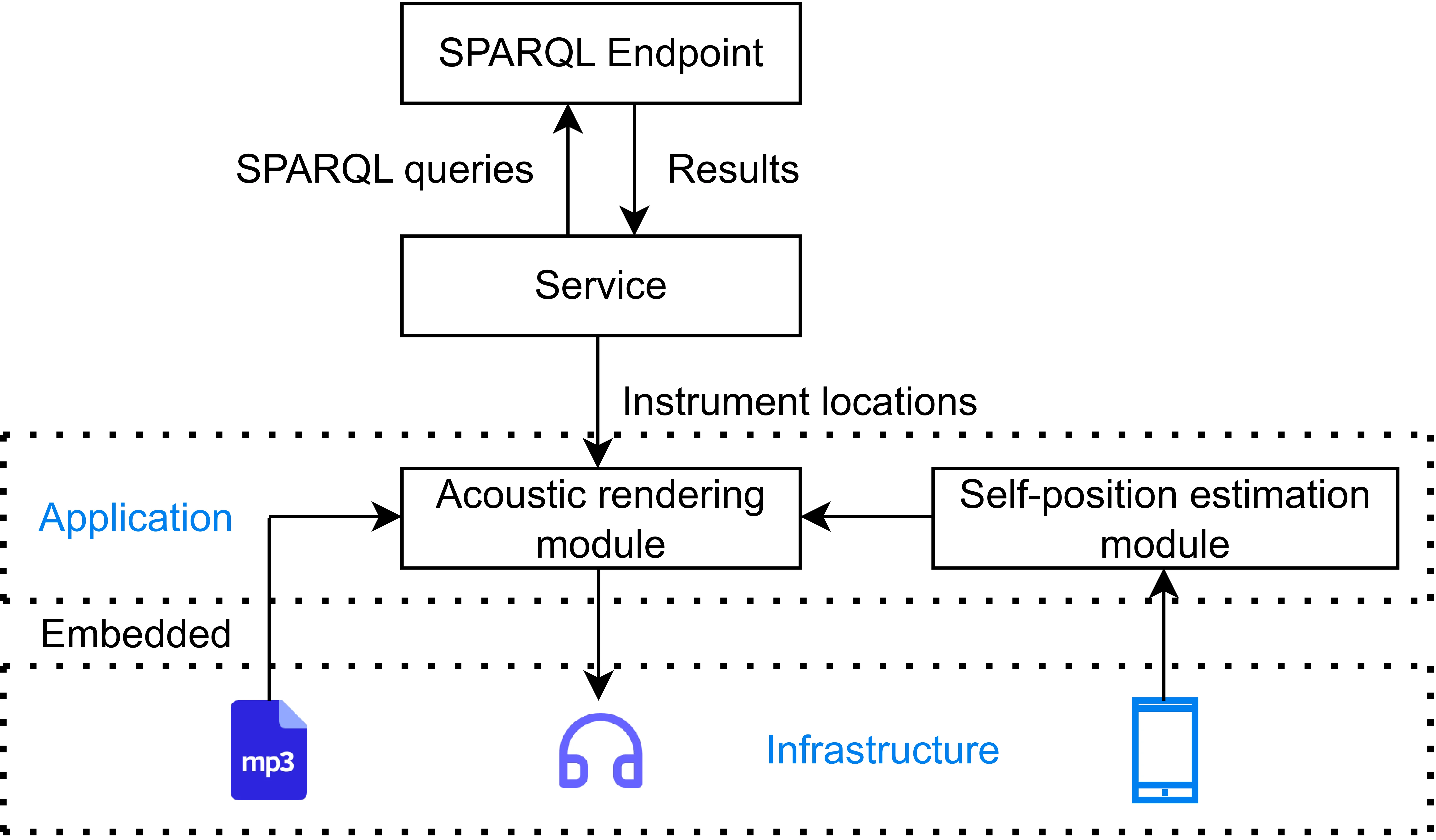
- AR端末と視覚測位を使い、収録した音声を実空間に対応付けた。
- 位置推定と音源定位の測定、参加者による体験評価で試作システムを検証した。
論文の図
アブストラクト(原文)
Digital twins have recently attracted attention from academia and industry as a technology connecting physical space and cyberspace. Digital twins are compatible with Augmented Reality (AR) and Virtual Reality (VR), enabling us to understand information in cyberspace. In this study, we focus on music and design an architecture for a 3D representation of music using a digital twin. Specifically, we organize the requirements for a digital twin for music and design the architecture. We establish a method to perform 3D representation in cyberspace and map the recorded audio data in physical space. In this paper, we implemented the physical space representation using a smartphone as an AR device and employed a visual positioning system (VPS) for self-positioning. For evaluation, in addition to system errors in the 3D representation of audio data, we conducted a questionnaire evaluation with several users as a user study. From these results, we evaluated the effectiveness of the implemented system. At the same time, we also found issues we need to improve in the implemented system in future works.
動画
関連する研究・ソフトウェア
関連ニュース
引用方法
T. Takada, J. Nakazato, A. Orsholits, M. Tsukada, H. Ochiai, and H. Esaki, “Design of Digital Twin Architecture for 3D Audio Visualization in AR,” in The 2nd Annual IEEE International Conference on Metaverse Computing, Networking, and Applications (MetaCom 2024), Hong Kong, China, 2024, doi: 10.1109/MetaCom62920.2024.00044.
BibTeX
@inproceedings{Takada2024,
  title         = {Design of Digital Twin Architecture for 3D Audio Visualization in AR},
  author        = {Tokio Takada and Jin Nakazato and Alex Orsholits and Manabu Tsukada and Hideya Ochiai and Hiroshi Esaki},
  doi           = {10.1109/MetaCom62920.2024.00044},
  year          = {2024},
  date          = {2024-08-12},
  urldate       = {2024-08-12},
  booktitle     = {The 2nd Annual IEEE International Conference on Metaverse Computing, Networking, and Applications (MetaCom 2024)},
  address       = {Hong Kong, China},
  abstract      = {Digital twins have recently attracted attention from academia and industry as a technology connecting physical space and cyberspace. Digital twins are compatible with Augmented Reality (AR) and Virtual Reality (VR), enabling us to understand information in cyberspace. In this study, we focus on music and design an architecture for a 3D representation of music using a digital twin. Specifically, we organize the requirements for a digital twin for music and design the architecture. We establish a method to perform 3D representation in cyberspace and map the recorded audio data in physical space. In this paper, we implemented the physical space representation using a smartphone as an AR device and employed a visual positioning system (VPS) for self-positioning. For evaluation, in addition to system errors in the 3D representation of audio data, we conducted a questionnaire evaluation with several users as a user study. From these results, we evaluated the effectiveness of the implemented system. At the same time, we also found issues we need to improve in the implemented system in future works.},
  key           = {CREST},
  keywords      = {SDM},
  pubstate      = {published},
  tppubtype     = {inproceedings}
}