
Design and Performance Evaluation of a Metadata-Driven Photosensitive-Epilepsy Safety Framework for Streaming Video
Master Thesis, Graduate School of Information Science and Technology, The University of Tokyo, 2026年9月30日
3行要約
- 光過敏性の危険をサーバーで検出し、同期メタデータを使って視聴端末で緩和する配信方式を設計する。
- 高彩度の赤の判定を再定式化し、異なる色域でも一貫して適用できるようにした。
- 動画コーパスで残存違反、再生コスト、メタデータの帯域を評価した。
論文の図
アブストラクト(原文)
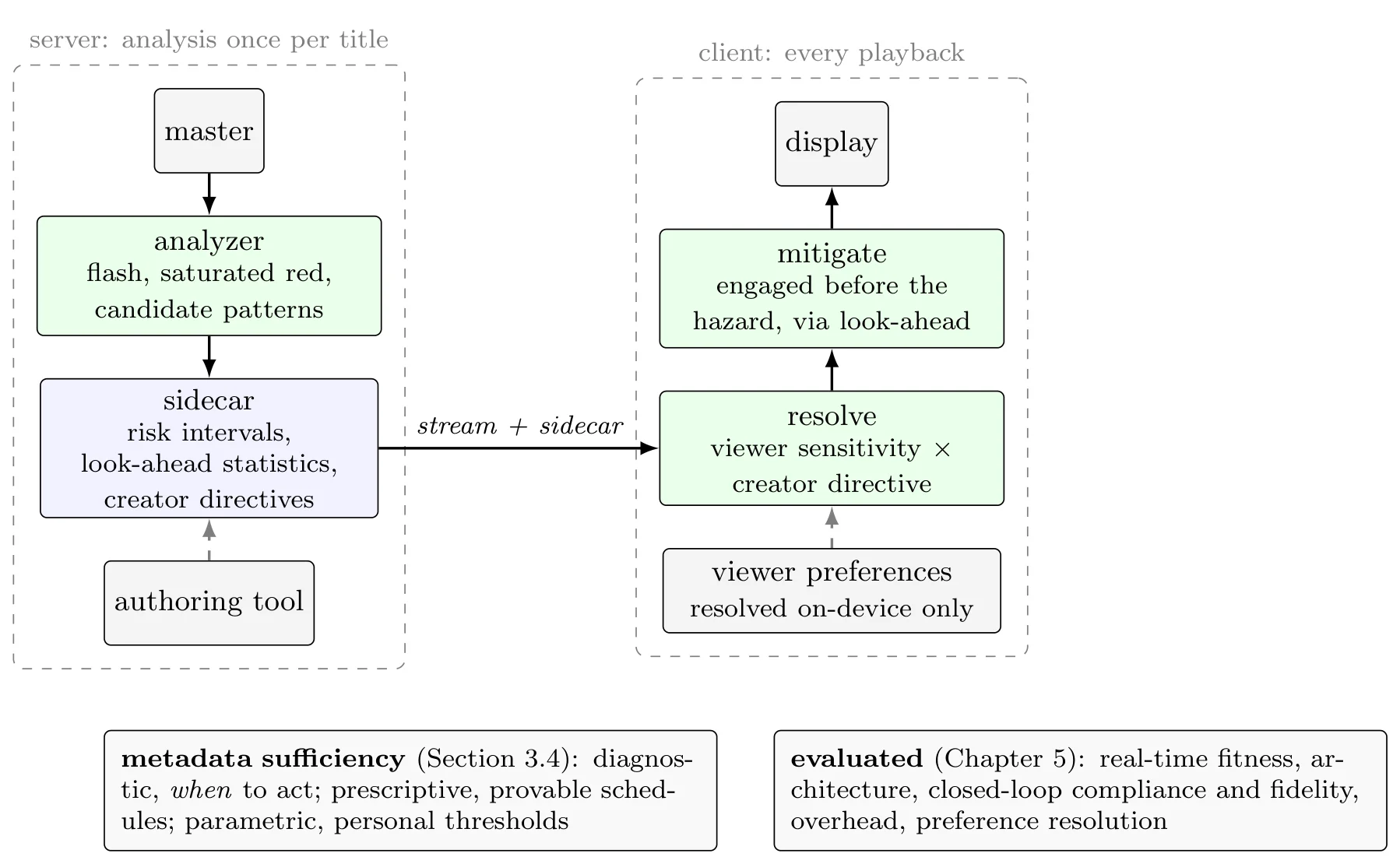
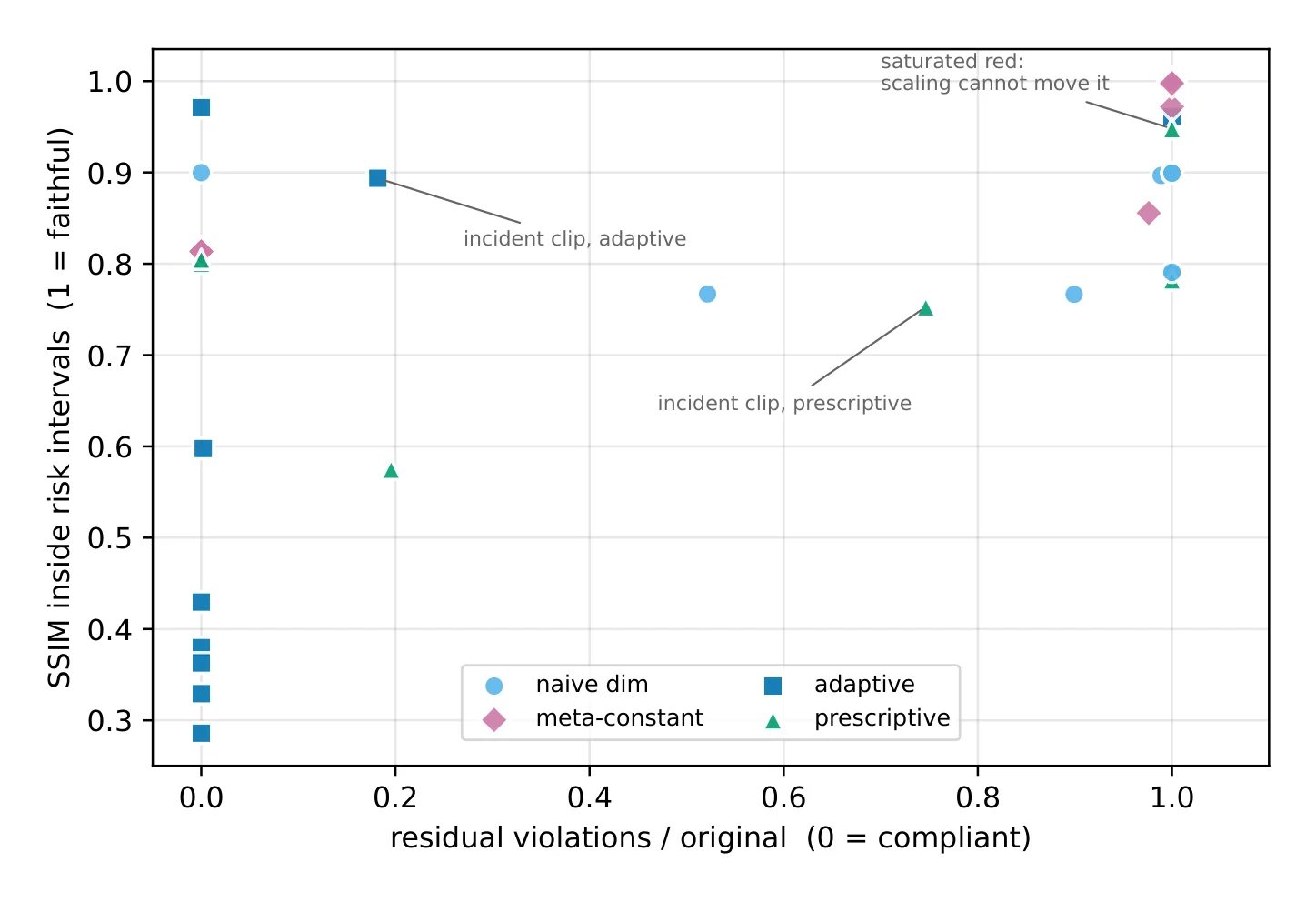
Flashing video sequences and regular spatial patterns can trigger seizures in photosensitive viewers. Broadcast-era guidelines quantify these hazards, but their enforcement model is production-side: content is edited until it passes, and one altered master serves every viewer. On the consumer playback path, protection today exists only at three disconnected points: whole-work warning flags, vendor-specific quality-control reports that never leave the production house, and reactive on-device detection. The last of these pays for analysis on every device and still exposes the viewer to the first hazardous frames of every burst. What is missing is time-ranged, machine-readable, creator-controllable hazard metadata that travels with the stream and lets any client protect any viewer without modifying the content. This thesis designs, implements and evaluates such a framework. Hazards are detected once, server-side, and compressed into a compact sidecar carrying risk intervals with per-interval statistics and optional creator directives. The client never detects; it mitigates locally, resolving creator intent against viewer sensitivity under safety-floor semantics and adapting to ambient viewing conditions. Two analytical results support the design. First, the standardized saturated-red test is shown to be silently gamut-dependent, missing 73.3% of the hazardous colours in a uniform sample of the Rec. 2020 wide gamut; a device-independent half-plane reformulation restores the original intent exactly, with a closed-form covering threshold for legacy-form tools. Second, a sufficiency analysis of the metadata itself shows that prescriptive, slew-limited mitigation schedules computed at authoring time make playback-time compliance provable with no client-side measurement. This avoids the instability that frame-by-frame adaptive control can itself introduce. The framework is implemented twice in Python, as a reference implementation and an optimized one, numerically equivalent within a stated tolerance. Both are evaluated by closed-loop re-analysis against the detector that produced the ground truth. The prescriptive tier achieves zero residual violations on every pure luminance-flash stress clip at millisecond-scale per-frame cost, roughly two orders of magnitude cheaper than reactive detection and with no exposed frames by construction. Detection and mitigation are then checked against an independent conformance corpus of 306 generated test videos carrying per-guideline expected verdicts. Detection misses none of the hazards that corpus designates; of the clips the analyzer flags, the adaptive tier makes 40 of 41 safe under re-analysis and the prescriptive tier 31, neither worsening any. The prescriptive tier fails only on saturated red, since uniform luminance scaling preserves the colour ratio the criterion tests. The optimized implementation meets real-time budgets through 720p under typical load and through 1080p on hazard-free content on consumer hardware, with every miss quantified by a pixel-linear cost model. The same optimization more than halves the measured energy per frame. The interval-level sidecar itself costs well under one tenth of a percent of typical streaming bitrates. No single mitigation scheme is universally compliant, which motivates the tiered composition the framework supports; spatial-pattern mitigation and luminance-threshold recalibration for high dynamic range remain the principal open problems.
引用方法
Y. Tong, “Design and Performance Evaluation of a Metadata-Driven Photosensitive-Epilepsy Safety Framework for Streaming Video,” in Master Thesis, Graduate School of Information Science and Technology, The University of Tokyo, 2026.
BibTeX
@mastersthesis{Tong2026b,
  title         = {Design and Performance Evaluation of a Metadata-Driven Photosensitive-Epilepsy Safety Framework for Streaming Video},
  author        = {Yige Tong},
  year          = {2026},
  date          = {2026-09-30},
  urldate       = {2026-09-30},
  school        = {Master Thesis, Graduate School of Information Science and Technology, The University of Tokyo},
  abstract      = {Flashing video sequences and regular spatial patterns can trigger seizures in photosensitive viewers. Broadcast-era guidelines quantify these hazards, but their enforcement model is production-side: content is edited until it passes, and one altered master serves every viewer. On the consumer playback path, protection today exists only at three disconnected points: whole-work warning flags, vendor-specific quality-control reports that never leave the production house, and reactive on-device detection. The last of these pays for analysis on every device and still exposes the viewer to the first hazardous frames of every burst. What is missing is time-ranged, machine-readable, creator-controllable hazard metadata that travels with the stream and lets any client protect any viewer without modifying the content. This thesis designs, implements and evaluates such a framework. Hazards are detected once, server-side, and compressed into a compact sidecar carrying risk intervals with per-interval statistics and optional creator directives. The client never detects; it mitigates locally, resolving creator intent against viewer sensitivity under safety-floor semantics and adapting to ambient viewing conditions. Two analytical results support the design. First, the standardized saturated-red test is shown to be silently gamut-dependent, missing 73.3% of the hazardous colours in a uniform sample of the Rec. 2020 wide gamut; a device-independent half-plane reformulation restores the original intent exactly, with a closed-form covering threshold for legacy-form tools. Second, a sufficiency analysis of the metadata itself shows that prescriptive, slew-limited mitigation schedules computed at authoring time make playback-time compliance provable with no client-side measurement. This avoids the instability that frame-by-frame adaptive control can itself introduce. The framework is implemented twice in Python, as a reference implementation and an optimized one, numerically equivalent within a stated tolerance. Both are evaluated by closed-loop re-analysis against the detector that produced the ground truth. The prescriptive tier achieves zero residual violations on every pure luminance-flash stress clip at millisecond-scale per-frame cost, roughly two orders of magnitude cheaper than reactive detection and with no exposed frames by construction. Detection and mitigation are then checked against an independent conformance corpus of 306 generated test videos carrying per-guideline expected verdicts. Detection misses none of the hazards that corpus designates; of the clips the analyzer flags, the adaptive tier makes 40 of 41 safe under re-analysis and the prescriptive tier 31, neither worsening any. The prescriptive tier fails only on saturated red, since uniform luminance scaling preserves the colour ratio the criterion tests. The optimized implementation meets real-time budgets through 720p under typical load and through 1080p on hazard-free content on consumer hardware, with every miss quantified by a pixel-linear cost model. The same optimization more than halves the measured energy per frame. The interval-level sidecar itself costs well under one tenth of a percent of typical streaming bitrates. No single mitigation scheme is universally compliant, which motivates the tiered composition the framework supports; spatial-pattern mitigation and luminance-threshold recalibration for high dynamic range remain the principal open problems.},
  keywords      = {Thesis},
  pubstate      = {published},
  tppubtype     = {mastersthesis}
}