
Overcoming Environmental Challenges in CAVs Through MEC-Based Federated Learning
14th International Conference on Ubiquitous and Future Networks (ICUFN 2023), Paris, France, pp. 1–6, 2023年7月4日
PDFDOI: 10.1109/ICUFN57995.2023.10200688
3行要約
- 天候や走行環境の変化により、コネクテッド自動運転車のモデルの性能が変わる。
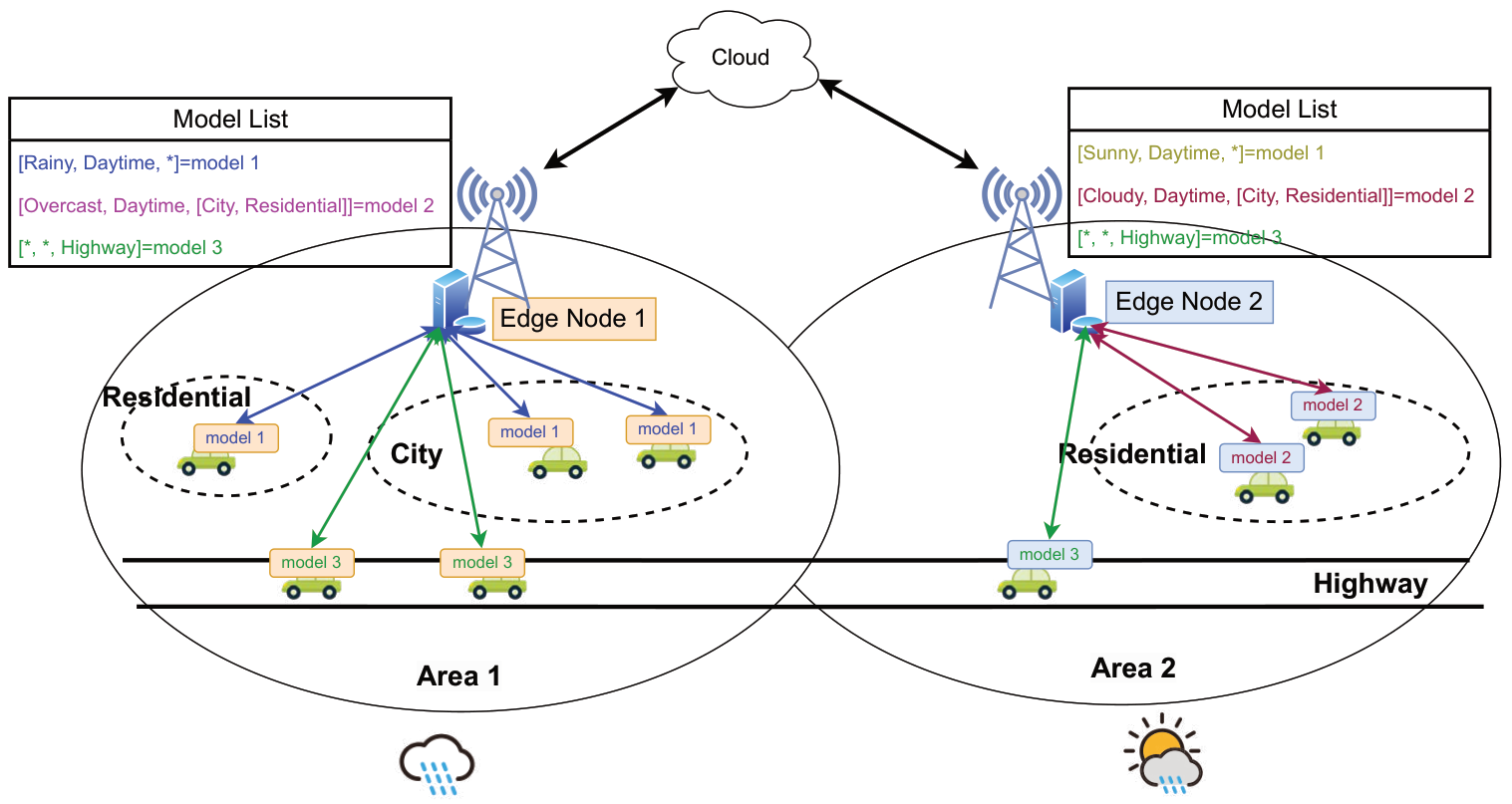
- エッジ上の連合学習基盤で、環境別のモデルを保持し、継続的に更新する。
- エッジノードが各端末の学習結果を集約し、提案手法がモデルの分類と管理を行う。
論文の図
アブストラクト(原文)
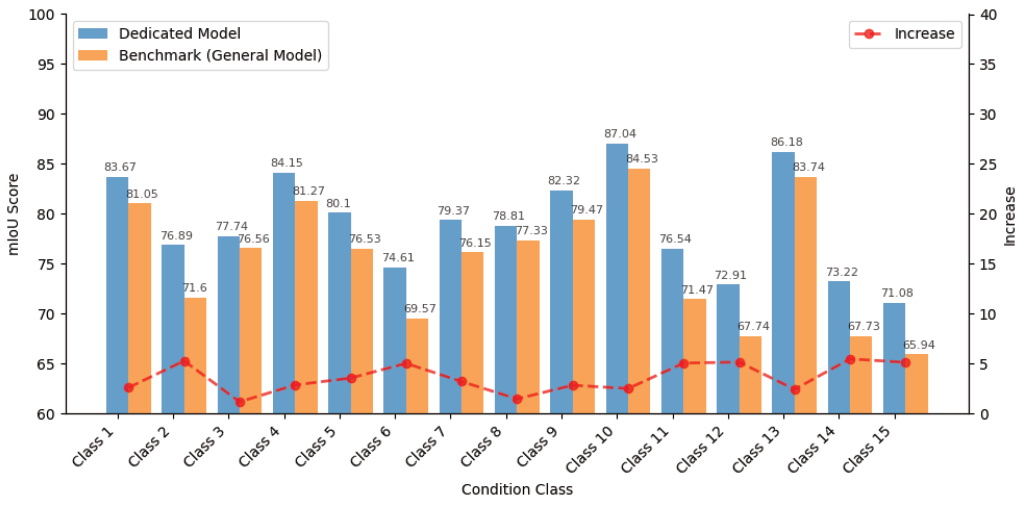
Connected autonomous vehicles (CAVs), through vehicle-to-everything communication and computing resources, enable the vital exchange of information. Although deep learning is crucial in this landscape, it requires extensive and intricate datasets covering all potential scenarios. Furthermore, this situation poses a hazard, as the likelihood of accidents associated with imbalanced datasets increases, particularly in scenarios where processing analysis is compromised due to fluctuating weather conditions. We propose a Federated Learning (FL) framework undergirded by Multi-Access Edge Computing (MEC) to counter these challenges. This local device-focused framework enhances task-specific models' caching and continual updating across various conditions. In a more specific sense, edge nodes (ENs) operate as MEC, each caching multiple dedicated models and serving as the aggregator as part of the FL process. Additionally, we have engineered two innovative algorithms that categorize various states into multiple classes, thereby ensuring the efficient utilization of computing resources in ENs. Simulation results substantiate the effectiveness of our approach, showing that the proposed dedicated model consistently outperforms a general model designed for all situations.
関連する研究・ソフトウェア
引用方法
Z. Wang, J. Nakazato, M. Asad, E. Javanmardi, and M. Tsukada, “Overcoming Environmental Challenges in CAVs Through MEC-Based Federated Learning,” in 14th International Conference on Ubiquitous and Future Networks (ICUFN 2023), Paris, France, 2023, doi: 10.1109/ICUFN57995.2023.10200688.
BibTeX
@inproceedings{Wang2023,
  title         = {Overcoming Environmental Challenges in CAVs Through MEC-Based Federated Learning},
  author        = {Zekun Wang and Jin Nakazato and Muhammad Asad and Ehsan Javanmardi and Manabu Tsukada},
  url           = {https://www.researchgate.net/profile/Jin-Nakazato/publication/371685830_Overcoming_Environmental_Challenges_in_CAVs_through_MEC-based_Federated_Learning/links/64a420ea8de7ed28ba7465c7/Overcoming-Environmental-Challenges-in-CAVs-through-MEC-based-Federated-Learning.pdf},
  doi           = {10.1109/ICUFN57995.2023.10200688},
  year          = {2023},
  date          = {2023-07-04},
  urldate       = {2023-07-04},
  booktitle     = {14th International Conference on Ubiquitous and Future Networks (ICUFN 2023)},
  pages         = {1--6},
  address       = {Paris, France},
  abstract      = {Connected autonomous vehicles (CAVs), through vehicle-to-everything communication and computing resources, enable the vital exchange of information. Although deep learning is crucial in this landscape, it requires extensive and intricate datasets covering all potential scenarios. Furthermore, this situation poses a hazard, as the likelihood of accidents associated with imbalanced datasets increases, particularly in scenarios where processing analysis is compromised due to fluctuating weather conditions. We propose a Federated Learning (FL) framework undergirded by Multi-Access Edge Computing (MEC) to counter these challenges. This local device-focused framework enhances task-specific models' caching and continual updating across various conditions. In a more specific sense, edge nodes (ENs) operate as MEC, each caching multiple dedicated models and serving as the aggregator as part of the FL process. Additionally, we have engineered two innovative algorithms that categorize various states into multiple classes, thereby ensuring the efficient utilization of computing resources in ENs. Simulation results substantiate the effectiveness of our approach, showing that the proposed dedicated model consistently outperforms a general model designed for all situations.},
  keywords      = {ITS},
  pubstate      = {published},
  tppubtype     = {inproceedings}
}