
Low Latency Redundant Network Architecture for Enhancing 5G Mobile Communication Quality
39th International Conference on Information Networking (ICOIN 2025), Chiang Mai, Thailand, 2025年1月14日
DOI: 10.1109/ICOIN63865.2025.10993150
3行要約
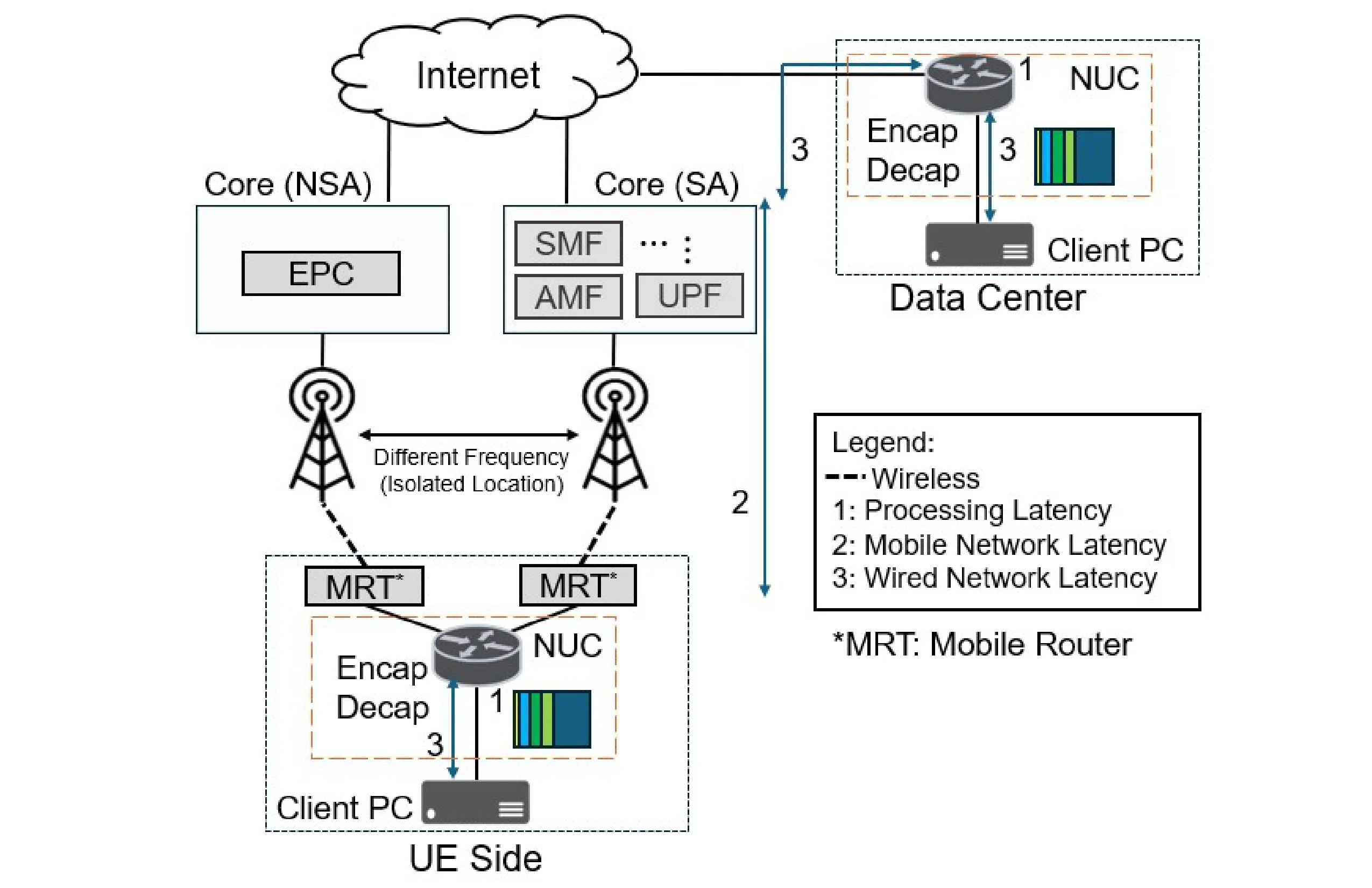
- 単一の通信事業者内でLTEと5G SAを別経路として利用する冗長化構成を提案する。
- 処理の負荷を抑えたパケット処理により、両経路で低遅延の通信を支える。
- 静止環境での初期検証では、従来方式から遅延が38.1 ms減少した。
論文の図
アブストラクト(原文)
With growing demand for high-capacity, low-latency communication driven by the increasing use of video streaming and real-time data applications, efficient data transfer methods have become essential. While 5G technology provides enhanced data transfer capabilities, its directional nature can lead to stability issues, including connection interruptions, frequent handoffs, data loss, and increased latency. To address these challenges, we propose a system architecture with a redundant configuration that separates LTE and 5G-SA within a single MNO, alongside a method to reduce overhead. Initial verification in a stationary environment demonstrated the reduction of latency by 38.1 ms compared to the conventional method, underscoring the potential of our approach for stable and efficient data transmission.
引用方法
N. Yamane, J. Nakazato, K. Ito, M. Mikami, T. Tsuchiya, M. Tsukada, and H. Esaki, “Low Latency Redundant Network Architecture for Enhancing 5G Mobile Communication Quality,” in 39th International Conference on Information Networking (ICOIN 2025), Chiang Mai, Thailand, 2025, doi: 10.1109/ICOIN63865.2025.10993150.
BibTeX
@inproceedings{Yamane2025,
  title         = {Low Latency Redundant Network Architecture for Enhancing 5G Mobile Communication Quality},
  author        = {Nayuta Yamane and Jin Nakazato and Koki Ito and Manabu Mikami and Takahiro Tsuchiya and Manabu Tsukada and Hiroshi Esaki},
  doi           = {10.1109/ICOIN63865.2025.10993150},
  year          = {2025},
  date          = {2025-01-14},
  urldate       = {2025-01-14},
  booktitle     = {39th International Conference on Information Networking (ICOIN 2025)},
  address       = {Chiang Mai, Thailand},
  abstract      = {With growing demand for high-capacity, low-latency communication driven by the increasing use of video streaming and real-time data applications, efficient data transfer methods have become essential. While 5G technology provides enhanced data transfer capabilities, its directional nature can lead to stability issues, including connection interruptions, frequent handoffs, data loss, and increased latency. To address these challenges, we propose a system architecture with a redundant configuration that separates LTE and 5G-SA within a single MNO, alongside a method to reduce overhead. Initial verification in a stationary environment demonstrated the reduction of latency by 38.1 ms compared to the conventional method, underscoring the potential of our approach for stable and efficient data transmission.},
  keywords      = {Other},
  pubstate      = {published},
  tppubtype     = {inproceedings}
}