
Trajectory Planning for UAV-Based Smart Farming Using Imitation-Based Triple Deep Q-Learning
IEEE International Conference on Robotics & Automation (ICRA 2026), Vienna, Austria, 2026年6月1日
3行要約
- 雑草の検出・識別と無線センサのデータ収集を行うUAVの軌道を計画する。
- ITDQNは成績の良いエージェントの模倣と、学習を安定させる中間Qネットワークを組み合わせる。
- Double DQNとの比較で雑草認識率とデータ収集率が向上した。
論文の図
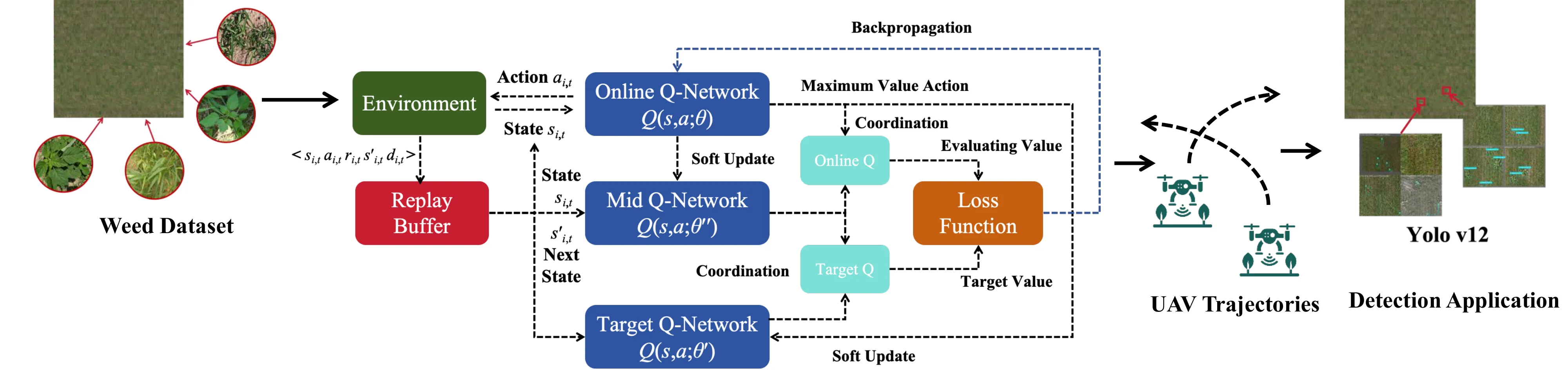
アブストラクト(原文)
Unmanned aerial vehicles (UAVs) have emerged as a promising auxiliary platform for smart agriculture, capable of simultaneously performing weed detection, recognition, and data collection from wireless sensors. However, trajectory planning for UAV-based smart agriculture is challenging due to the high uncertainty of the environment, partial observations, and limited battery capacity of UAVs. To address these issues, we formulate the trajectory planning problem as a Markov decision process (MDP) and leverage multi-agent reinforcement learning (MARL) to solve it. Furthermore, we propose a novel imitation-based triple deep Q-network (ITDQN) algorithm, which employs an elite imitation mechanism to reduce exploration costs and utilizes a mediator Q-network over a double deep Q-network (DDQN) to accelerate and stabilize training and improve performance. Experimental results in both simulated and real-world environments demonstrate the effectiveness of our solution. Moreover, our proposed ITDQN outperforms DDQN by 4.43% in weed recognition rate and 6.94% in data collection rate.
動画
関連する研究・ソフトウェア
関連ニュース
引用方法
Q. Zhou, W. Mao, T. C. Coddou, M. Tsukada, Y. Liu, and Y. Ji, “Trajectory Planning for UAV-Based Smart Farming Using Imitation-Based Triple Deep Q-Learning,” in IEEE International Conference on Robotics & Automation (ICRA 2026), Vienna, Austria, 2026.
BibTeX
@inproceedings{Zhou2026b,
  title         = {Trajectory Planning for UAV-Based Smart Farming Using Imitation-Based Triple Deep Q-Learning},
  author        = {Quanxi Zhou and Wencan Mao and Tomás Couso Coddou and Manabu Tsukada and Yunling Liu and Yusheng Ji},
  url           = {https://youtu.be/D-vz9HafnUM https://arxiv.org/abs/2512.18604},
  eprint        = {2512.18604},
  archiveprefix = {arXiv},
  primaryclass  = {cs.LG},
  year          = {2026},
  date          = {2026-06-01},
  urldate       = {2026-06-01},
  booktitle     = {IEEE International Conference on Robotics & Automation (ICRA 2026)},
  address       = {Vienna, Austria},
  abstract      = {Unmanned aerial vehicles (UAVs) have emerged as a promising auxiliary platform for smart agriculture, capable of simultaneously performing weed detection, recognition, and data collection from wireless sensors. However, trajectory planning for UAV-based smart agriculture is challenging due to the high uncertainty of the environment, partial observations, and limited battery capacity of UAVs. To address these issues, we formulate the trajectory planning problem as a Markov decision process (MDP) and leverage multi-agent reinforcement learning (MARL) to solve it. Furthermore, we propose a novel imitation-based triple deep Q-network (ITDQN) algorithm, which employs an elite imitation mechanism to reduce exploration costs and utilizes a mediator Q-network over a double deep Q-network (DDQN) to accelerate and stabilize training and improve performance. Experimental results in both simulated and real-world environments demonstrate the effectiveness of our solution. Moreover, our proposed ITDQN outperforms DDQN by 4.43% in weed recognition rate and 6.94% in data collection rate.},
  keywords      = {Other},
  pubstate      = {published},
  tppubtype     = {inproceedings}
}