
A State-Interactive MAC Layer TDMA Protocol Based on Smart Antennas
Electronics, vol. 13, no. 11, 2024年5月23日
Web サイトDOI: 10.3390/electronics13112037
3行要約
- スマートアンテナを用いる長距離モバイルアドホック網向けにTDMAのスロット割当方式を提案する。
- スロットの状態をノード間で共有し、伝搬遅延や指向性のある送信に伴う競合を回避する。
- シミュレーションでは干渉が減り、スループットが改善し、遅延も安定した。
論文の図
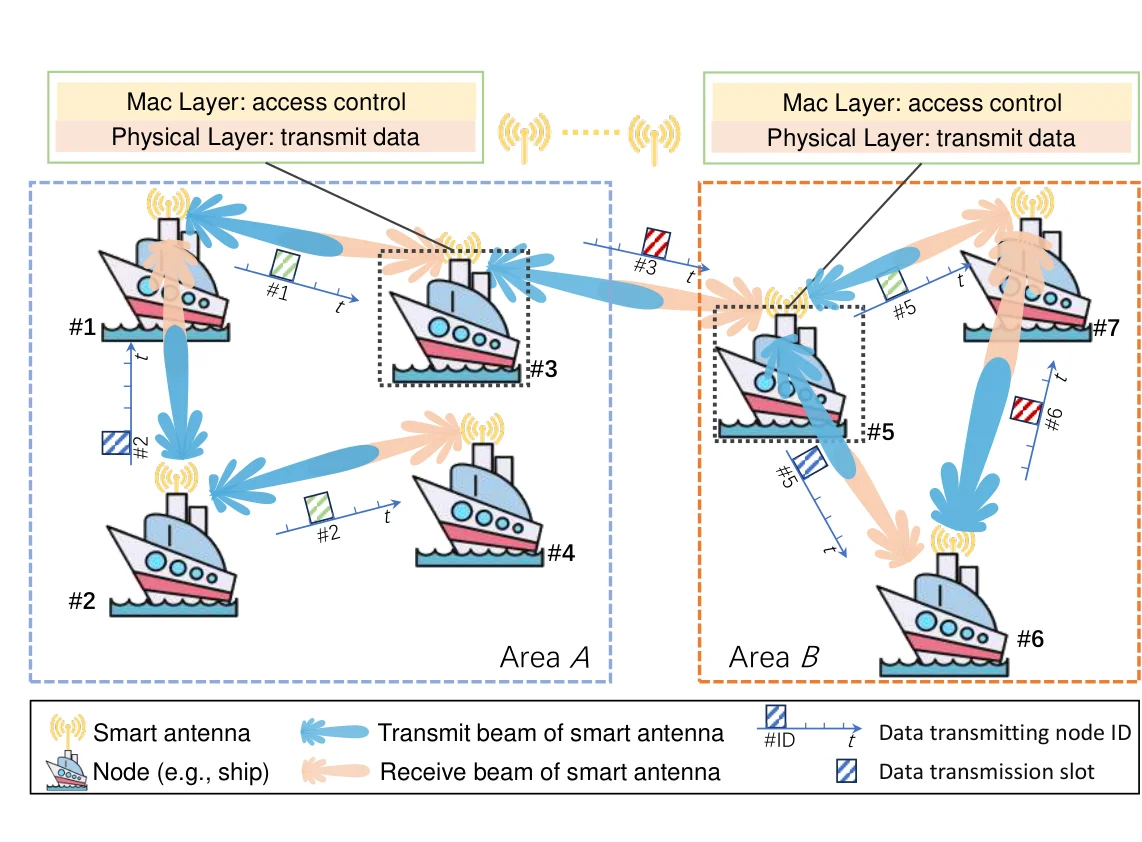
アブストラクト(原文)
Mobile ad hoc networks are self-organizing networks that do not rely on fixed infrastructure. Smart antennas employ advanced beamforming technology, enabling ultra-long-range directional transmission in wireless networks, which leads to lower power consumption and better utilization of spatial resources. The media access control (MAC) protocol design using smart antennas can lead to efficient usage of channel resources. However, during ultra-long-distance transmissions, there may be significant transport delays. In addition, when using the time division multiple access (TDMA) schemes, it can be difficult to manage conflicts arising from adjacent time slot advancement caused by latency compensation in ultra-long-range propagation. Directional transmission and reception can also cause interference between links that reuse the same time slot. This paper proposes a new distributed dynamic TDMA protocol called State Interaction-based Slot Allocation Protocol (SISAP) to address these issues. This protocol is based on slot states and includes TDMA frame structure, slot allocation process, interference self-avoidance strategy, and slot allocation algorithms. According to the simulation results, the MAC layer design scheme suggested in this paper can achieve ultra-long-distance transmission without conflicts. Additionally, it can reduce the interference between links while space multiplexing. Furthermore, the system exhibits remarkable performance in various network aspects, such as throughput and link delay.
引用方法
D. Li, J. Nakazato, and M. Tsukada, “A State-Interactive MAC Layer TDMA Protocol Based on Smart Antennas,” Electronics, vol. 13, no. 11, 2024, doi: 10.3390/electronics13112037.
BibTeX
@article{electronics13112037,
  title         = {A State-Interactive MAC Layer TDMA Protocol Based on Smart Antennas},
  author        = {Donghui Li and Jin Nakazato and Manabu Tsukada},
  url           = {https://www.mdpi.com/2079-9292/13/11/2037},
  doi           = {10.3390/electronics13112037},
  issn          = {2079-9292},
  year          = {2024},
  date          = {2024-05-23},
  urldate       = {2024-01-01},
  journal       = {Electronics},
  volume        = {13},
  number        = {11},
  abstract      = {Mobile ad hoc networks are self-organizing networks that do not rely on fixed infrastructure. Smart antennas employ advanced beamforming technology, enabling ultra-long-range directional transmission in wireless networks, which leads to lower power consumption and better utilization of spatial resources. The media access control (MAC) protocol design using smart antennas can lead to efficient usage of channel resources. However, during ultra-long-distance transmissions, there may be significant transport delays. In addition, when using the time division multiple access (TDMA) schemes, it can be difficult to manage conflicts arising from adjacent time slot advancement caused by latency compensation in ultra-long-range propagation. Directional transmission and reception can also cause interference between links that reuse the same time slot. This paper proposes a new distributed dynamic TDMA protocol called State Interaction-based Slot Allocation Protocol (SISAP) to address these issues. This protocol is based on slot states and includes TDMA frame structure, slot allocation process, interference self-avoidance strategy, and slot allocation algorithms. According to the simulation results, the MAC layer design scheme suggested in this paper can achieve ultra-long-distance transmission without conflicts. Additionally, it can reduce the interference between links while space multiplexing. Furthermore, the system exhibits remarkable performance in various network aspects, such as throughput and link delay.},
  keywords      = {Other},
  pubstate      = {published},
  tppubtype     = {article}
}