
MAC address randomization tolerant crowd monitoring system using Wi-Fi packets
16th Asian Internet Engineering Conference (AINTEC 2021), Online, Dec 14, 2021
arXivDOI: 10.1145/3497777.3498547
Summary in three lines
- Wi-Fi crowdsensing can overcount devices when they rotate their MAC addresses.
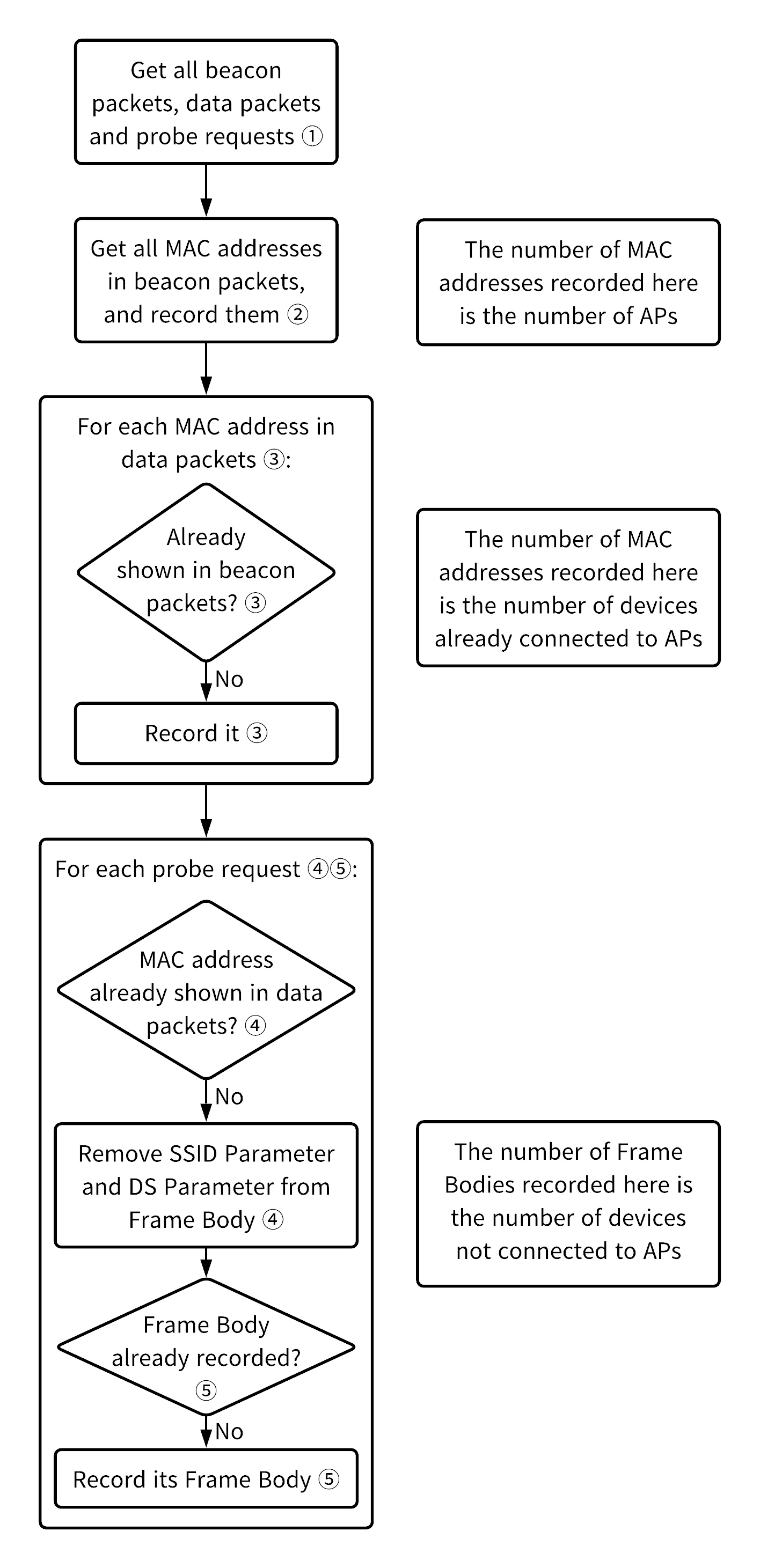
- Vision combines multiple packet types, while TrueSight groups observations using sequence numbers and hierarchical clustering.
- Vision grouped 440 randomized addresses as one device, and TrueSight achieved over 75% accuracy when an error of one device was allowed.
Figures from the paper
Abstract
Media access control (MAC) addresses inside Wi-Fi packets can be used for beneficial activities such as crowdedness estimation, marketing, and hazard maps. However, the MAC address randomization systems introduced around 2014 make all conventional MAC-address-based crowd monitoring systems count the same device more than once. Therefore, there is a need to create a new crowd monitoring system tolerant to MAC address randomization to estimate the number of devices accurately. In this paper, Vision and TrueSight, two new crowd monitoring algorithms that estimate the number of devices, are proposed to prove that MAC-address-based crowd monitoring is still possible. In addition to probe requests, Vision uses data packets and beacon packets to mitigate the influence of randomization. Moreover, TrueSight uses sequence numbers and hierarchical clustering to estimate the number of devices. The experimental results of this study show that even without installing any special software, Vision can gather 440 randomly generated MAC addresses into one group and count only once, and TrueSight can estimate the number of devices with an accuracy of more than 75% with an acceptable error range of 1.
Video
How to cite
Y. Cai, M. Tsukada, H. Ochiai, and H. Esaki, “MAC address randomization tolerant crowd monitoring system using Wi-Fi packets,” in 16th Asian Internet Engineering Conference (AINTEC 2021), Online, 2021, doi: 10.1145/3497777.3498547.
BibTeX
@inproceedings{Cai2021,
  title         = {MAC address randomization tolerant crowd monitoring system using Wi-Fi packets},
  author        = {Yuyi Cai and Manabu Tsukada and Hideya Ochiai and Hiroshi Esaki},
  url           = {http://arxiv.org/abs/2112.02161 https://youtu.be/gVkdQ8LWDdI},
  doi           = {10.1145/3497777.3498547},
  year          = {2021},
  date          = {2021-12-14},
  urldate       = {2021-12-14},
  booktitle     = {16th Asian Internet Engineering Conference (AINTEC 2021)},
  address       = {Online},
  abstract      = {Media access control (MAC) addresses inside Wi-Fi packets can be used for beneficial activities such as crowdedness estimation, marketing, and hazard maps. However, the MAC address randomization systems introduced around 2014 make all conventional MAC-address-based crowd monitoring systems count the same device more than once. Therefore, there is a need to create a new crowd monitoring system tolerant to MAC address randomization to estimate the number of devices accurately. In this paper, Vision and TrueSight, two new crowd monitoring algorithms that estimate the number of devices, are proposed to prove that MAC-address-based crowd monitoring is still possible. In addition to probe requests, Vision uses data packets and beacon packets to mitigate the influence of randomization. Moreover, TrueSight uses sequence numbers and hierarchical clustering to estimate the number of devices. The experimental results of this study show that even without installing any special software, Vision can gather 440 randomly generated MAC addresses into one group and count only once, and TrueSight can estimate the number of devices with an accuracy of more than 75% with an acceptable error range of 1.},
  keywords      = {Other},
  pubstate      = {published},
  tppubtype     = {inproceedings}
}