
Keep Calm and Cross: Smart Pole Interaction Unit for Easing Pedestrian Cognitive Load
9th IEEE World Forum on Internet of Things (WF-IoT 2023), Aveiro, Portugal, Oct 12, 2023
PDFDOI: 10.1109/WF-IoT58464.2023.10539511
Summary in three lines
- The authors evaluate a smart pole that complements a vehicle-mounted external display.
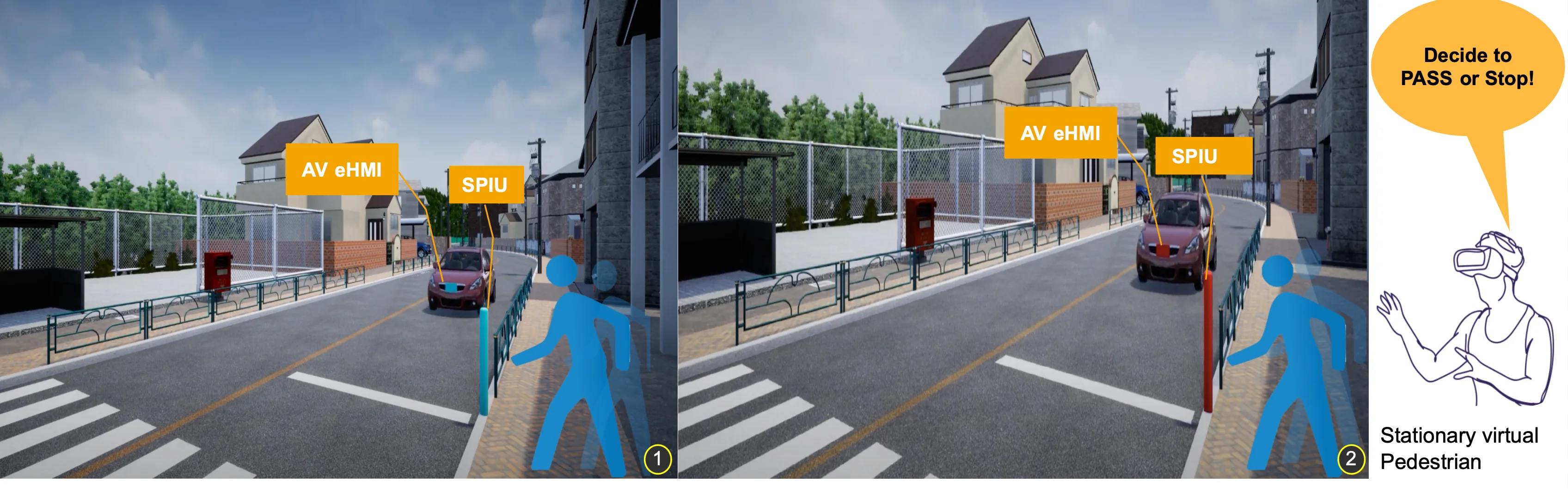
- A virtual reality crossing study compares pedestrian decisions with and without smart-pole cues.
- The pole supported quicker stop-or-go decisions and reduced cognitive load in the tested settings.
Figures from the paper
Abstract
Recently, there has been a growing emphasis on autonomous vehicles (AVs), and as they coexist with pedestrians, ensuring pedestrian safety at crosswalks has become paramount. While AVs exhibit commendable performance on traditional roads with established traffic infrastructure, their interaction in different environments, such as shared spaces lacking traffic lights or sign rules (also known as naked streets), can present significant challenges, including right-of-way and accessibility concerns. To address these challenges, this study proposes a novel approach to enhance pedestrian safety in shared spaces, focusing on the proposed smart pole interaction unit (SPIU) combined with an external human-machine interface (eHMI). By evaluating the proposal of SPIU developed by a virtual reality system, we explore its usability and effectiveness in facilitating vehicle-to-pedestrian (V2P) interactions at crosswalks. Our findings from this study showed that SPIU facilitates safe, quicker decision-making to stop and pass at crosswalks in shared space and reduces cognitive load compared to scenarios where an SPIU is absent for pedestrians and reduce the need for eHMI to see on multiple AVs. The SPIU addition with the eHMI in vehicles yields a noteworthy 21 % improvement in response time, enhancing efficiency during pedestrian stops. In both scenarios, whether with a single AV (1-way) or multiple AVs (2-way), SPIU has a positive impact on interaction dynamics and statistically demonstrates a significant improvement (p = 0.001).
Related research and software
How to cite
V. Chauhan, C.-M. Chang, E. Javanmardi, J. Nakazato, K. Toda, P. Lin, T. Igarashi, and M. Tsukada, “Keep Calm and Cross: Smart Pole Interaction Unit for Easing Pedestrian Cognitive Load,” in 9th IEEE World Forum on Internet of Things (WF-IoT 2023), Aveiro, Portugal, 2023, doi: 10.1109/WF-IoT58464.2023.10539511.
BibTeX
@inproceedings{Chauhan2023,
  title         = {Keep Calm and Cross: Smart Pole Interaction Unit for Easing Pedestrian Cognitive Load},
  author        = {Vishal Chauhan and Chia-Ming Chang and Ehsan Javanmardi and Jin Nakazato and Koki Toda and Pengfei Lin and Takeo Igarashi and Manabu Tsukada},
  url           = {https://www.researchgate.net/profile/Jin-Nakazato/publication/374582122_Keep_Calm_and_Cross_Smart_Pole_Interaction_Unit_for_Easing_Pedestrian_Cognitive_Load/links/6525681eb32c91681fb2e1b5/Keep-Calm-and-Cross-Smart-Pole-Interaction-Unit-for-Easing-Pedestrian-Cognitive-Load.pdf},
  doi           = {10.1109/WF-IoT58464.2023.10539511},
  year          = {2023},
  date          = {2023-10-12},
  urldate       = {2023-10-12},
  booktitle     = {9th IEEE World Forum on Internet of Things (WF-IoT 2023)},
  address       = {Aveiro, Portugal},
  abstract      = {Recently, there has been a growing emphasis on autonomous vehicles (AVs), and as they coexist with pedestrians, ensuring pedestrian safety at crosswalks has become paramount. While AVs exhibit commendable performance on traditional roads with established traffic infrastructure, their interaction in different environments, such as shared spaces lacking traffic lights or sign rules (also known as naked streets), can present significant challenges, including right-of-way and accessibility concerns. To address these challenges, this study proposes a novel approach to enhance pedestrian safety in shared spaces, focusing on the proposed smart pole interaction unit (SPIU) combined with an external human-machine interface (eHMI). By evaluating the proposal of SPIU developed by a virtual reality system, we explore its usability and effectiveness in facilitating vehicle-to-pedestrian (V2P) interactions at crosswalks. Our findings from this study showed that SPIU facilitates safe, quicker decision-making to stop and pass at crosswalks in shared space and reduces cognitive load compared to scenarios where an SPIU is absent for pedestrians and reduce the need for eHMI to see on multiple AVs. The SPIU addition with the eHMI in vehicles yields a noteworthy 21 % improvement in response time, enhancing efficiency during pedestrian stops. In both scenarios, whether with a single AV (1-way) or multiple AVs (2-way), SPIU has a positive impact on interaction dynamics and statistically demonstrates a significant improvement (p = 0.001).},
  keywords      = {ITS},
  pubstate      = {published},
  tppubtype     = {inproceedings}
}