
Fostering Fuzzy Logic in Enhancing Pedestrian Safety: Harnessing Smart Pole Interaction Unit for Autonomous Vehicle-to-Pedestrian Communication and Decision Optimization
Electronics, vol. 12, no. 20, Oct 11, 2023
WebsiteDOI: 10.3390/electronics12204207
Summary in three lines
- A smart pole supplements vehicle displays to communicate with pedestrians in shared spaces.
- A virtual reality evaluation considers pedestrian decisions and uses fuzzy logic to discuss their ambiguity.
- The study reports a 21% response-time improvement when the pole and vehicle display were combined in a tested scenario.
Figures from the paper
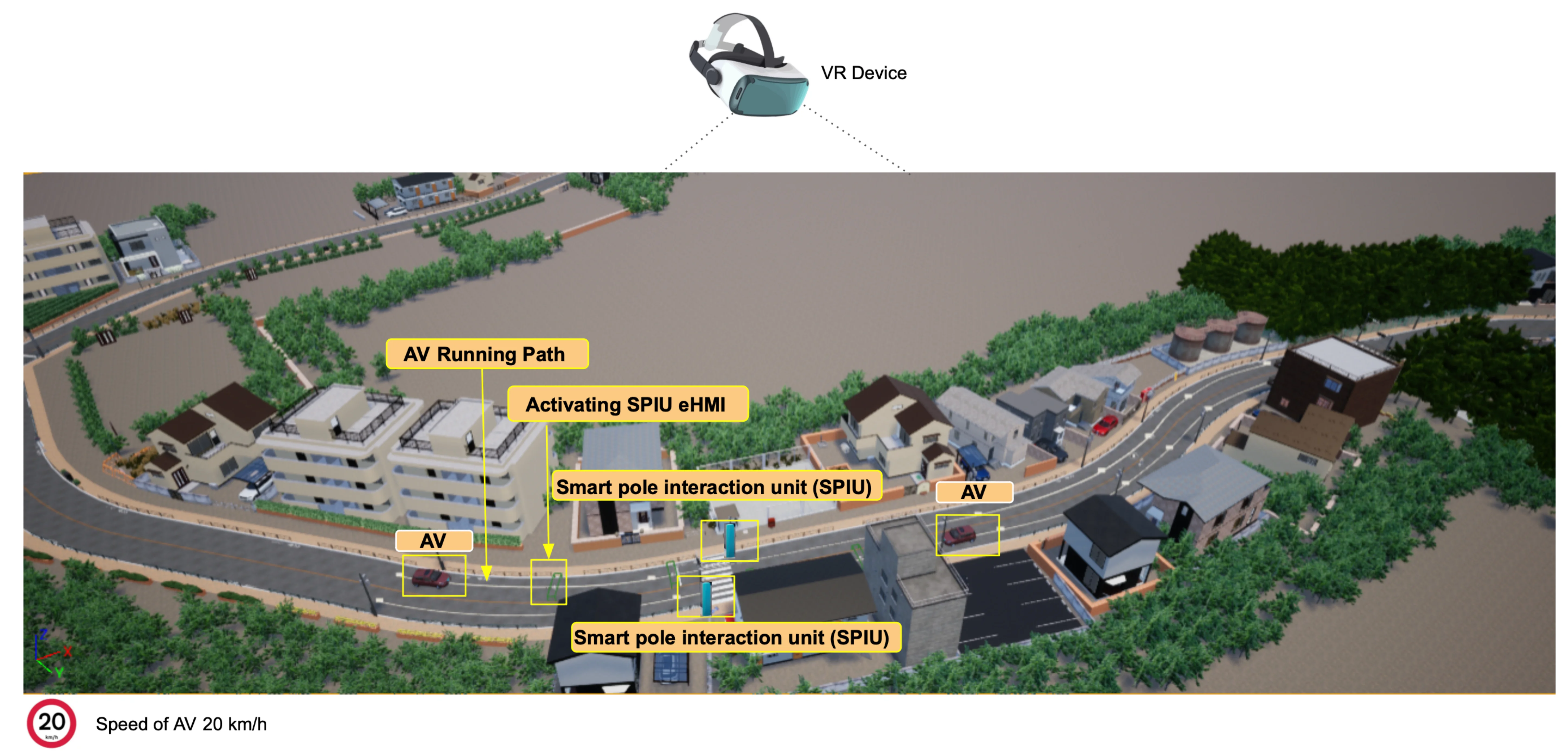
Abstract
In autonomous vehicles (AVs), ensuring pedestrian safety within intricate and dynamic settings, particularly at crosswalks, has gained substantial attention. While AVs perform admirably in standard road conditions, their integration into unique environments like shared spaces devoid of traditional traffic infrastructure control presents complex challenges. These challenges involve issues of right-of-way negotiation and accessibility, particularly in “naked streets”. This research delves into an innovative smart pole interaction unit (SPIU) with an external human–machine interface (eHMI). Utilizing virtual reality (VR) technology to evaluate the SPIU efficacy, this study investigates its capacity to enhance interactions between vehicles and pedestrians at crosswalks. The SPIU is designed to communicate the vehicles’ real-time intentions well before arriving at the crosswalk. The study findings demonstrate that the SPIU significantly improves secure decision making for pedestrian passing and stops in shared spaces. Integrating an SPIU with an eHMI in vehicles leads to a substantial 21% reduction in response time, greatly enhancing the efficiency of pedestrian stops. Notable enhancements are observed in unidirectional (one-way) and bidirectional (two-way) scenarios, highlighting the positive impact of the SPIU on interaction dynamics. This work contributes to AV–pedestrian interaction and underscores the potential of fuzzy-logic-driven solutions in addressing complex and ambiguous pedestrian behaviors.
Related research and software
How to cite
V. Chauhan, C.-M. Chang, E. Javanmardi, J. Nakazato, P. Lin, T. Igarashi, and M. Tsukada, “Fostering Fuzzy Logic in Enhancing Pedestrian Safety: Harnessing Smart Pole Interaction Unit for Autonomous Vehicle-to-Pedestrian Communication and Decision Optimization,” Electronics, vol. 12, no. 20, 2023, doi: 10.3390/electronics12204207.
BibTeX
@article{Chauhan2023c,
  title         = {Fostering Fuzzy Logic in Enhancing Pedestrian Safety: Harnessing Smart Pole Interaction Unit for Autonomous Vehicle-to-Pedestrian Communication and Decision Optimization},
  author        = {Vishal Chauhan and Chia-Ming Chang and Ehsan Javanmardi and Jin Nakazato and Pengfei Lin and Takeo Igarashi and Manabu Tsukada},
  url           = {https://www.mdpi.com/2079-9292/12/20/4207},
  doi           = {10.3390/electronics12204207},
  issn          = {2079-9292},
  year          = {2023},
  date          = {2023-10-11},
  urldate       = {2023-10-11},
  journal       = {Electronics},
  volume        = {12},
  number        = {20},
  abstract      = {In autonomous vehicles (AVs), ensuring pedestrian safety within intricate and dynamic settings, particularly at crosswalks, has gained substantial attention. While AVs perform admirably in standard road conditions, their integration into unique environments like shared spaces devoid of traditional traffic infrastructure control presents complex challenges. These challenges involve issues of right-of-way negotiation and accessibility, particularly in “naked streets”. This research delves into an innovative smart pole interaction unit (SPIU) with an external human–machine interface (eHMI). Utilizing virtual reality (VR) technology to evaluate the SPIU efficacy, this study investigates its capacity to enhance interactions between vehicles and pedestrians at crosswalks. The SPIU is designed to communicate the vehicles’ real-time intentions well before arriving at the crosswalk. The study findings demonstrate that the SPIU significantly improves secure decision making for pedestrian passing and stops in shared spaces. Integrating an SPIU with an eHMI in vehicles leads to a substantial 21% reduction in response time, greatly enhancing the efficiency of pedestrian stops. Notable enhancements are observed in unidirectional (one-way) and bidirectional (two-way) scenarios, highlighting the positive impact of the SPIU on interaction dynamics. This work contributes to AV–pedestrian interaction and underscores the potential of fuzzy-logic-driven solutions in addressing complex and ambiguous pedestrian behaviors.},
  keywords      = {ITS},
  pubstate      = {published},
  tppubtype     = {article}
}