
Transforming Pedestrian and Autonomous Vehicles Interactions in Shared Spaces: A Think-Tank Study on Exploring Human-Centric Designs
16th International ACM Conference on Automotive User Interfaces and Interactive Vehicular Applications (AutoUI 2024), Work in Progress (WiP), California, USA, pp. 1–8, Sep 22, 2024
Summary in three lines
- Twenty-five participants helped design interfaces for pedestrians and automated vehicles in shared spaces.
- The study considered simplicity, visibility, clarity, and effectiveness across vehicle displays and smart poles.
- Participants preferred real-time cues and favored smart poles when several vehicles approached.
Figures from the paper
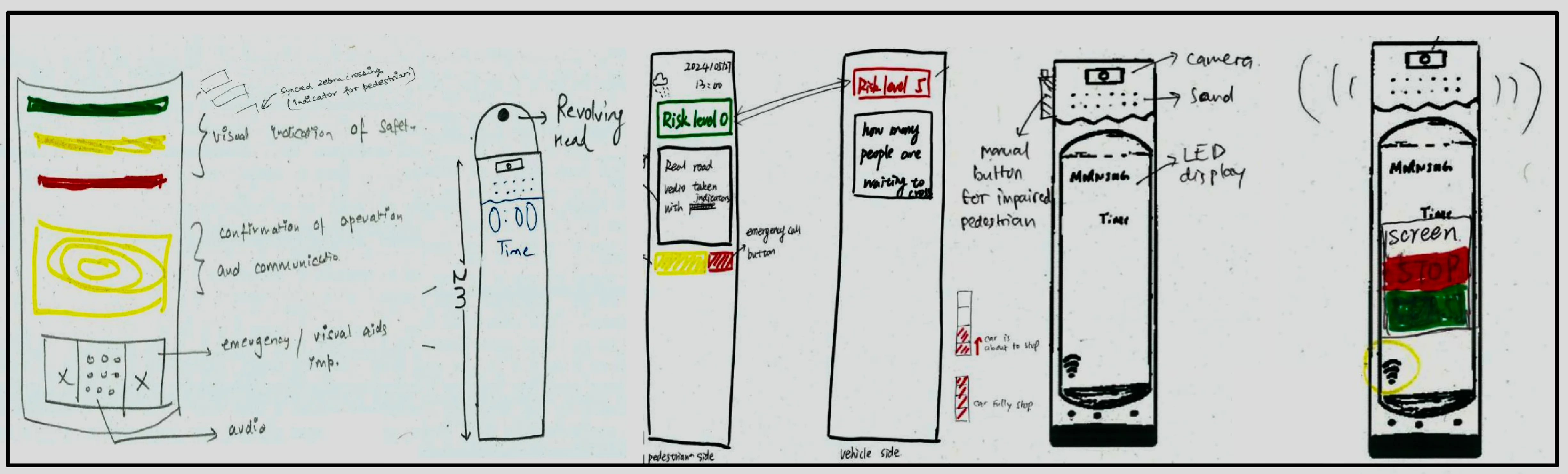
Abstract
Our research focuses on the smart pole interaction unit (SPIU) as an infrastructure external human-machine interface (HMI) to enhance pedestrian interaction with autonomous vehicles (AVs) in shared spaces. We extensively study SPIU with external human-machine interfaces (eHMI) on AVs as an integrated solution. To discuss interaction barriers and enhance pedestrian safety, we engaged 25 participants aged 18-40 to brainstorm design solutions for pedestrian-AV interactions, emphasising effectiveness, simplicity, visibility, and clarity. Findings indicate a preference for real-time SPIU interaction over eHMI on AVs in multiple AV scenarios. However, the combined use of SPIU and eHMI on AVs is crucial for building trust in decision-making. Consequently, we propose innovative design solutions for both SPIU and eHMI on AVs, discussing their pros and cons. This study lays the groundwork for future autonomous mobility solutions by developing human-centric eHMI and SPIU prototypes as ieHMI.
Related research and software
Related news
How to cite
V. Chauhan, A. Anubhav, C.-M. Chang, J. Nakazato, E. Javanmardi, A. Orsholits, T. Igarashi, K. Fujiwara, and M. Tsukada, “Transforming Pedestrian and Autonomous Vehicles Interactions in Shared Spaces: A Think-Tank Study on Exploring Human-Centric Designs,” in 16th International ACM Conference on Automotive User Interfaces and Interactive Vehicular Applications (AutoUI 2024), Work in Progress (WiP), California, USA, 2024, doi: 10.1145/3641308.3685037.
BibTeX
@inproceedings{Chauhan2024,
  title         = {Transforming Pedestrian and Autonomous Vehicles Interactions in Shared Spaces: A Think-Tank Study on Exploring Human-Centric Designs},
  author        = {Vishal Chauhan and Anubhav Anubhav and Chia-Ming Chang and Jin Nakazato and Ehsan Javanmardi and Alex Orsholits and Takeo Igarashi and Kantaro Fujiwara and Manabu Tsukada},
  doi           = {10.1145/3641308.3685037},
  year          = {2024},
  date          = {2024-09-22},
  urldate       = {2024-09-22},
  booktitle     = {16th International ACM Conference on Automotive User Interfaces and Interactive Vehicular Applications (AutoUI 2024), Work in Progress (WiP)},
  pages         = {1--8},
  address       = {California, USA},
  abstract      = {Our research focuses on the smart pole interaction unit (SPIU) as an infrastructure external human-machine interface (HMI) to enhance pedestrian interaction with autonomous vehicles (AVs) in shared spaces. We extensively study SPIU with external human-machine interfaces (eHMI) on AVs as an integrated solution. To discuss interaction barriers and enhance pedestrian safety, we engaged 25 participants aged 18-40 to brainstorm design solutions for pedestrian-AV interactions, emphasising effectiveness, simplicity, visibility, and clarity. Findings indicate a preference for real-time SPIU interaction over eHMI on AVs in multiple AV scenarios. However, the combined use of SPIU and eHMI on AVs is crucial for building trust in decision-making. Consequently, we propose innovative design solutions for both SPIU and eHMI on AVs, discussing their pros and cons. This study lays the groundwork for future autonomous mobility solutions by developing human-centric eHMI and SPIU prototypes as ieHMI.},
  keywords      = {ITS},
  pubstate      = {published},
  tppubtype     = {inproceedings}
}