
Connected Shared Spaces: Expert Insights into the Impact of eHMI and SPIU for Next-Generation Pedestrian-AV Communication
International Conference on Intelligent Computing and its Emerging Applications (ICEA 2024), Tokyo, Japan, pp. 16–20, Nov 28, 2024
Summary in three lines
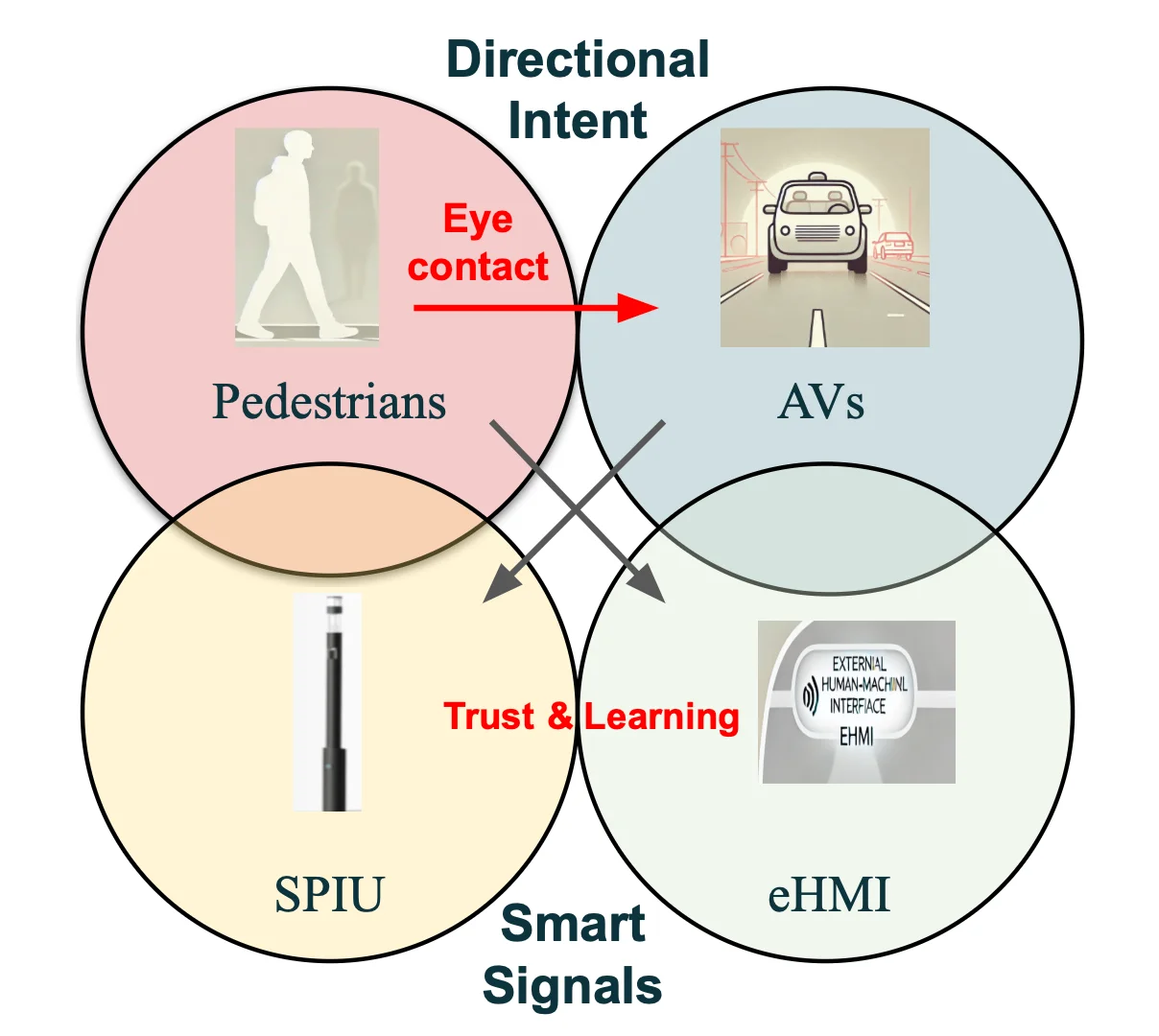
- Twelve automotive interface experts rated a vehicle display, a smart pole, and their combination on five criteria.
- The vehicle display scored well for seamlessness, while the pole scored well for safety, adaptability, accessibility, and trust.
- The combined interface received higher ratings overall, with the pole particularly useful around multiple vehicles.
Figures from the paper
Abstract
Increasing prevalence of Autonomous Vehicles (AVs) necessitates efficient communication with susceptible road users, especially pedestrians, in communal urban areas. To improve pedestrians’ trust and safety, Smart Pole Interaction Units (SPIU) and external Human-Machine Interfaces (eHMI) have become crucial interfaces. In this study, we ask 12 automotive UI design experts to evaluate eHMI, SPIU, and eHMI+SPIU through an online survey. They evaluated the interfaces’ effects on five key parameters: Safety, Seamless, Adaptability, Accessibility, and Trust. Our findings show that eHMI stands out for its smooth integration (Seamless), whereas SPIU is favoured for fostering Safety, Adaptability, Accessibility, and Trust. Furthermore, an integrated eHMI+SPIU solution is rated higher than individual eHMI and SPIU. In particular, when several AVs interact, the best way to promote pedestrian trust is to employ eHMI in conjunction with SPIU. This study highlights the benefits of SPIU as a centralised information hub for reliable pedestrian communication and presents innovative design considerations for eHMI on AVs in shared spaces. The results provide a framework for more practical testing of these systems to create safe, inclusive, and human-centric pedestrian-AV interactions in various urban environments beyond shared spaces.
Related research and software
How to cite
V. Chauhan, A. Anubhav, C.-M. Chang, J. Nakazato, E. Javanmardi, A. Orsholits, T. Igarashi, K. Fujiwara, and M. Tsukada, “Connected Shared Spaces: Expert Insights into the Impact of eHMI and SPIU for Next-Generation Pedestrian-AV Communication,” in International Conference on Intelligent Computing and its Emerging Applications (ICEA 2024), Tokyo, Japan, 2024, doi: 10.1145/3732437.3732752.
BibTeX
@inproceedings{Chauhan2024b,
  title         = {Connected Shared Spaces: Expert Insights into the Impact of eHMI and SPIU for Next-Generation Pedestrian-AV Communication},
  author        = {Vishal Chauhan and Anubhav Anubhav and Chia-Ming Chang and Jin Nakazato and Ehsan Javanmardi and Alex Orsholits and Takeo Igarashi and Kantaro Fujiwara and Manabu Tsukada},
  doi           = {10.1145/3732437.3732752},
  year          = {2024},
  date          = {2024-11-28},
  urldate       = {2024-11-28},
  booktitle     = {International Conference on Intelligent Computing and its Emerging Applications (ICEA 2024)},
  pages         = {16--20},
  address       = {Tokyo, Japan},
  abstract      = {Increasing prevalence of Autonomous Vehicles (AVs) necessitates efficient communication with susceptible road users, especially pedestrians, in communal urban areas. To improve pedestrians’ trust and safety, Smart Pole Interaction Units (SPIU) and external Human-Machine Interfaces (eHMI) have become crucial interfaces. In this study, we ask 12 automotive UI design experts to evaluate eHMI, SPIU, and eHMI+SPIU through an online survey. They evaluated the interfaces’ effects on five key parameters: Safety, Seamless, Adaptability, Accessibility, and Trust. Our findings show that eHMI stands out for its smooth integration (Seamless), whereas SPIU is favoured for fostering Safety, Adaptability, Accessibility, and Trust. Furthermore, an integrated eHMI+SPIU solution is rated higher than individual eHMI and SPIU. In particular, when several AVs interact, the best way to promote pedestrian trust is to employ eHMI in conjunction with SPIU. This study highlights the benefits of SPIU as a centralised information hub for reliable pedestrian communication and presents innovative design considerations for eHMI on AVs in shared spaces. The results provide a framework for more practical testing of these systems to create safe, inclusive, and human-centric pedestrian-AV interactions in various urban environments beyond shared spaces.},
  keywords      = {ITS},
  pubstate      = {published},
  tppubtype     = {inproceedings}
}