
Pedestrian-centric Augmented Reality Visualization of Real-time Autonomous Vehicle Intentions
Master Thesis, Graduate School of Information Science and Technology, The University of Tokyo, Mar 30, 2024
Summary in three lines
- The thesis builds an augmented reality application that displays intentions from an operating connected automated vehicle.
- It integrates live vehicle data with a pedestrian-facing AR interface.
- Field tests and user feedback examine information delivery and perceived safety.
Figures from the paper
Abstract
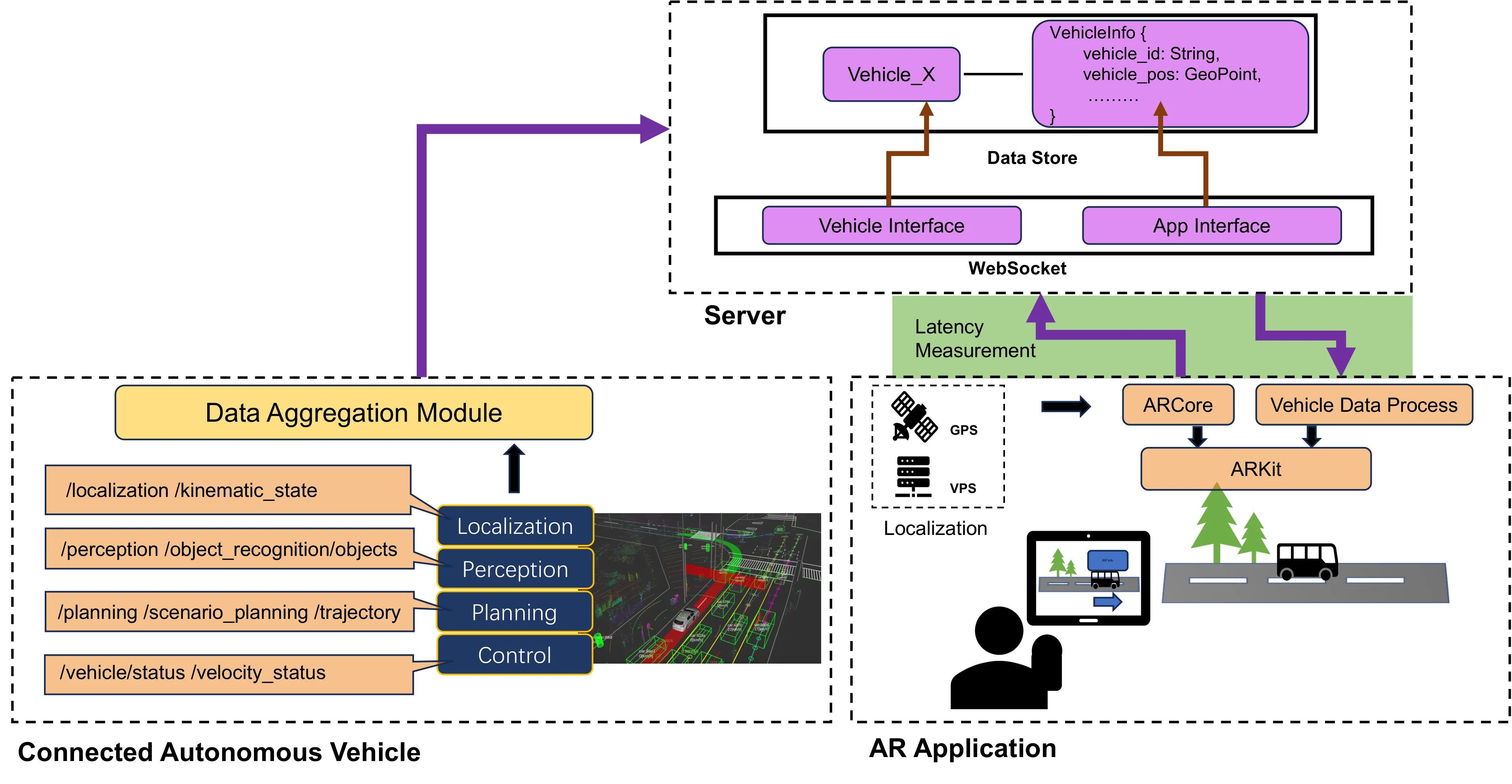
Connected Autonomous Vehicles (CAVs) produce a variety of information within their systems. With the advancement of communication and V2X (Vehicle-to-Everything) com- munication technology, there is a growing challenge to effectively convey this information to pedestrians and enhance their sense of safety when encountering such vehicles. Efforts to communicate this information to pedestrians have been made through various means, with Augmented Reality (AR) emerging as a notable approach. We found that previous studies have yet to integrate a functional AR application with a real-world autonomous driving system. In response to this gap, we proposed an AR application that visualizes real-time data from an active CAV and subsequently developed the system. Furthermore, we conducted field experiments using this developed system and conducted user studies to gather insights into the public’s perception of the system. Our results showed that the system can effectively transmit information from the CAV, and when provided with additional information, people tend to feel safer and confident regarding understanding the vehicle’s intentions.
How to cite
Y. Cheng, “Pedestrian-centric Augmented Reality Visualization of Real-time Autonomous Vehicle Intentions,” in Master Thesis, Graduate School of Information Science and Technology, The University of Tokyo, 2024.
BibTeX
@mastersthesis{Cheng2024,
  title         = {Pedestrian-centric Augmented Reality Visualization of Real-time Autonomous Vehicle Intentions},
  author        = {Yiwei Cheng},
  year          = {2024},
  date          = {2024-03-30},
  urldate       = {2024-03-31},
  school        = {Master Thesis, Graduate School of Information Science and Technology, The University of Tokyo},
  abstract      = {Connected Autonomous Vehicles (CAVs) produce a variety of information within their systems. With the advancement of communication and V2X (Vehicle-to-Everything) com- munication technology, there is a growing challenge to effectively convey this information to pedestrians and enhance their sense of safety when encountering such vehicles. Efforts to communicate this information to pedestrians have been made through various means, with Augmented Reality (AR) emerging as a notable approach. We found that previous studies have yet to integrate a functional AR application with a real-world autonomous driving system. In response to this gap, we proposed an AR application that visualizes real-time data from an active CAV and subsequently developed the system. Furthermore, we conducted field experiments using this developed system and conducted user studies to gather insights into the public’s perception of the system. Our results showed that the system can effectively transmit information from the CAV, and when provided with additional information, people tend to feel safer and confident regarding understanding the vehicle’s intentions.},
  keywords      = {ITS, Thesis},
  pubstate      = {published},
  tppubtype     = {mastersthesis}
}