
Web-Based BIM Platform for Building Digital Twin
3rd Annual IEEE International Conference on Digital Twins and Parallel Intelligence (DTPI 2023), Florida, USA, Nov 7, 2023
GitHub (code)DOI: 10.1109/DTPI59677.2023.10365476
Summary in three lines
- Building digital twins need tools for visualization and updates, particularly during operations and maintenance.
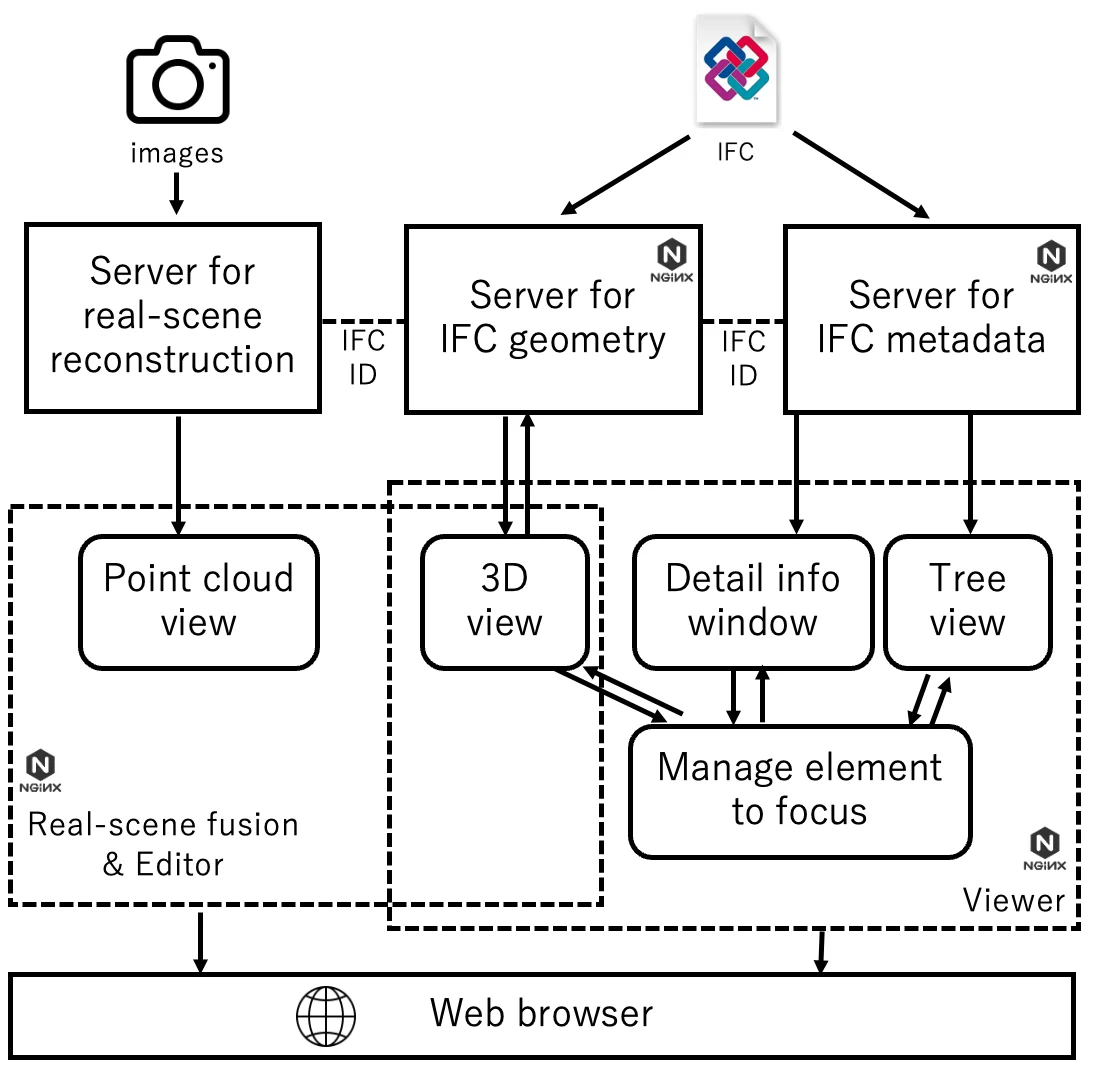
- The study implements a web platform that uses BIM geometry and semantics to represent a building.
- The prototype supports viewing, updating, and real-scene reconstruction.
Figures from the paper
Abstract
Building digital twin (BDT) is utilized throughout the lifecycle of a building. It serves for efficient operations during the design and construction phases, and during the operational and maintenance phases, it’s used for asset management and as field maps for robots. Building Information Modeling (BIM), which contains both semantics and geometry data of building elements, holds promise as a data source for BDT. We have extracted four key technical challenges of the digital twin, particularly vital during the operational and maintenance phases: software, visualization, update, and real-scene reconstruction. Due to the exclusive and static nature of BIM, these challenges also pose significant issues in the context of BDT. To address these challenges, we designed and implemented a Web-based BIM platform. The implemented application shows not only geometry data but also semantics data, enables easy overlay with the latest indoor conditions, and provides updating functionality. The developed system is essential for the continuous operation of BDT in dynamic indoor environments. We evaluated the application through a questionnaire survey.
Video
Code
Related research and software
How to cite
S. Furuta, J. Nakazato, and M. Tsukada, “Web-Based BIM Platform for Building Digital Twin,” in 3rd Annual IEEE International Conference on Digital Twins and Parallel Intelligence (DTPI 2023), Florida, USA, 2023, doi: 10.1109/DTPI59677.2023.10365476.
BibTeX
@inproceedings{Furuta2023,
  title         = {Web-Based BIM Platform for Building Digital Twin},
  author        = {Satoru Furuta and Jin Nakazato and Manabu Tsukada},
  url           = {https://github.com/gutp-bim/ifcdata-management-systems/tree/main/viewer https://youtu.be/mC_CXoSo2Mk},
  doi           = {10.1109/DTPI59677.2023.10365476},
  year          = {2023},
  date          = {2023-11-07},
  urldate       = {2023-11-07},
  booktitle     = {3rd Annual IEEE International Conference on Digital Twins and Parallel Intelligence (DTPI 2023)},
  address       = {Florida, USA},
  abstract      = {Building digital twin (BDT) is utilized throughout the lifecycle of a building. It serves for efficient operations during the design and construction phases, and during the operational and maintenance phases, it’s used for asset management and as field maps for robots. Building Information Modeling (BIM), which contains both semantics and geometry data of building elements, holds promise as a data source for BDT. We have extracted four key technical challenges of the digital twin, particularly vital during the operational and maintenance phases: software, visualization, update, and real-scene reconstruction. Due to the exclusive and static nature of BIM, these challenges also pose significant issues in the context of BDT. To address these challenges, we designed and implemented a Web-based BIM platform. The implemented application shows not only geometry data but also semantics data, enables easy overlay with the latest indoor conditions, and provides updating functionality. The developed system is essential for the continuous operation of BDT in dynamic indoor environments. We evaluated the application through a questionnaire survey.},
  keywords      = {SDM},
  pubstate      = {published},
  tppubtype     = {inproceedings}
}