
Reliable GPS-Free Vehicle Localization for V2X Systems: A Study across Blockage, High-Mobility, and Multi-User Conditions
Ph.D. Thesis, The University of Tokyo, Mar 31, 2026
Summary in three lines
- The dissertation studies GPS-free vehicle positioning and velocity estimation under changing V2X channel conditions.
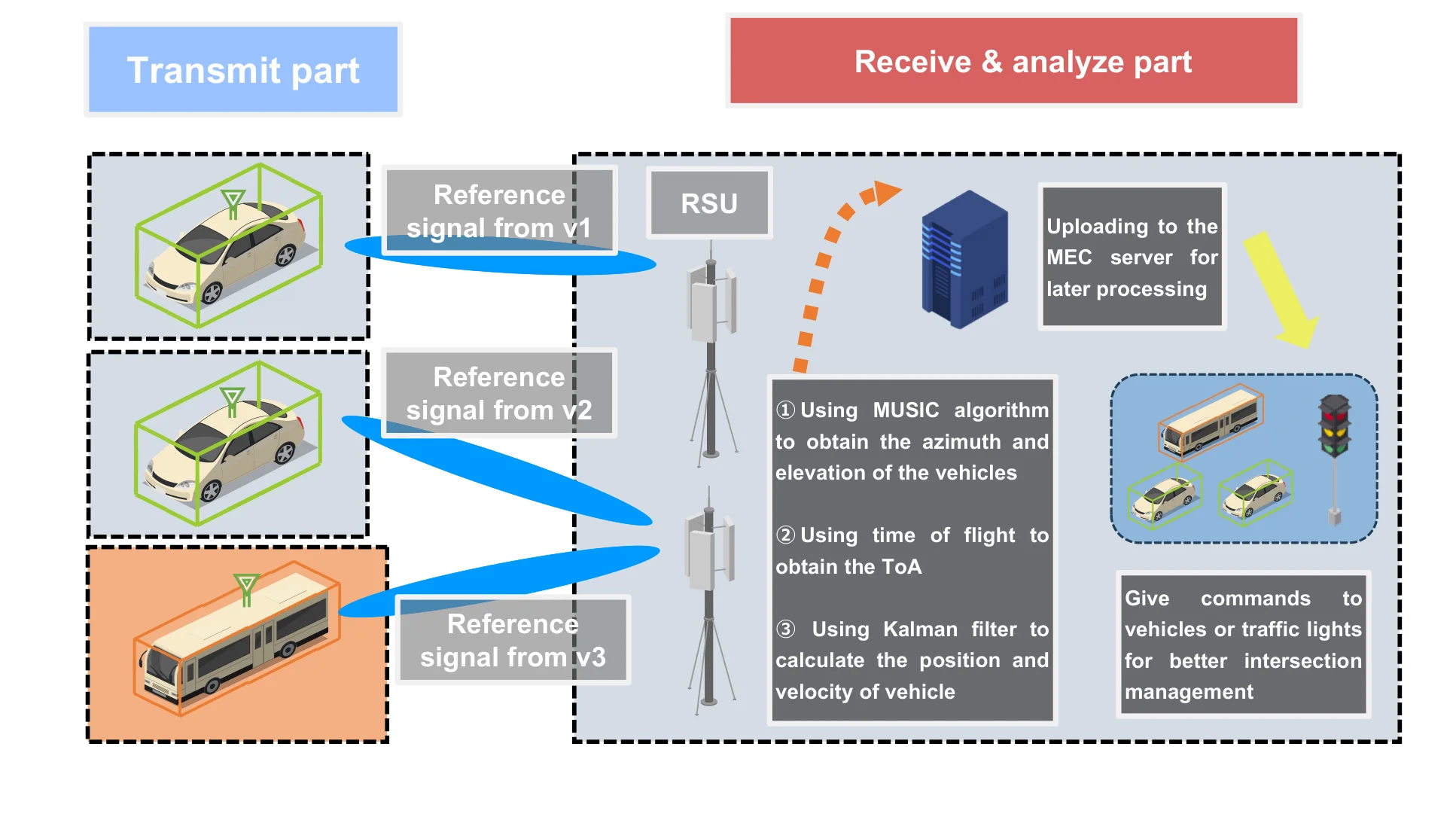
- It integrates antenna-array direction estimates with motion filtering and examines alternatives for blocked, high-mobility and multi-user conditions.
- The evaluation compares positioning performance across the propagation and mobility regimes addressed by the framework.
Figures from the paper
Abstract
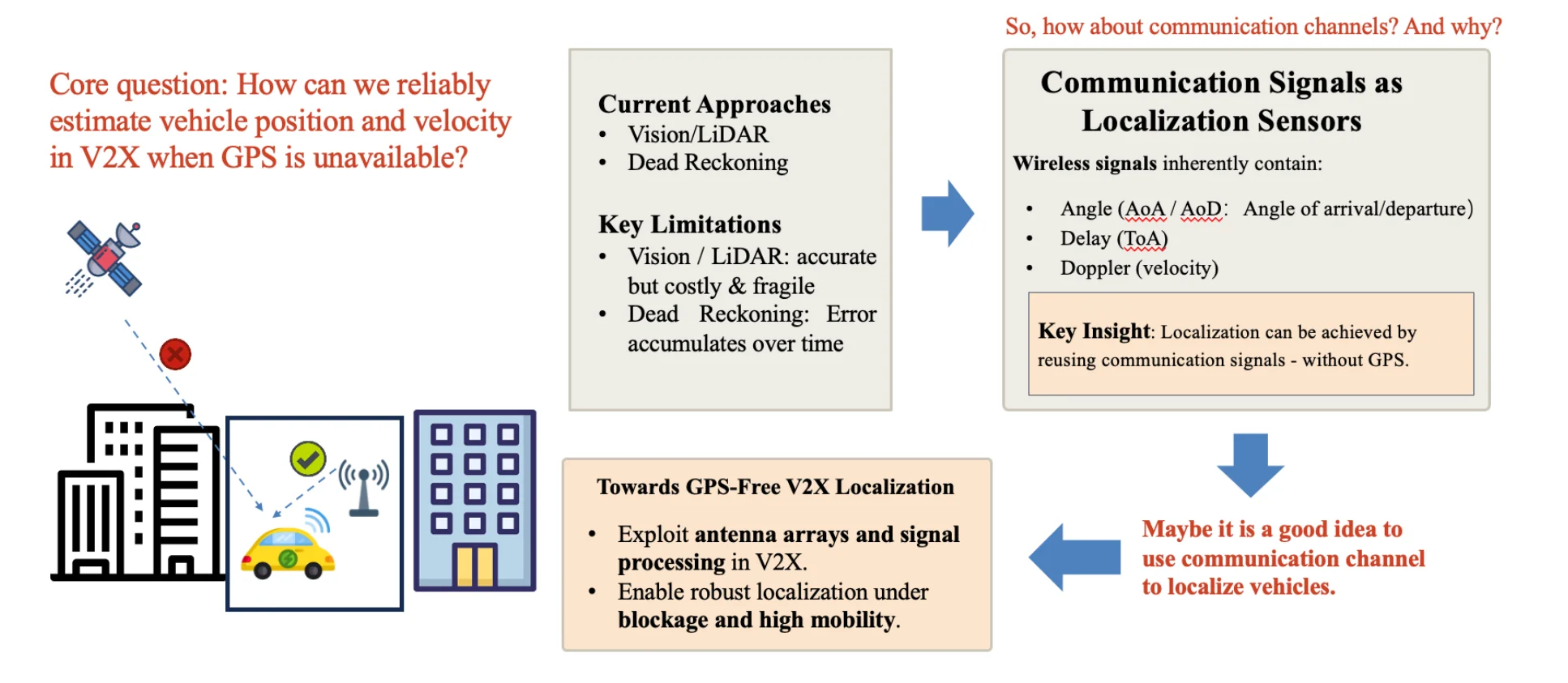
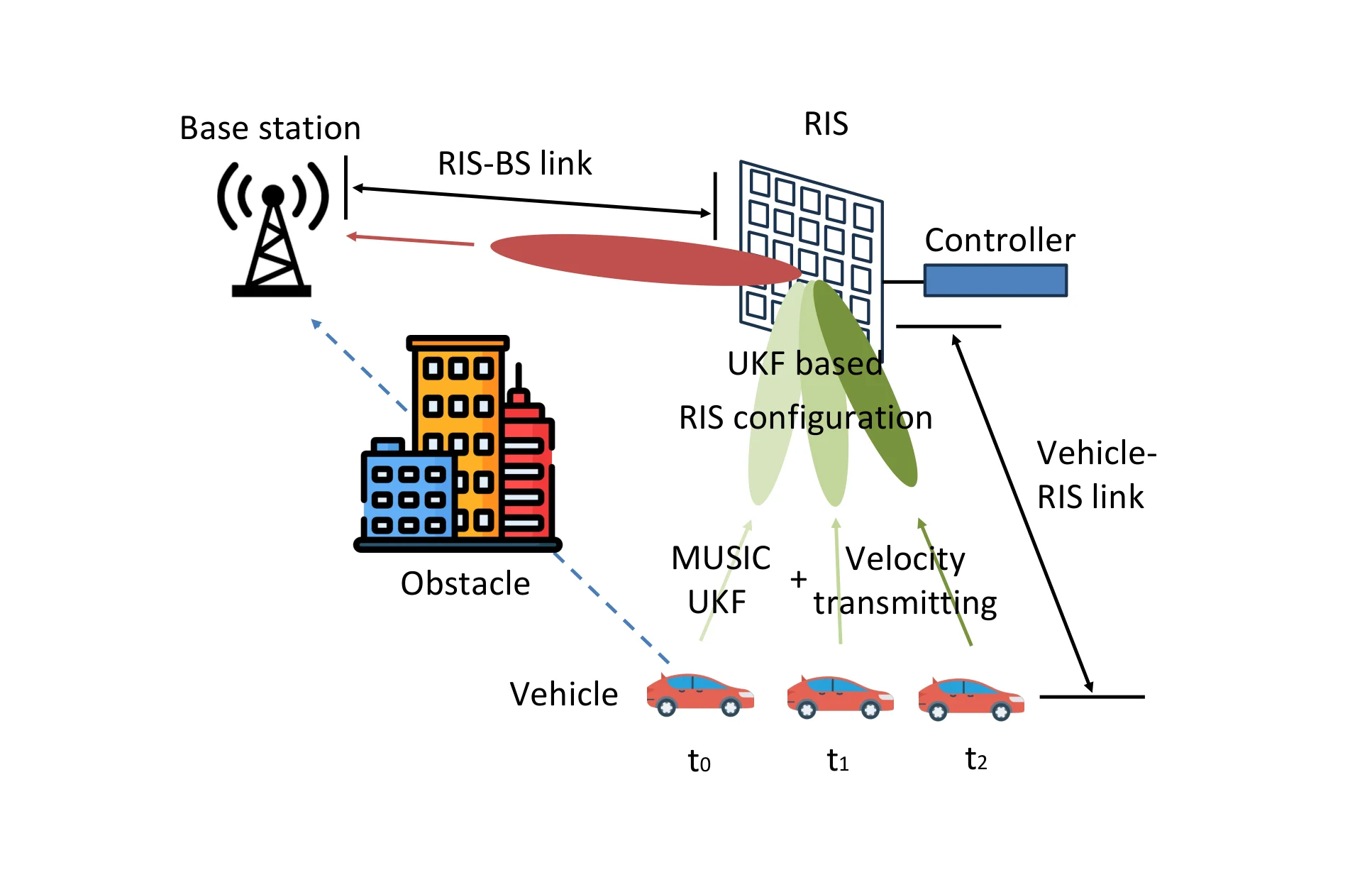
Accurate vehicle localization and velocity estimation is a fundamental requirement for intelligent transportation systems, autonomous mobility, and safety-critical V2X communication. However, achieving reliable positioning in realistic vehicular environments remains challenging, as signal propagation continuously transitions between line-of-sight (LoS) and non-line-of-sight (NLOS) conditions, while Doppler dynamics, fast mobility, and multipath fading disrupt classical localization strategies. To address these challenges, this dissertation presents a unified and channel-adaptive localization framework that maintains reliable positioning performance across heterogeneous V2X scenarios. For LoS environments, a low-complexity 2D MUSIC-based direction-of-arrival estimator is developed to extract azimuth and elevation information from mmWave antenna arrays. The estimated angles are fused with kinematic motion states using an Unscented Kalman Filter (UKF), enabling continuous trajectory estimation with high temporal stability and robustness against measurement noise. This module demonstrates centimeter-level accuracy while significantly reducing computational overhead compared with exhaustive spectral search-based approaches. When LoS paths disappear and angle-based localization becomes unreliable, the framework transitions to a sensing strategy built on Orthogonal Time-Frequency Space (OTFS) modulation. A reconfigurable intelligent surface (RIS) is incorporated to reconstruct controllable propagation paths and enhance channel observability in NLoS conditions. A structured delay-Doppler processing and velocity estimation method are further designed to ensure delay, Doppler, and channel coefficient resolvability under high mobility and sparse multipath conditions. The final stage extends the methodology to multi-user environments. An interference-aware iterative SIC-based page-style method is introduced to separate overlapping user signals. Furthermore, we also give the idea for adopting different MUSIC algorithms under different SNR between an adaptive FBSS and Root-MUSIC-enhanced estimator, the method dynamically selects processing modes based on interference level and snapshot quality. This enables scalable localization without sacrificing precision under dense vehicular access. Comprehensive simulations confirm the effectiveness of the proposed system under different mobility levels, SNR conditions, antenna geometries, waveform configurations, and user densities. Results demonstrate that the framework achieves sub-degree DoA estimation accuracy in LoS conditions, maintains reliable localization performance under severe NLoS environments with RIS assistance, and supports multi-user coexistence with predictable computational complexity. Overall, this dissertation presents a scalable, robust, and environment-adaptive localization framework that bridges classical array-signal processing, OTFS waveform design, and RIS-assisted channel engineering. The proposed methodology serves as a promising foundation for next-generation autonomous mobility, cooperative perception, and future V2X communication systems.
Related research and software
How to cite
D. Hu, “Reliable GPS-Free Vehicle Localization for V2X Systems: A Study across Blockage, High-Mobility, and Multi-User Conditions,” in Ph.D. Thesis, The University of Tokyo, 2026.
BibTeX
@phdthesis{Hu2025,
  title         = {Reliable GPS-Free Vehicle Localization for V2X Systems: A Study across Blockage, High-Mobility, and Multi-User Conditions},
  author        = {Dou Hu},
  year          = {2026},
  date          = {2026-03-31},
  urldate       = {2026-03-31},
  school        = {Ph.D. Thesis, The University of Tokyo},
  abstract      = {Accurate vehicle localization and velocity estimation is a fundamental requirement for intelligent transportation systems, autonomous mobility, and safety-critical V2X communication. However, achieving reliable positioning in realistic vehicular environments remains challenging, as signal propagation continuously transitions between line-of-sight (LoS) and non-line-of-sight (NLOS) conditions, while Doppler dynamics, fast mobility, and multipath fading disrupt classical localization strategies. To address these challenges, this dissertation presents a unified and channel-adaptive localization framework that maintains reliable positioning performance across heterogeneous V2X scenarios. For LoS environments, a low-complexity 2D MUSIC-based direction-of-arrival estimator is developed to extract azimuth and elevation information from mmWave antenna arrays. The estimated angles are fused with kinematic motion states using an Unscented Kalman Filter (UKF), enabling continuous trajectory estimation with high temporal stability and robustness against measurement noise. This module demonstrates centimeter-level accuracy while significantly reducing computational overhead compared with exhaustive spectral search-based approaches. When LoS paths disappear and angle-based localization becomes unreliable, the framework transitions to a sensing strategy built on Orthogonal Time-Frequency Space (OTFS) modulation. A reconfigurable intelligent surface (RIS) is incorporated to reconstruct controllable propagation paths and enhance channel observability in NLoS conditions. A structured delay-Doppler processing and velocity estimation method are further designed to ensure delay, Doppler, and channel coefficient resolvability under high mobility and sparse multipath conditions. The final stage extends the methodology to multi-user environments. An interference-aware iterative SIC-based page-style method is introduced to separate overlapping user signals. Furthermore, we also give the idea for adopting different MUSIC algorithms under different SNR between an adaptive FBSS and Root-MUSIC-enhanced estimator, the method dynamically selects processing modes based on interference level and snapshot quality. This enables scalable localization without sacrificing precision under dense vehicular access. Comprehensive simulations confirm the effectiveness of the proposed system under different mobility levels, SNR conditions, antenna geometries, waveform configurations, and user densities. Results demonstrate that the framework achieves sub-degree DoA estimation accuracy in LoS conditions, maintains reliable localization performance under severe NLoS environments with RIS assistance, and supports multi-user coexistence with predictable computational complexity. Overall, this dissertation presents a scalable, robust, and environment-adaptive localization framework that bridges classical array-signal processing, OTFS waveform design, and RIS-assisted channel engineering. The proposed methodology serves as a promising foundation for next-generation autonomous mobility, cooperative perception, and future V2X communication systems.},
  keywords      = {Thesis},
  pubstate      = {published},
  tppubtype     = {phdthesis}
}