
A Low PAPR Layered Multi-User OTFS Modulation
IEEE VTS Tokyo/Japan Chapter 2025 Young Researcher's Encouragement AwardWorkshop on AI-Driven Connectivity for Vehicular and Wireless Networks in VTC2025-Spring, Oslo, Norway, Jun 17, 2025
Summary in three lines
- This work proposes layered multi-user OTFS to support high-mobility communication with low peak-to-average power ratio.
- It designs pilot placement for channel estimation and studies how several users share the transmission resources.
- Simulations compare error rates, interference behavior and transmission performance with existing schemes.
Figures from the paper
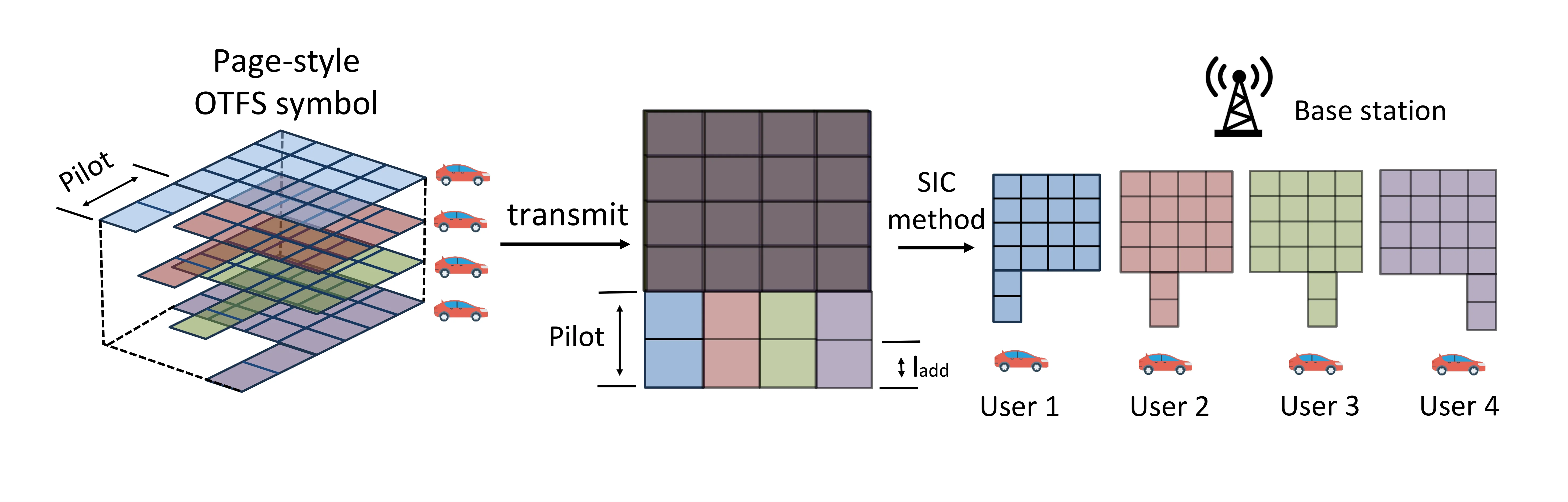
Abstract
In modern communication systems, meeting the growing demand for high-capacity transmission requires developing efficient and robust modulation techniques. To address this, we propose a low-PAPR page-style Orthogonal Time Frequency Space (OTFS) modulation framework that enhances communication capacity while maintaining a low peak-to-average power ratio (PAPR). The proposed design introduces a novel pilot signal placement and analysis method, improving channel estimation accuracy and system performance in high-mobility multi-user scenarios. This paper provides an overview of recent advancements in OTFS-based multi-user communication systems, emphasizing their contributions to enhancing spectral efficiency, reliability, and robustness. Through extensive simulations, we demonstrate the effectiveness of the proposed framework in achieving superior BER performance, improved interference mitigation, and robust transmission capabilities compared to traditional methods, validating its suitability for next-generation communication networks.
Related research and software
How to cite
D. Hu, J. Nakazato, K. Maruta, O. A. Aghda, R. Dinis, and M. Tsukada, “A Low PAPR Layered Multi-User OTFS Modulation,” in Workshop on AI-Driven Connectivity for Vehicular and Wireless Networks in VTC2025-Spring, Oslo, Norway, 2025.
BibTeX
@workshop{Hu2025OTFS,
  title         = {A Low PAPR Layered Multi-User OTFS Modulation},
  author        = {Dou Hu and Jin Nakazato and Kazuki Maruta and Omid Abbassi Aghda and Rui Dinis and Manabu Tsukada},
  year          = {2025},
  date          = {2025-06-17},
  urldate       = {2025-06-17},
  booktitle     = {Workshop on AI-Driven Connectivity for Vehicular and Wireless Networks in VTC2025-Spring},
  address       = {Oslo, Norway},
  abstract      = {In modern communication systems, meeting the growing demand for high-capacity transmission requires developing efficient and robust modulation techniques. To address this, we propose a low-PAPR page-style Orthogonal Time Frequency Space (OTFS) modulation framework that enhances communication capacity while maintaining a low peak-to-average power ratio (PAPR). The proposed design introduces a novel pilot signal placement and analysis method, improving channel estimation accuracy and system performance in high-mobility multi-user scenarios. This paper provides an overview of recent advancements in OTFS-based multi-user communication systems, emphasizing their contributions to enhancing spectral efficiency, reliability, and robustness. Through extensive simulations, we demonstrate the effectiveness of the proposed framework in achieving superior BER performance, improved interference mitigation, and robust transmission capabilities compared to traditional methods, validating its suitability for next-generation communication networks.},
  howpublished  = {Workshop on AI-Driven Connectivity for Vehicular and Wireless Networks in VTC2025-Spring},
  note          = {IEEE VTS Tokyo/Japan Chapter 2025 Young Researcher's Encouragement Award},
  keywords      = {Award, ITS},
  pubstate      = {published},
  tppubtype     = {workshop}
}