
Semantic Digital Twin for interoperability and comprehensive management of data assets
IEEE International Conference on Metaverse Computing, Networking, and Applications (MetaCom 2023), Kyoto, Japan, Jun 26, 2023
PDFDOI: 10.1109/MetaCom57706.2023.00049
Summary in three lines
- Physical, temporal, and structural differences make digital twin data hard to manage consistently.
- The study proposes two semantic metadata schemas to describe dynamic entities and data transformations.
- A viewer for an office-like test environment demonstrates the use of the proposed ontologies.
Figures from the paper
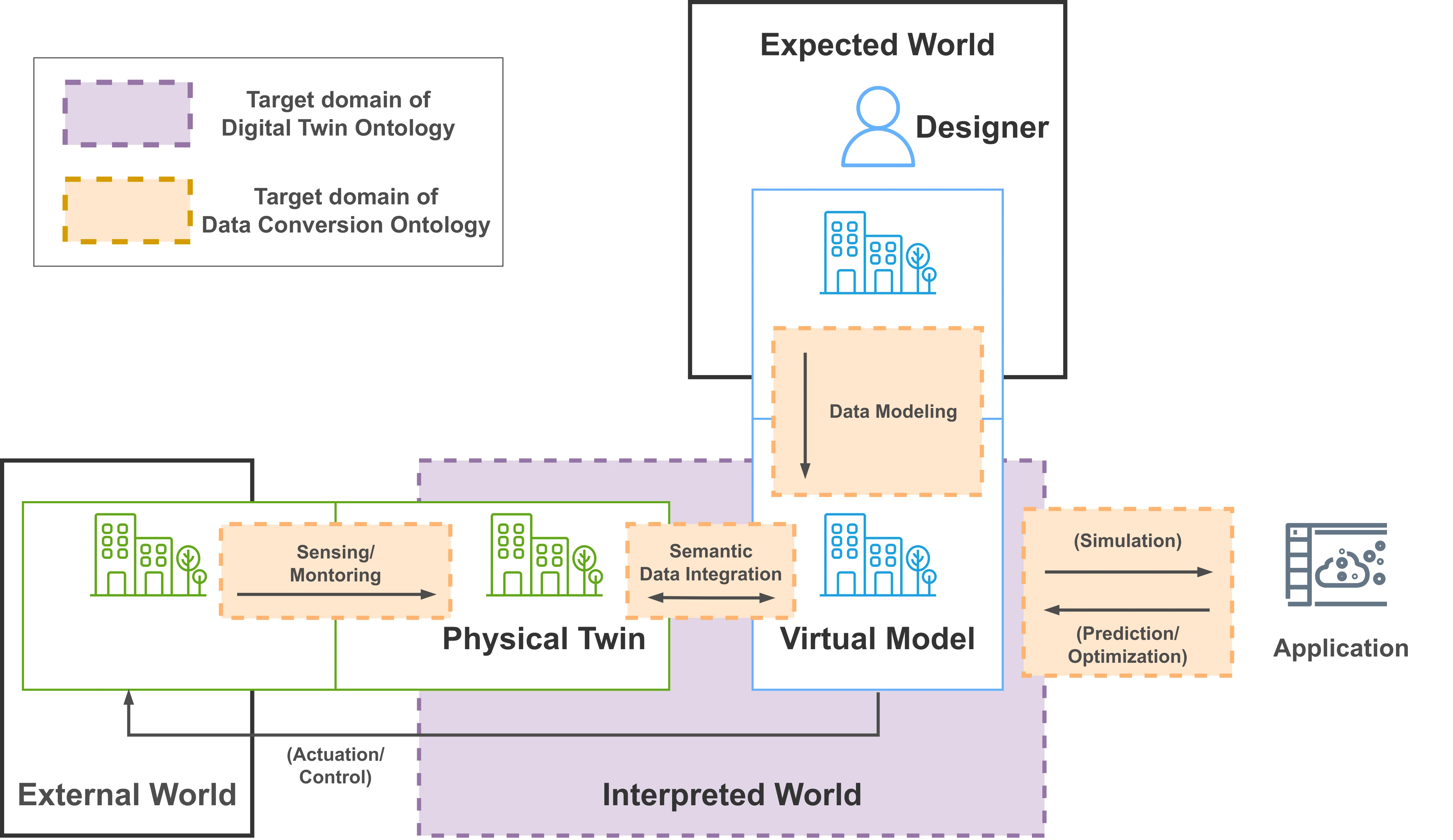
Abstract
Fusion of the real and virtual worlds is essential for applying digital technology to the infrastructure of human life. A digital twin is one of the technologies that aim to integrate real and virtual space. It creates a digital world with high fidelity to reality by accumulating exhaustive information from sensors to improve simulation and prediction accuracy. However, traditional digital twins have data asset management challenges owing to the physical, temporal, and structural heterogeneity of their objects. In this paper, we propose two metadata schemas that leverage semantics to construct a designer-oriented digital twin. Moreover, we implemented a viewer that reproduced the office-like demonstration field to verify the application of the proposed ontology. The proposed method enables a generic description of the dynamic behaviors of any entity by integrating physical twins faithful to the real world with virtual models expected by designers. We compared the proposed ontologies with existing techniques, conducted user evaluations, and discussed possible approaches for further enhancements for widespread use.
Video
Related research and software
Related news
How to cite
K. Inokuchi, J. Nakazato, M. Tsukada, and H. Esaki, “Semantic Digital Twin for interoperability and comprehensive management of data assets,” in IEEE International Conference on Metaverse Computing, Networking, and Applications (MetaCom 2023), Kyoto, Japan, 2023, doi: 10.1109/MetaCom57706.2023.00049.
BibTeX
@inproceedings{Inokuchi2023b,
  title         = {Semantic Digital Twin for interoperability and comprehensive management of data assets},
  author        = {Kazuma Inokuchi and Jin Nakazato and Manabu Tsukada and Hiroshi Esaki},
  url           = {https://www.researchgate.net/profile/Jin-Nakazato/publication/371903091_Semantic_digital_twin_for_interoperability_and_Comprehensive_Management_of_Data_Assets/links/649b13318de7ed28ba5ca665/Semantic-digital-twin-for-interoperability-and-Comprehensive-Management-of-Data-Assets.pdf},
  doi           = {10.1109/MetaCom57706.2023.00049},
  year          = {2023},
  date          = {2023-06-26},
  urldate       = {2023-06-26},
  booktitle     = {IEEE International Conference on Metaverse Computing, Networking, and Applications (MetaCom 2023)},
  address       = {Kyoto, Japan},
  abstract      = {Fusion of the real and virtual worlds is essential for applying digital technology to the infrastructure of human life. A digital twin is one of the technologies that aim to integrate real and virtual space. It creates a digital world with high fidelity to reality by accumulating exhaustive information from sensors to improve simulation and prediction accuracy. However, traditional digital twins have data asset management challenges owing to the physical, temporal, and structural heterogeneity of their objects. In this paper, we propose two metadata schemas that leverage semantics to construct a designer-oriented digital twin. Moreover, we implemented a viewer that reproduced the office-like demonstration field to verify the application of the proposed ontology. The proposed method enables a generic description of the dynamic behaviors of any entity by integrating physical twins faithful to the real world with virtual models expected by designers. We compared the proposed ontologies with existing techniques, conducted user evaluations, and discussed possible approaches for further enhancements for widespread use.},
  keywords      = {SDM},
  pubstate      = {published},
  tppubtype     = {inproceedings}
}