
CacheComm: A Motion-Aware Cache System for Cooperative Perception
IEEE 104th Vehicular Technology Conference (VTC2026-Fall), Boston, MA, USA, pp. 1–6, Sep 6, 2026
DOI: 10.1109/VTC2026-Fall68024.2026.11758235
Summary in three lines
- CacheComm uses a roadside feature cache to avoid retransmitting unchanged parts of a cooperative perception scene.
- Roadside camera observations identify moving cells that require fresh features.
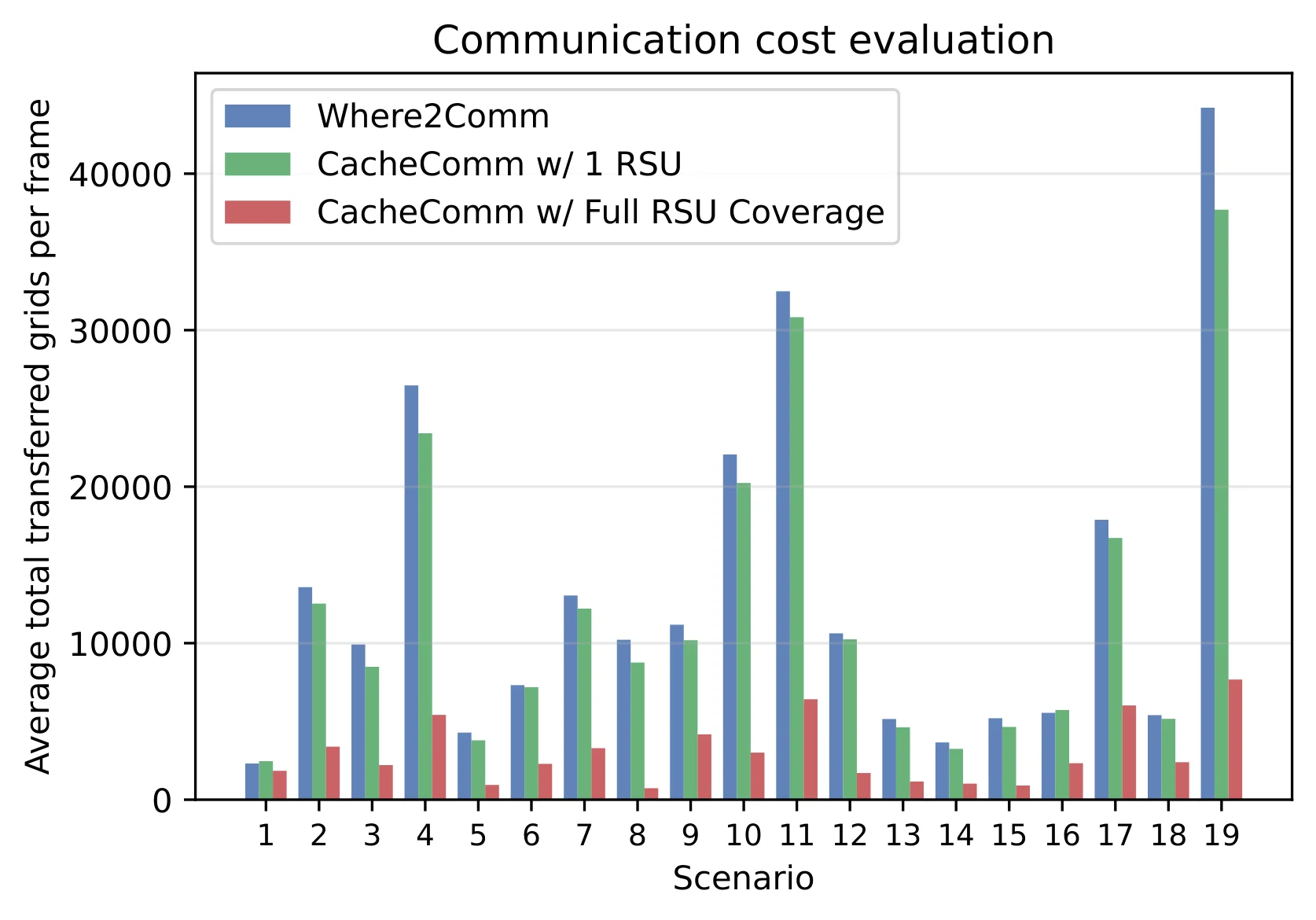
- On V2XSet, communication dropped by about 10% with limited coverage and about 77% with full coverage, with small detection losses.
Figures from the paper
Abstract
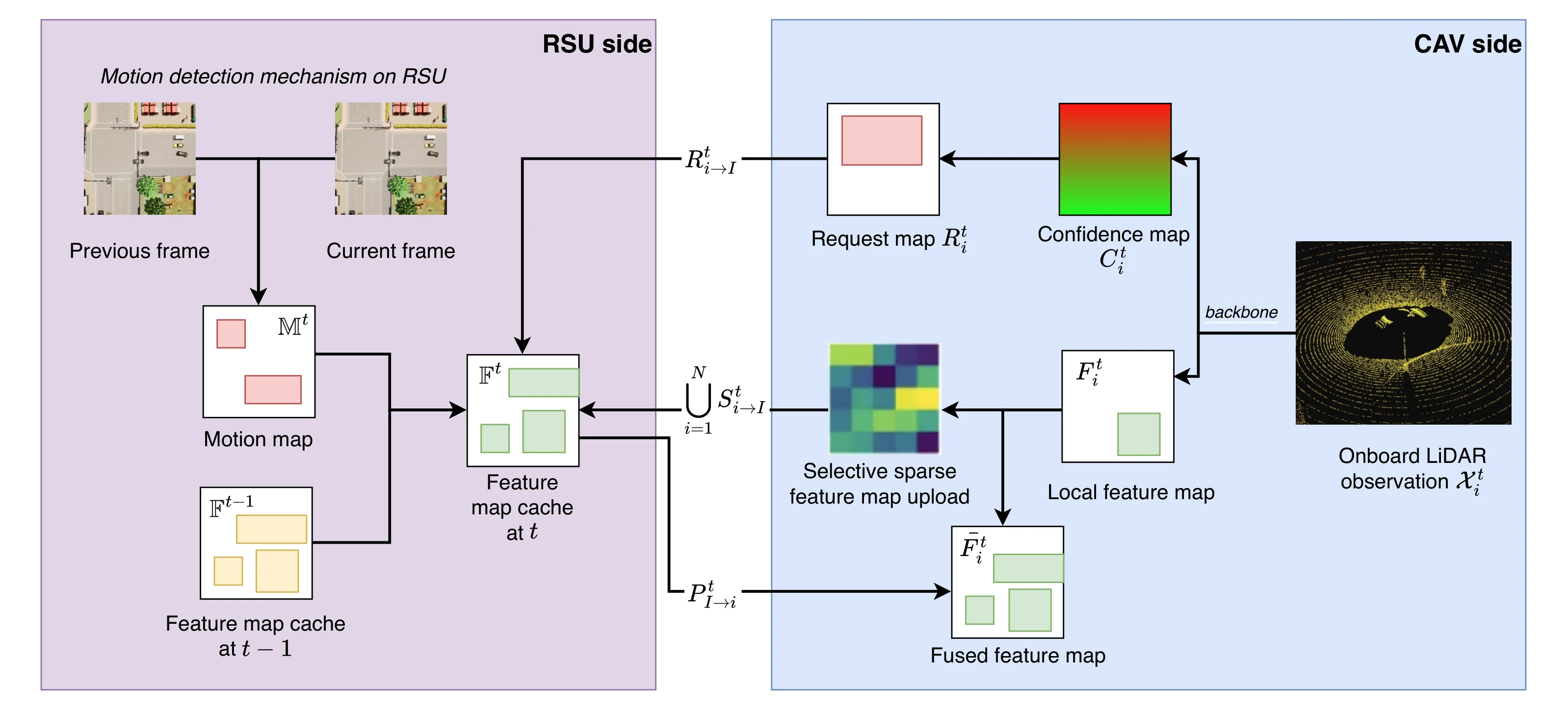
Cooperative perception enables connected and automated vehicles (CAVs) to overcome the inherent limitations of single-agent sensing by sharing perceptual information through vehicular communications. However, existing intermediate-fusion approaches treat each transmission cycle independently, re-transmitting features for the entire scene regardless of how much has actually changed, resulting in significant bandwidth waste. We propose CacheComm, a motion-aware caching framework that exploits temporal redundancy in cooperative perception by utilizing an RSU as an intermediate feature cache. The RSU maintains an up-to-date feature map of its coverage area and uses lightweight motion detection to identify scene changes. It selectively updates the cached feature map and serve the cache to CAVs based on the motion map to save communication resources. Experiments show that our system saves 10% V2X communication load under sparse CAV and limited RSU range, and up to 77% with full RSU coverage. Our method can be easily expanded to cover more area to achieve more reduction on communication cost. Saved bandwidth can be used to transmit more critical information or further increase the perception range for a CAV.
How to cite
Y. Jiang, E. Javanmardi, B. Qian, M. Tsukada, and H. Esaki, “CacheComm: A Motion-Aware Cache System for Cooperative Perception,” in IEEE 104th Vehicular Technology Conference (VTC2026-Fall), Boston, MA, USA, 2026, doi: 10.1109/VTC2026-Fall68024.2026.11758235.
BibTeX
@inproceedings{Jiang2026b,
  title         = {CacheComm: A Motion-Aware Cache System for Cooperative Perception},
  author        = {Yuze Jiang and Ehsan Javanmardi and Bo Qian and Manabu Tsukada and Hiroshi Esaki},
  doi           = {10.1109/VTC2026-Fall68024.2026.11758235},
  year          = {2026},
  date          = {2026-09-06},
  booktitle     = {IEEE 104th Vehicular Technology Conference (VTC2026-Fall)},
  pages         = {1--6},
  address       = {Boston, MA, USA},
  abstract      = {Cooperative perception enables connected and automated vehicles (CAVs) to overcome the inherent limitations of single-agent sensing by sharing perceptual information through vehicular communications. However, existing intermediate-fusion approaches treat each transmission cycle independently, re-transmitting features for the entire scene regardless of how much has actually changed, resulting in significant bandwidth waste. We propose CacheComm, a motion-aware caching framework that exploits temporal redundancy in cooperative perception by utilizing an RSU as an intermediate feature cache. The RSU maintains an up-to-date feature map of its coverage area and uses lightweight motion detection to identify scene changes. It selectively updates the cached feature map and serve the cache to CAVs based on the motion map to save communication resources. Experiments show that our system saves 10% V2X communication load under sparse CAV and limited RSU range, and up to 77% with full RSU coverage. Our method can be easily expanded to cover more area to achieve more reduction on communication cost. Saved bandwidth can be used to transmit more critical information or further increase the perception range for a CAV.},
  keywords      = {CRONOS, ITS},
  pubstate      = {published},
  tppubtype     = {inproceedings}
}