
Remote Proxy V2V Messaging using IPv6 and GeoNetworking
Sixth International Conference on Advances in Vehicular Systems, Technologies and Applications (VEHICULAR 2017), Nice, France, pp. 74–80, Jul 10, 2017
Summary in three lines
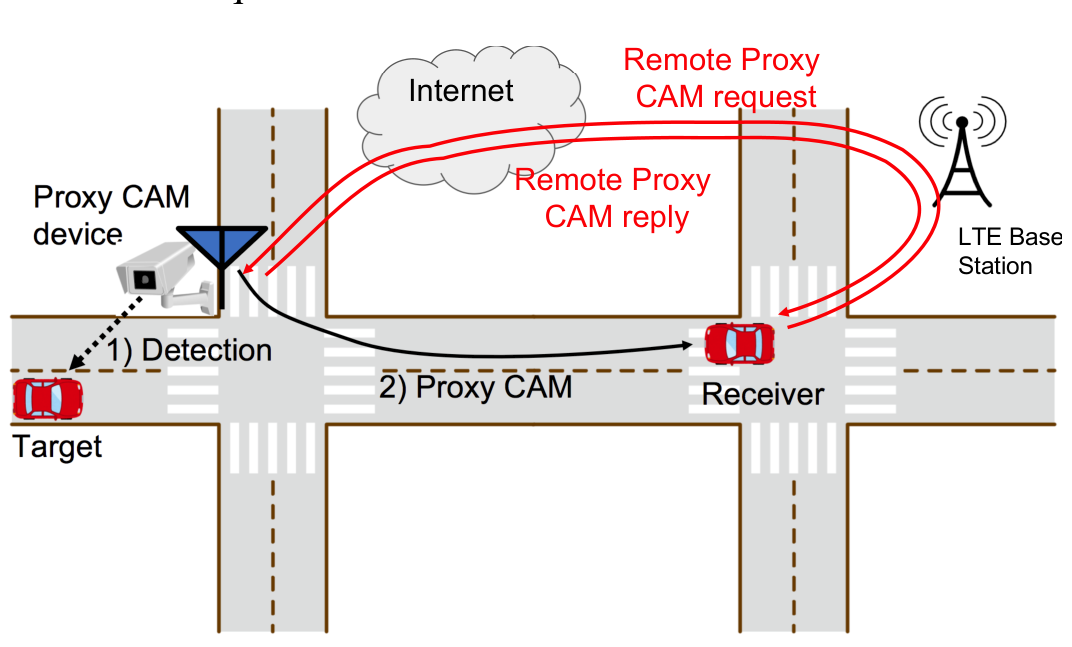
- Roadside sensors can generate Cooperative Awareness Messages (CAMs) on behalf of vehicles without transmitters, but direct delivery has limited range.
- The authors supplement IEEE 802.11p broadcasts by sending proxy CAMs over UDP/IPv6 and LTE.
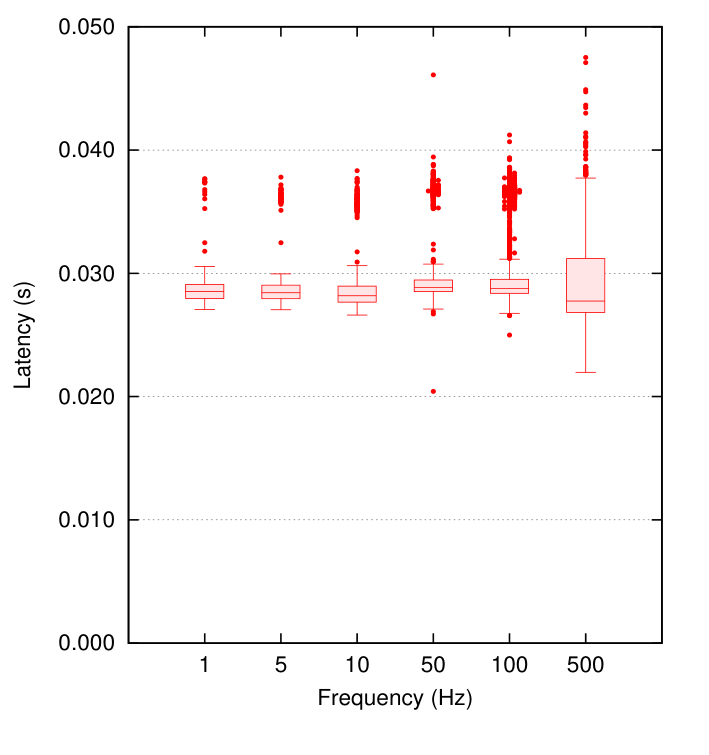
- Tests compared delivery ratio and update delay across distances and message rates, finding LTE more effective for long-distance updates.
Figures from the paper
How to cite
M. Kitazawa, M. Tsukada, K. Morino, H. Ochiai, and H. Esaki, “Remote Proxy V2V Messaging using IPv6 and GeoNetworking,” in Sixth International Conference on Advances in Vehicular Systems, Technologies and Applications (VEHICULAR 2017), Nice, France, 2017.
BibTeX
@inproceedings{Kitazawa2017,
  title         = {Remote Proxy V2V Messaging using IPv6 and GeoNetworking},
  author        = {Masahiro Kitazawa and Manabu Tsukada and Kai Morino and Hideya Ochiai and Hiroshi Esaki},
  url           = {https://hal.archives-ouvertes.fr/hal-01578410/document?.pdf},
  year          = {2017},
  date          = {2017-07-10},
  booktitle     = {Sixth International Conference on Advances in Vehicular Systems, Technologies and Applications (VEHICULAR 2017)},
  pages         = {74--80},
  address       = {Nice, France},
  keywords      = {ITS},
  pubstate      = {published},
  tppubtype     = {inproceedings}
}