
Time-To-Collision-Aware Lane-Change Strategy Based on Potential Field and Cubic Polynomial for Autonomous Vehicles
34th IEEE Intelligent Vehicles Symposium (IV 2023), Anchorage, Alaska, USA, Jun 4, 2023
arXivDOI: 10.1109/IV55152.2023.10186619
Summary in three lines
- A potential-field lane-change plan can leave a vehicle alongside an obstacle for too long.
- The proposed method adds a time-to-collision constraint to cubic-polynomial trajectory fitting.
- The authors compare the resulting paths in high-speed MATLAB/Simulink simulations.
Figures from the paper
Abstract
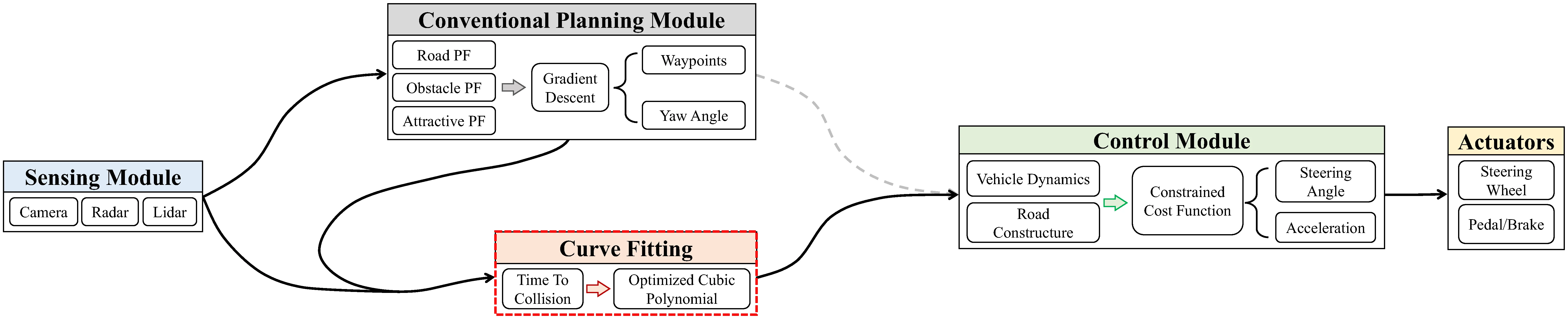
Making safe and successful lane changes (LCs) is one of the many vitally important functions of autonomous vehicles (AVs) that are needed to ensure safe driving on expressways. Recently, the simplicity and real-time performance of the potential field (PF) method have been leveraged to design decision and planning modules for AVs. However, the LC trajectory planned by the PF method is usually lengthy and takes the ego vehicle laterally parallel and close to the obstacle vehicle, which creates a dangerous situation if the obstacle vehicle suddenly steers. To mitigate this risk, we propose a time-to-collision-aware LC (TTCA-LC) strategy based on the PF and cubic polynomial in which the TTC constraint is imposed in the optimized curve fitting. The proposed approach is evaluated using MATLAB/Simulink under high-speed conditions in a comparative driving scenario. The simulation results indicate that the TTCA-LC method performs better than the conventional PF-based LC (CPF-LC) method in generating shorter, safer, and smoother trajectories. The length of the LC trajectory is shortened by over 27.1%, and the curvature is reduced by approximately 56.1% compared with the CPF-LC method.
Related news
How to cite
P. Lin, E. Javanmardi, Y. Tao, V. Chauhan, J. Nakazato, and M. Tsukada, “Time-To-Collision-Aware Lane-Change Strategy Based on Potential Field and Cubic Polynomial for Autonomous Vehicles,” in 34th IEEE Intelligent Vehicles Symposium (IV 2023), Anchorage, Alaska, USA, 2023, doi: 10.1109/IV55152.2023.10186619.
BibTeX
@inproceedings{Lin2023,
  title         = {Time-To-Collision-Aware Lane-Change Strategy Based on Potential Field and Cubic Polynomial for Autonomous Vehicles},
  author        = {Pengfei Lin and Ehsan Javanmardi and Ye Tao and Vishal Chauhan and Jin Nakazato and Manabu Tsukada},
  url           = {https://arxiv.org/abs/2306.06981},
  doi           = {10.1109/IV55152.2023.10186619},
  year          = {2023},
  date          = {2023-06-04},
  urldate       = {2023-06-04},
  booktitle     = {34th IEEE Intelligent Vehicles Symposium (IV 2023)},
  address       = {Anchorage, Alaska, USA},
  abstract      = {Making safe and successful lane changes (LCs) is one of the many vitally important functions of autonomous vehicles (AVs) that are needed to ensure safe driving on expressways. Recently, the simplicity and real-time performance of the potential field (PF) method have been leveraged to design decision and planning modules for AVs. However, the LC trajectory planned by the PF method is usually lengthy and takes the ego vehicle laterally parallel and close to the obstacle vehicle, which creates a dangerous situation if the obstacle vehicle suddenly steers. To mitigate this risk, we propose a time-to-collision-aware LC (TTCA-LC) strategy based on the PF and cubic polynomial in which the TTC constraint is imposed in the optimized curve fitting. The proposed approach is evaluated using MATLAB/Simulink under high-speed conditions in a comparative driving scenario. The simulation results indicate that the TTCA-LC method performs better than the conventional PF-based LC (CPF-LC) method in generating shorter, safer, and smoother trajectories. The length of the LC trajectory is shortened by over 27.1%, and the curvature is reduced by approximately 56.1% compared with the CPF-LC method.},
  keywords      = {ITS},
  pubstate      = {published},
  tppubtype     = {inproceedings}
}