
Occlusion-Aware Path Planning for Collision Avoidance: Leveraging Potential Field Method with Responsibility-Sensitive Safety
26th IEEE International Conference on Intelligent Transportation Systems (ITSC 2023), Bilbao, Bizkaia, Spain, Sep 24, 2023
arXivDOI: 10.1109/ITSC57777.2023.10422621
Summary in three lines
- A conventional potential-field planner can react abruptly when a previously hidden obstacle appears.
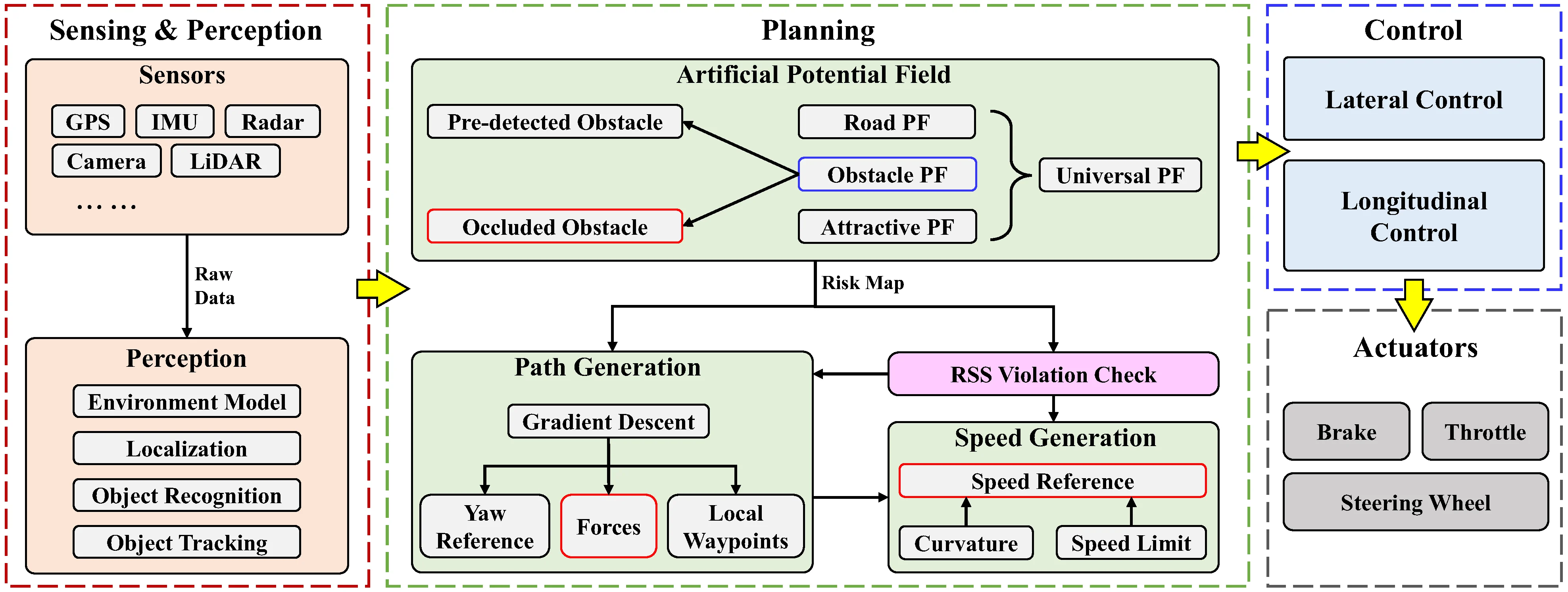
- The proposed method distinguishes occluded obstacles and uses Responsibility-Sensitive Safety to adapt the resulting field.
- MATLAB/Simulink comparisons show smoother paths without sudden lateral oscillations in the tested scenarios.
Figures from the paper
Abstract
Collision avoidance (CA) has always been the foremost task for autonomous vehicles (AVs) under safety criteria. And path planning is directly responsible for generating a safe path to accomplish CA while satisfying other commands. Due to the real-time computation and simple structure, the potential field (PF) has emerged as one of the mainstream path-planning algorithms. However, the current PF is primarily simulated in ideal CA scenarios, assuming complete obstacle information while disregarding occlusion issues where obstacles can be partially or entirely hidden from the AV's sensors. During the occlusion period, the occluded obstacles do not possess a PF. Once the occlusion is over, these obstacles can generate an instantaneous virtual force that impacts the ego vehicle. Therefore, we propose an occlusion-aware path planning (OAPP) with the responsibility-sensitive safety (RSS)-based PF to tackle the occlusion problem for non-connected AVs. We first categorize the detected and occluded obstacles, and then we proceed to the RSS violation check. Finally, we can generate different virtual forces from the PF for occluded and non-occluded obstacles. We compare the proposed OAPP method with other PF-based path planning methods via MATLAB/Simulink. The simulation results indicate that the proposed method can eliminate instantaneous lateral oscillation or sway and produce a smoother path than conventional PF methods.
Related news
How to cite
P. Lin, E. Javanmardi, J. Nakazato, and M. Tsukada, “Occlusion-Aware Path Planning for Collision Avoidance: Leveraging Potential Field Method with Responsibility-Sensitive Safety,” in 26th IEEE International Conference on Intelligent Transportation Systems (ITSC 2023), Bilbao, Bizkaia, Spain, 2023, doi: 10.1109/ITSC57777.2023.10422621.
BibTeX
@inproceedings{Lin2023b,
  title         = {Occlusion-Aware Path Planning for Collision Avoidance: Leveraging Potential Field Method with Responsibility-Sensitive Safety},
  author        = {Pengfei Lin and Ehsan Javanmardi and Jin Nakazato and Manabu Tsukada},
  url           = {https://arxiv.org/abs/2306.06993},
  doi           = {10.1109/ITSC57777.2023.10422621},
  year          = {2023},
  date          = {2023-09-24},
  urldate       = {2023-09-24},
  booktitle     = {26th IEEE International Conference on Intelligent Transportation Systems (ITSC 2023)},
  address       = {Bilbao, Bizkaia, Spain},
  abstract      = {Collision avoidance (CA) has always been the foremost task for autonomous vehicles (AVs) under safety criteria. And path planning is directly responsible for generating a safe path to accomplish CA while satisfying other commands. Due to the real-time computation and simple structure, the potential field (PF) has emerged as one of the mainstream path-planning algorithms. However, the current PF is primarily simulated in ideal CA scenarios, assuming complete obstacle information while disregarding occlusion issues where obstacles can be partially or entirely hidden from the AV's sensors. During the occlusion period, the occluded obstacles do not possess a PF. Once the occlusion is over, these obstacles can generate an instantaneous virtual force that impacts the ego vehicle. Therefore, we propose an occlusion-aware path planning (OAPP) with the responsibility-sensitive safety (RSS)-based PF to tackle the occlusion problem for non-connected AVs. We first categorize the detected and occluded obstacles, and then we proceed to the RSS violation check. Finally, we can generate different virtual forces from the PF for occluded and non-occluded obstacles. We compare the proposed OAPP method with other PF-based path planning methods via MATLAB/Simulink. The simulation results indicate that the proposed method can eliminate instantaneous lateral oscillation or sway and produce a smoother path than conventional PF methods.},
  keywords      = {ITS},
  pubstate      = {published},
  tppubtype     = {inproceedings}
}