
Potential Field-based Path Planning with Interactive Speed Optimization for Autonomous Vehicles
49th Annual Conference of the IEEE Industrial Electronics Society (IECON 2023), Oct 16, 2023
arXivDOI: 10.1109/IECON51785.2023.10311890
Summary in three lines
- Conventional potential-field planners simplify how surrounding vehicles react to the ego vehicle.
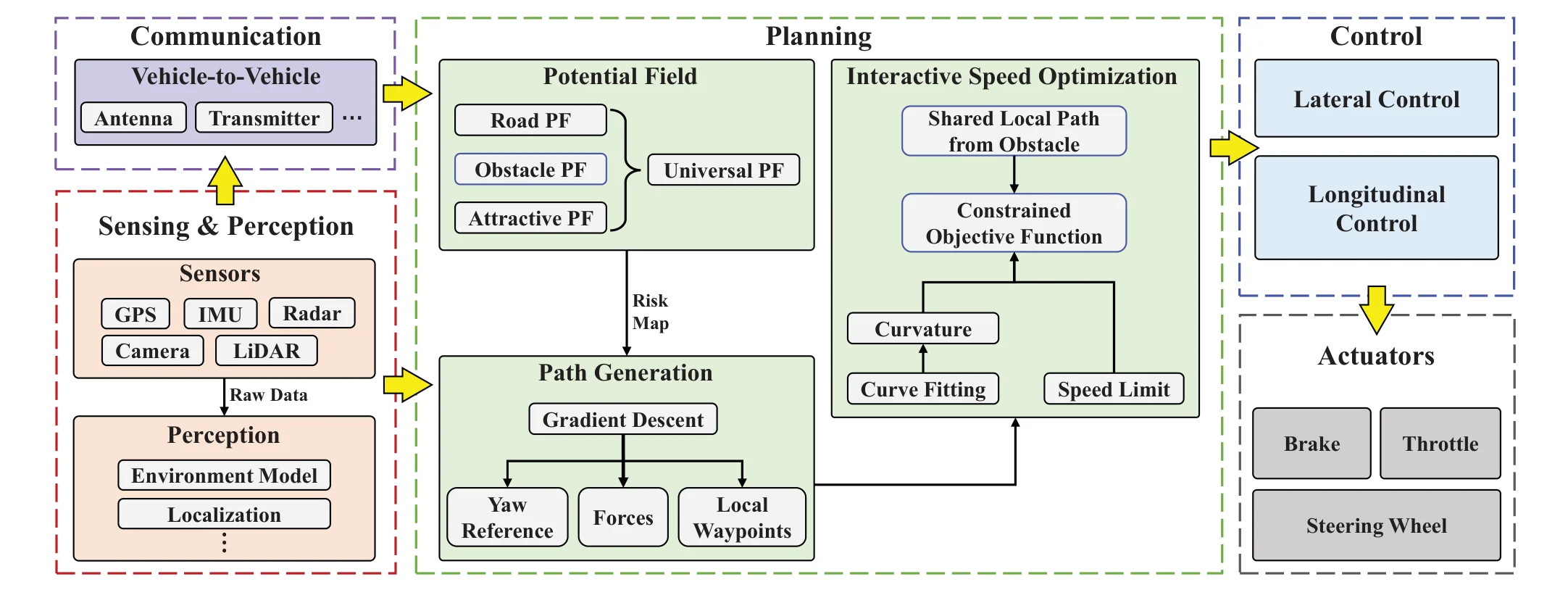
- The proposed method shares local paths over V2V and optimizes both vehicles’ speeds with their interaction in mind.
- In urgent merging simulations it reduced oscillation and avoided collision by slowing in advance.
Figures from the paper
Abstract
Path planning is critical for autonomous vehicles (AVs) to determine the optimal route while considering constraints and objectives. The potential field (PF) approach has become prevalent in path planning due to its simple structure and computational efficiency. However, current PF methods used in AVs focus solely on the path generation of the ego vehicle while assuming that the surrounding obstacle vehicles drive at a preset behavior without the PF-based path planner, which ignores the fact that the ego vehicle’s PF could also impact the path generation of the obstacle vehicles. To tackle this problem, we propose a PF-based path planning approach where local paths are shared among ego and obstacle vehicles via vehicle-to- vehicle (V2V) communication. Then by integrating this shared local path into an objective function, a new optimization function called interactive speed optimization (ISO) is designed to allow driving safety and comfort for both ego and obstacle vehicles. The proposed method is evaluated using MATLAB/Simulink in the urgent merging scenarios by comparing it with conventional methods. The simulation results indicate that the proposed method can mitigate the impact of other AVs’ PFs by slowing down in advance, effectively reducing the oscillations for both ego and obstacle AVs.
How to cite
P. Lin, E. Javanmardi, J. Nakazato, and M. Tsukada, “Potential Field-based Path Planning with Interactive Speed Optimization for Autonomous Vehicles,” in 49th Annual Conference of the IEEE Industrial Electronics Society (IECON 2023), 2023, doi: 10.1109/IECON51785.2023.10311890.
BibTeX
@inproceedings{Lin2023c,
  title         = {Potential Field-based Path Planning with Interactive Speed Optimization for Autonomous Vehicles},
  author        = {Pengfei Lin and Ehsan Javanmardi and Jin Nakazato and Manabu Tsukada},
  url           = {https://arxiv.org/abs/2306.06987},
  doi           = {10.1109/IECON51785.2023.10311890},
  year          = {2023},
  date          = {2023-10-16},
  urldate       = {2023-10-16},
  booktitle     = {49th Annual Conference of the IEEE Industrial Electronics Society (IECON 2023)},
  abstract      = {Path planning is critical for autonomous vehicles (AVs) to determine the optimal route while considering constraints and objectives. The potential field (PF) approach has become prevalent in path planning due to its simple structure and computational efficiency. However, current PF methods used in AVs focus solely on the path generation of the ego vehicle while assuming that the surrounding obstacle vehicles drive at a preset behavior without the PF-based path planner, which ignores the fact that the ego vehicle’s PF could also impact the path generation of the obstacle vehicles. To tackle this problem, we propose a PF-based path planning approach where local paths are shared among ego and obstacle vehicles via vehicle-to- vehicle (V2V) communication. Then by integrating this shared local path into an objective function, a new optimization function called interactive speed optimization (ISO) is designed to allow driving safety and comfort for both ego and obstacle vehicles. The proposed method is evaluated using MATLAB/Simulink in the urgent merging scenarios by comparing it with conventional methods. The simulation results indicate that the proposed method can mitigate the impact of other AVs’ PFs by slowing down in advance, effectively reducing the oscillations for both ego and obstacle AVs.},
  keywords      = {ITS},
  pubstate      = {published},
  tppubtype     = {inproceedings}
}