
eRSS-RAMP: A Rule-Adherence Motion Planner Based on Extended Responsibility-Sensitive Safety for Emergency Driving
IEEE Transactions on Vehicular Technology, vol. 75, no. 6, pp. 8978–8992, 2026
arXivDOI: 10.1109/TVT.2025.3637773
Summary in three lines
- eRSS-RAMP extends Responsibility-Sensitive Safety to incorporate constraints in emergency driving scenarios.
- The motion planner combines extended safety rules with sigmoid-based trajectory generation.
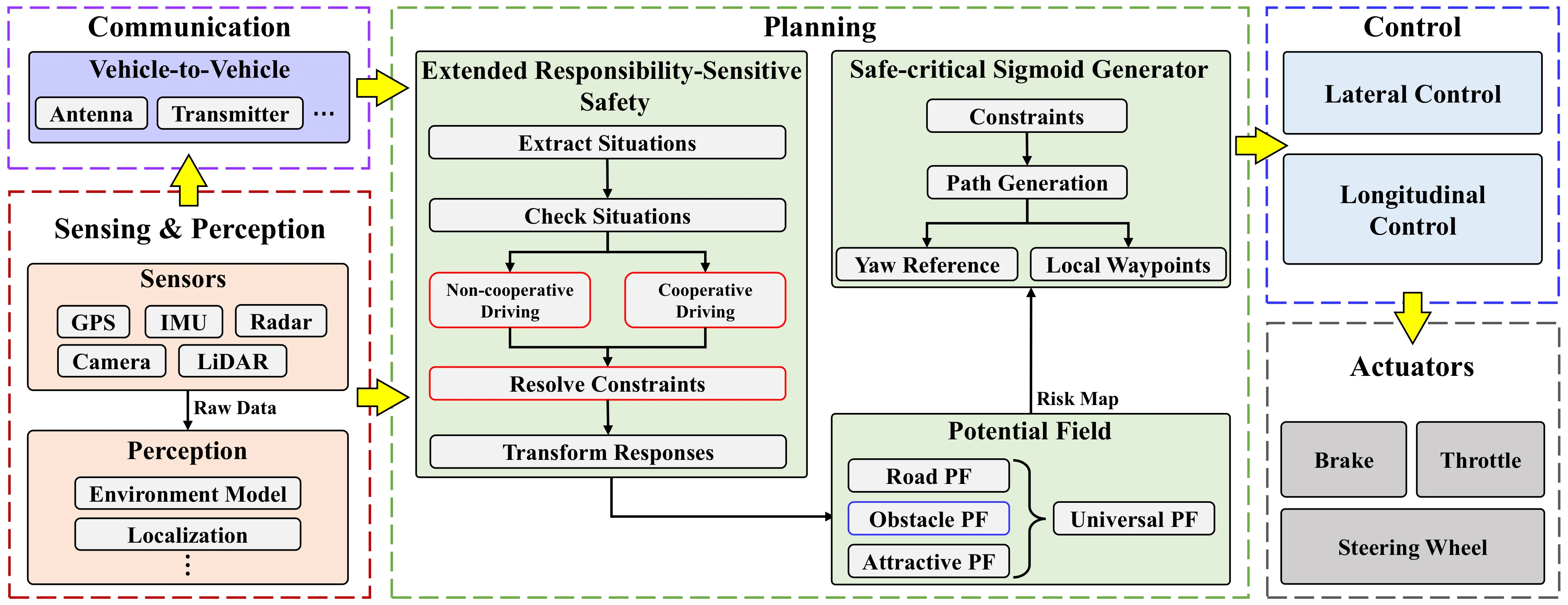
- Its architecture integrates V2V communication, sensing, planning and control.
Figures from the paper
Abstract
Abstract—Driving safety and responsibility determination are indispensable pieces of the puzzle for autonomous driving. They are also deeply related to the allocation of right-of-way and the determination of accident liability. Therefore, Intel/Mobileye designed the responsibility-sensitive safety (RSS) framework to further enhance the safety regulation of autonomous driving, which mathematically defines rules for autonomous vehicles (AVs) behaviors in various traffic scenarios. However, the RSS framework’s rules are relatively rudimentary in certain scenarios characterized by interaction uncertainty, especially those requiring collaborative driving during emergency collision avoidance. Besides, the integration of the RSS framework with motion planning is rarely discussed in current studies. Therefore, we proposed a rule-adherence motion planner (RAMP) based on the extended RSS (eRSS) regulation for non-connected and connected AVs in merging and emergency-avoiding scenarios. Unlike conventional planners, eRSS-RAMP embeds two-dimensional extended-RSS safety thresholds directly into trajectory generation and selection. The simulation results indicate that the proposed method can achieve faster and safer lane merging performance (53.1%±1.7% shorter merging length and a 73.2%±2.4% decrease in merging time), and allows for more stable steering maneuvers in emergency collision avoidance, resulting in smoother paths for ego vehicle and surrounding vehicles.
How to cite
P. Lin, E. Javanmardi, Y. Jiang, D. Hu, S. Zhang, and M. Tsukada, “eRSS-RAMP: A Rule-Adherence Motion Planner Based on Extended Responsibility-Sensitive Safety for Emergency Driving,” IEEE Transactions on Vehicular Technology, vol. 75, no. 6, pp. 8978–8992, 2026, doi: 10.1109/TVT.2025.3637773.
BibTeX
@article{Lin2025,
  title         = {eRSS-RAMP: A Rule-Adherence Motion Planner Based on Extended Responsibility-Sensitive Safety for Emergency Driving},
  author        = {Pengfei Lin and Ehsan Javanmardi and Yuze Jiang and Dou Hu and Shangkai Zhang and Manabu Tsukada},
  doi           = {10.1109/TVT.2025.3637773},
  isbn          = {0018-9545},
  url           = {https://arxiv.org/abs/2409.02503},
  eprint        = {2409.02503},
  archiveprefix = {arXiv},
  primaryclass  = {cs.RO},
  year          = {2026},
  date          = {2026-06},
  urldate       = {2025-11-27},
  journal       = {IEEE Transactions on Vehicular Technology},
  volume        = {75},
  number        = {6},
  pages         = {8978--8992},
  abstract      = {Abstract—Driving safety and responsibility determination are indispensable pieces of the puzzle for autonomous driving. They are also deeply related to the allocation of right-of-way and the determination of accident liability. Therefore, Intel/Mobileye designed the responsibility-sensitive safety (RSS) framework to further enhance the safety regulation of autonomous driving, which mathematically defines rules for autonomous vehicles (AVs) behaviors in various traffic scenarios. However, the RSS framework’s rules are relatively rudimentary in certain scenarios characterized by interaction uncertainty, especially those requiring collaborative driving during emergency collision avoidance. Besides, the integration of the RSS framework with motion planning is rarely discussed in current studies. Therefore, we proposed a rule-adherence motion planner (RAMP) based on the extended RSS (eRSS) regulation for non-connected and connected AVs in merging and emergency-avoiding scenarios. Unlike conventional planners, eRSS-RAMP embeds two-dimensional extended-RSS safety thresholds directly into trajectory generation and selection. The simulation results indicate that the proposed method can achieve faster and safer lane merging performance (53.1%±1.7% shorter merging length and a 73.2%±2.4% decrease in merging time), and allows for more stable steering maneuvers in emergency collision avoidance, resulting in smoother paths for ego vehicle and surrounding vehicles.},
  keywords      = {ITS},
  pubstate      = {published},
  tppubtype     = {article}
}