
WebRTC-based measurement tool for peer-to-peer applications and preliminary findings with real users
16th Asian Internet Engineering Conference (AINTEC 2021), Online, Dec 14, 2021
arXivDOI: 10.1145/3497777.3498544
Summary in three lines
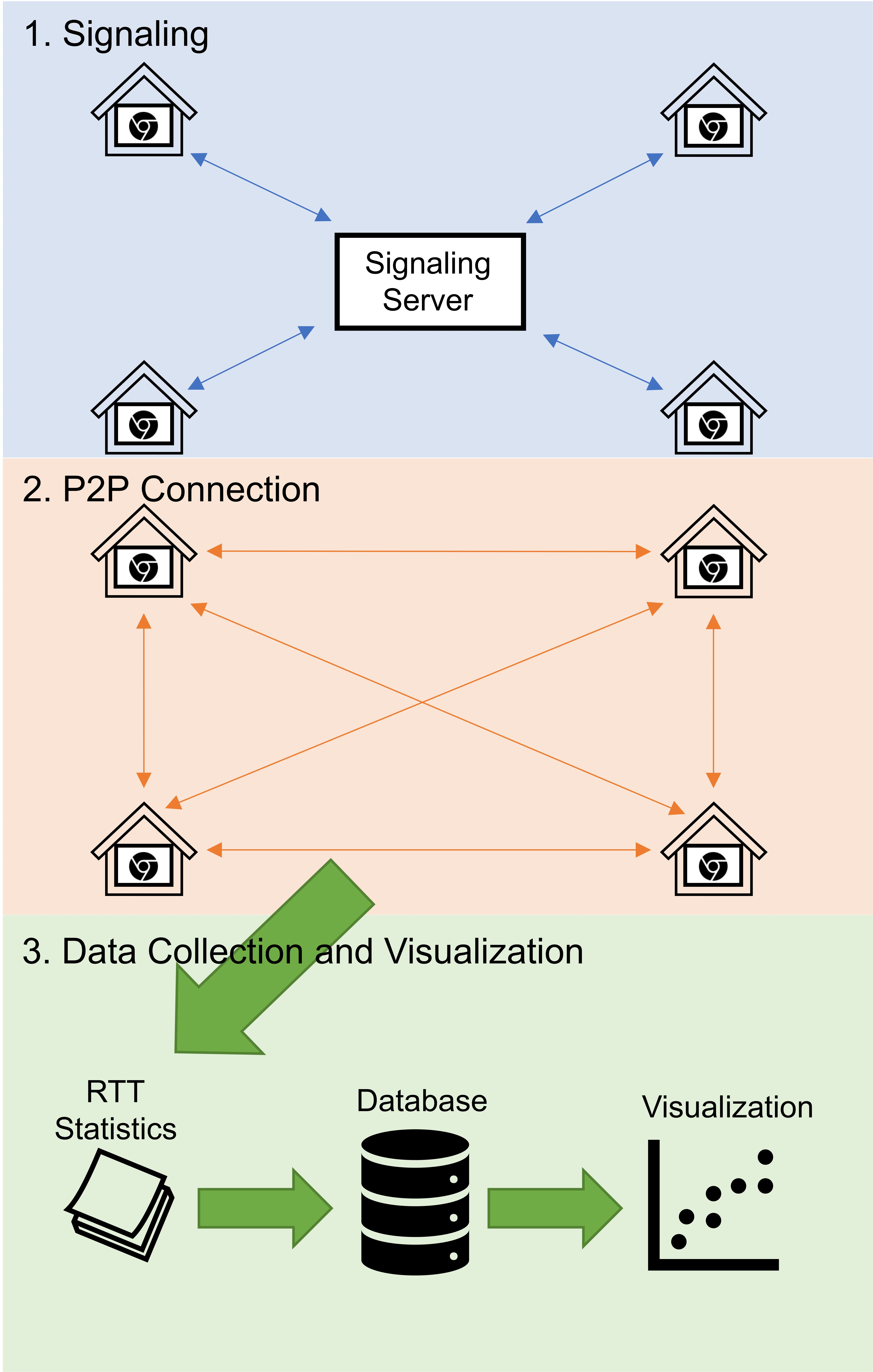
- The authors built a browser-based tool that uses WebRTC statistics to measure latency between home networks.
- They verified that its measurements of round-trip time and jitter were accurate enough for real-time applications.
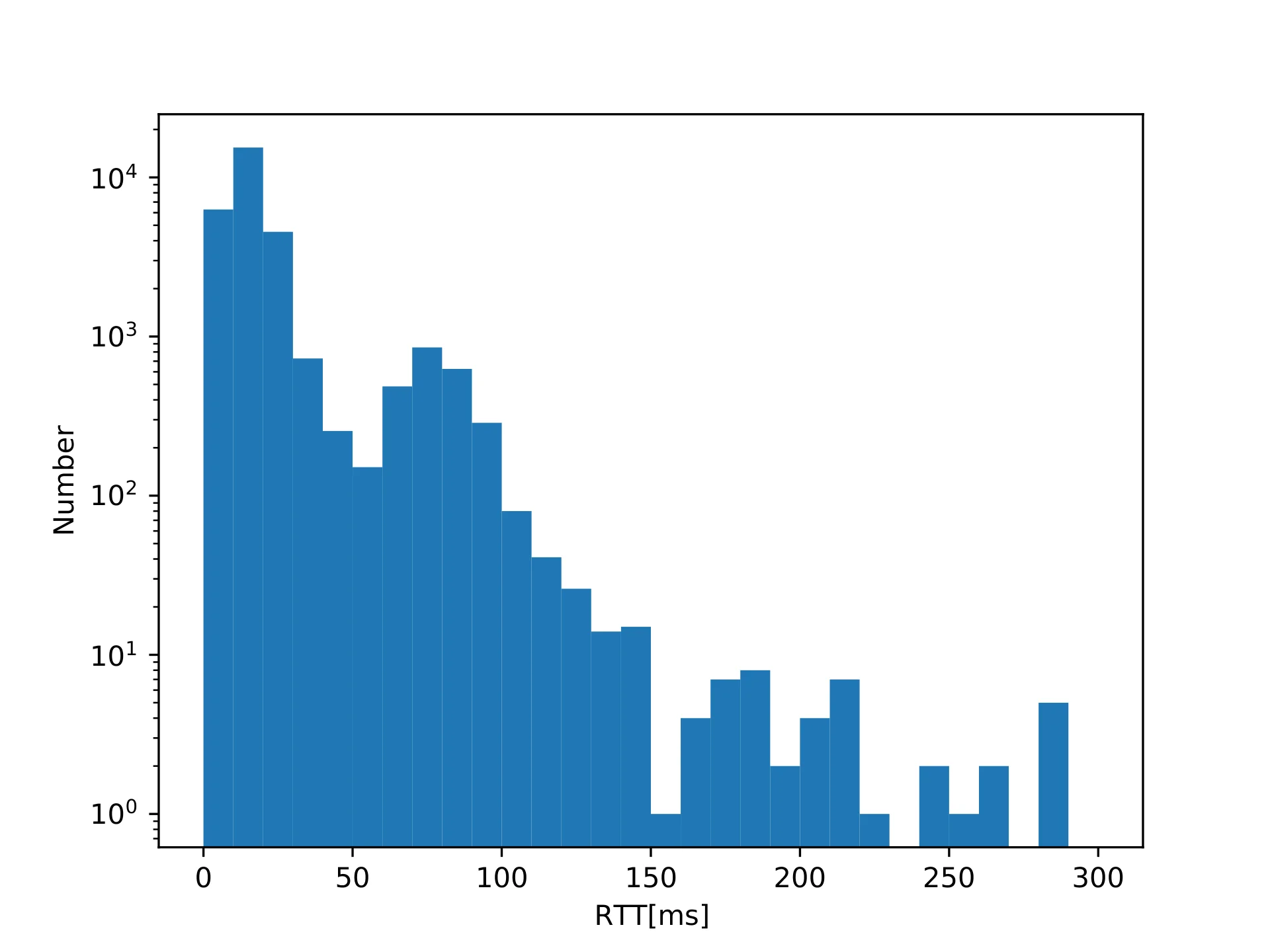
- In a full mesh of ten users in Japan, 66% of peer links met the 30 ms latency threshold used for remote ensembles.
Figures from the paper
Abstract
Direct peer-to-peer (P2P) communication is often used to minimize the end-to-end latency for real-time applications that require accurate synchronization, such as remote musical ensembles. However, there are few studies on the performance of P2P communication between home network environments, thus hindering the deployment of services that require synchronization. In this study, we developed a P2P performance measurement tool using the Web Real-Time Communication (WebRTC) statistics application programming interface. Using this tool, we can easily measure P2P performance between home network environments on a web browser without downloading client applications. We also verified the reliability of round-trip time (RTT) measurements using WebRTC and confirmed that our system could provide the necessary measurement accuracy for RTT and jitter measurements for real-time applications. In addition, we measured the performance of a full mesh topology connection with 10 users in an actual environment in Japan. Consequently, we found that only 66% of the peer connections had a latency of 30 ms or less, which is the minimum requirement for high synchronization applications, such as musical ensembles.
Video
How to cite
K. Nakagawa, M. Tsukada, K. Shima, and H. Esaki, “WebRTC-based measurement tool for peer-to-peer applications and preliminary findings with real users,” in 16th Asian Internet Engineering Conference (AINTEC 2021), Online, 2021, doi: 10.1145/3497777.3498544.
BibTeX
@inproceedings{Nakagawa2021,
  title         = {WebRTC-based measurement tool for peer-to-peer applications and preliminary findings with real users},
  author        = {Kosuke Nakagawa and Manabu Tsukada and Keiichi Shima and Hiroshi Esaki},
  url           = {http://arxiv.org/abs/2112.02163 https://youtu.be/4XeCpuBLa7E},
  doi           = {10.1145/3497777.3498544},
  year          = {2021},
  date          = {2021-12-14},
  urldate       = {2021-12-14},
  booktitle     = {16th Asian Internet Engineering Conference (AINTEC 2021)},
  address       = {Online},
  abstract      = {Direct peer-to-peer (P2P) communication is often used to minimize the end-to-end latency for real-time applications that require accurate synchronization, such as remote musical ensembles. However, there are few studies on the performance of P2P communication between home network environments, thus hindering the deployment of services that require synchronization. In this study, we developed a P2P performance measurement tool using the Web Real-Time Communication (WebRTC) statistics application programming interface. Using this tool, we can easily measure P2P performance between home network environments on a web browser without downloading client applications. We also verified the reliability of round-trip time (RTT) measurements using WebRTC and confirmed that our system could provide the necessary measurement accuracy for RTT and jitter measurements for real-time applications. In addition, we measured the performance of a full mesh topology connection with 10 users in an actual environment in Japan. Consequently, we found that only 66% of the peer connections had a latency of 30 ms or less, which is the minimum requirement for high synchronization applications, such as musical ensembles.},
  keywords      = {SDM},
  pubstate      = {published},
  tppubtype     = {inproceedings}
}