
WebRTC over 5G: A Study of Remote Collaboration QoS in Mobile Environment
Journal of Network and Systems Management, vol. 32, Oct 24, 2023
PDFDOI: 10.1007/s10922-023-09778-5
Summary in three lines
- The study measures WebRTC quality of service during remote collaboration over mobile 5G networks.
- A prototype collects application metrics alongside radio signal information across frequency bands.
- The authors examine how signal quality, handovers, geography, and mobility relate to call performance.
Figures from the paper
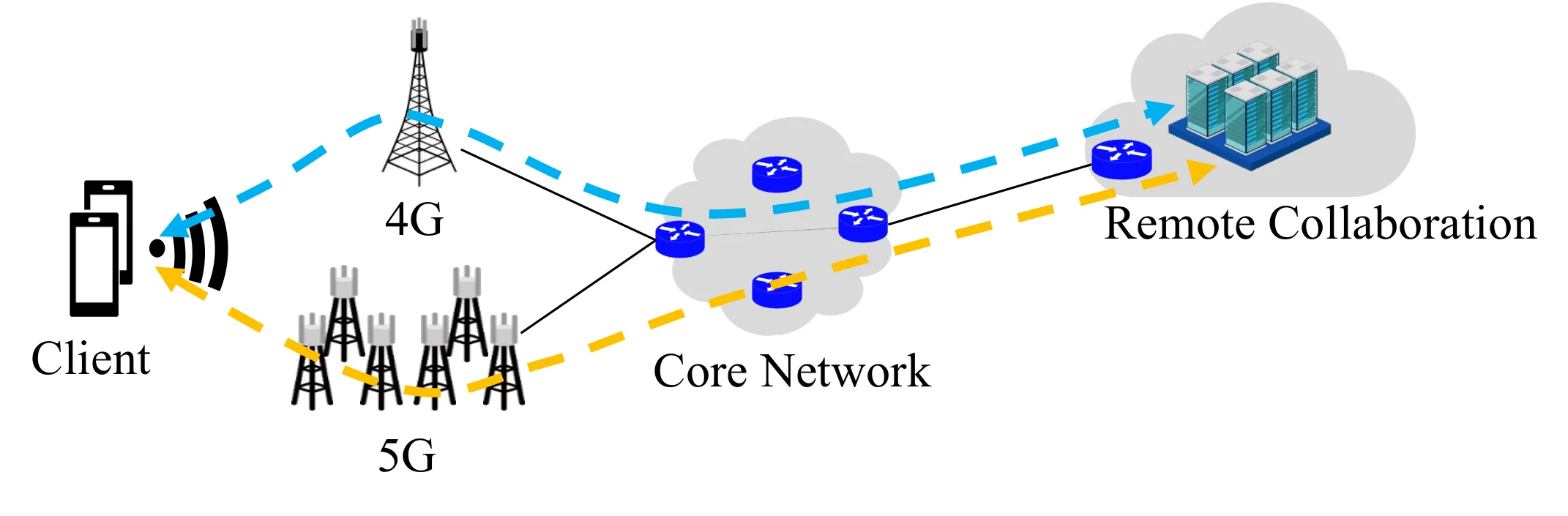
Abstract
The increasing demand for remote collaboration and remote working has become crucial to daily life owing to the Covid-19 pandemic and the development of internet-based video distribution services. Furthermore, low-latency remote collaboration, such as teleoperation and support applications designed for in-vehicle environments, has gained considerable attention. The 5G technology is considered as a key infrastructure for remote collaboration. This study aimed to evaluate the actual 5G capability to achieve high quality of service (QoS) for remote collaboration. We designed and implemented a measurement tool to monitor the QoS of remote collaboration under real-world 5G conditions. We performed measurements encompassing the various 5G frequency bands. During these experiments, we employed various tools to obtain detailed mobile signal conditions to analyze the relationship between various environmental factors (e.g. signal quality, band, handoff, geographic conditions, and mobility) and the QoS performance of remote collaboration in a real-world 5G environment. This study elucidated the correlation between the WebRTC performance and various environmental factors as well as the performance improvement potential by leveraging the communication technologies of multiple mobile carriers. The collected data has been made publicly available to foster research on QoS and 5G.
Related research and software
How to cite
J. Nakazato, K. Nakagawa, K. Ito, R. Fontugne, M. Tsukada, and H. Esaki, “WebRTC over 5G: A Study of Remote Collaboration QoS in Mobile Environment,” Journal of Network and Systems Management, vol. 32, 2023, doi: 10.1007/s10922-023-09778-5.
BibTeX
@article{Nakazato2023,
  title         = {WebRTC over 5G: A Study of Remote Collaboration QoS in Mobile Environment},
  author        = {Jin Nakazato and Kousuke Nakagawa and Koki Ito and Romain Fontugne and Manabu Tsukada and Hiroshi Esaki},
  url           = {https://link.springer.com/content/pdf/10.1007/s10922-023-09778-5.pdf},
  doi           = {10.1007/s10922-023-09778-5},
  issn          = {1573-7705},
  year          = {2023},
  date          = {2023-10-24},
  urldate       = {2023-10-24},
  journal       = {Journal of Network and Systems Management},
  volume        = {32},
  issue         = {1},
  abstract      = {The increasing demand for remote collaboration and remote working has become crucial to daily life owing to the Covid-19 pandemic and the development of internet-based video distribution services. Furthermore, low-latency remote collaboration, such as teleoperation and support applications designed for in-vehicle environments, has gained considerable attention. The 5G technology is considered as a key infrastructure for remote collaboration. This study aimed to evaluate the actual 5G capability to achieve high quality of service (QoS) for remote collaboration. We designed and implemented a measurement tool to monitor the QoS of remote collaboration under real-world 5G conditions. We performed measurements encompassing the various 5G frequency bands. During these experiments, we employed various tools to obtain detailed mobile signal conditions to analyze the relationship between various environmental factors (e.g. signal quality, band, handoff, geographic conditions, and mobility) and the QoS performance of remote collaboration in a real-world 5G environment. This study elucidated the correlation between the WebRTC performance and various environmental factors as well as the performance improvement potential by leveraging the communication technologies of multiple mobile carriers. The collected data has been made publicly available to foster research on QoS and 5G.},
  keywords      = {SDM},
  pubstate      = {published},
  tppubtype     = {article}
}