
Toward 6G Mobility Networks: A Proposal for Cell-Free Cooperative Distributed Beamforming
International Conference on Intelligent Computing and its Emerging Applications (ICEA 2024), Tokyo, Japan, Nov 28, 2024
Summary in three lines
- The paper proposes hybrid beamforming across distributed roadside units for cell-free vehicular networks.
- Simulations compare channel capacity and signal quality as the number of units changes.
- More units increased capacity even as the signal-to-noise ratio at each unit fell.
Figures from the paper
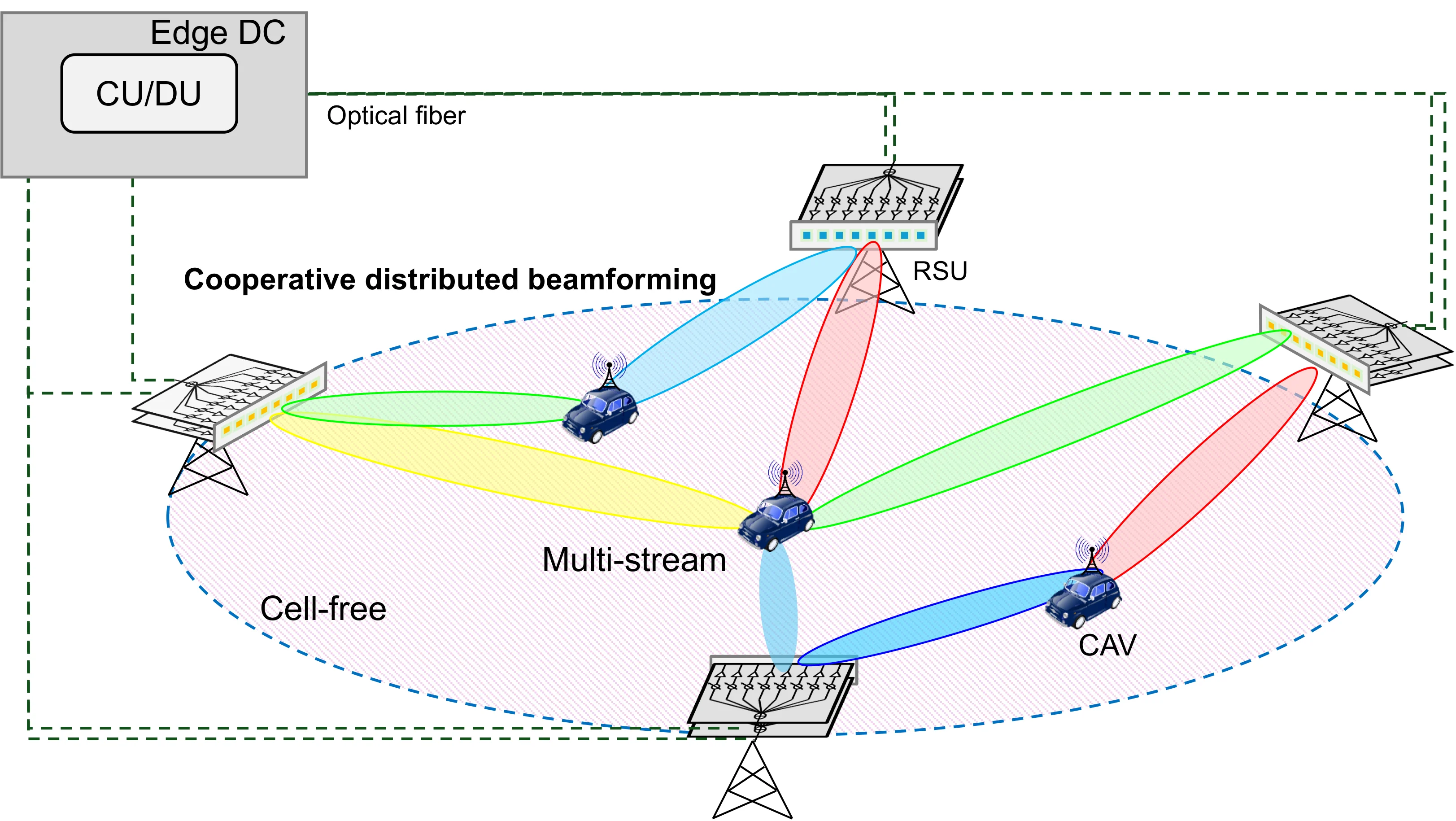
Abstract
This paper proposes a hybrid beamforming architecture utilizing multiple distributed Roadside Units (RSUs) to improve the overall channel capacity of millimeter-wave (mmWave) vehicular networks. The proposed system leverages a cell-free mobility network architecture with distributed RSUs, enhancing communication performance in Vehicle-to-Everything (V2X) scenarios. Through computer simulations, we demonstrate that increasing the number of distributed RSUs leads to improved channel capacity, even though the per-RSU Signal-to-Noise Ratio (SNR) decreases due to reduced transmit power and fewer antenna elements. Furthermore, our results show that the proposed architecture can effectively mitigate interference and support reliable communications, making it a viable approach for future 6G autonomous driving systems. Future work will include extending the proposed method to environments with multiple Connected Autonomous Vehicles (CAVs) and varying mobility patterns to verify its robustness and scalability.
How to cite
J. Nakazato, S. Ozawa, Y. Sasaki, K. Suzuki, K. Maruta, T. Iye, Y. Susukida, E. Sato, and M. Tsukada, “Toward 6G Mobility Networks: A Proposal for Cell-Free Cooperative Distributed Beamforming,” in International Conference on Intelligent Computing and its Emerging Applications (ICEA 2024), Tokyo, Japan, 2024, doi: 10.1145/3732437.3732750.
BibTeX
@inproceedings{Nakazato2024,
  title         = {Toward 6G Mobility Networks: A Proposal for Cell-Free Cooperative Distributed Beamforming},
  author        = {Jin Nakazato and Sojin Ozawa and Yuki Sasaki and Kengo Suzuki and Kazuki Maruta and Tetsuya Iye and Yuki Susukida and Eisaku Sato and Manabu Tsukada},
  doi           = {10.1145/3732437.3732750},
  year          = {2024},
  date          = {2024-11-28},
  urldate       = {2024-11-28},
  booktitle     = {International Conference on Intelligent Computing and its Emerging Applications (ICEA 2024)},
  address       = {Tokyo, Japan},
  abstract      = {This paper proposes a hybrid beamforming architecture utilizing multiple distributed Roadside Units (RSUs) to improve the overall channel capacity of millimeter-wave (mmWave) vehicular networks. The proposed system leverages a cell-free mobility network architecture with distributed RSUs, enhancing communication performance in Vehicle-to-Everything (V2X) scenarios. Through computer simulations, we demonstrate that increasing the number of distributed RSUs leads to improved channel capacity, even though the per-RSU Signal-to-Noise Ratio (SNR) decreases due to reduced transmit power and fewer antenna elements. Furthermore, our results show that the proposed architecture can effectively mitigate interference and support reliable communications, making it a viable approach for future 6G autonomous driving systems. Future work will include extending the proposed method to environments with multiple Connected Autonomous Vehicles (CAVs) and varying mobility patterns to verify its robustness and scalability.},
  keywords      = {ITS},
  pubstate      = {published},
  tppubtype     = {inproceedings}
}