
PLATONE: An Immersive Geospatial Audio Spatialization Platform
2nd Annual IEEE International Conference on Metaverse Computing, Networking, and Applications (MetaCom 2024), Hong Kong, China, Aug 12, 2024
DOI: 10.1109/MetaCom62920.2024.00020
Summary in three lines
- PLATONE is a mixed-reality prototype for spatial audio at urban scale.
- It uses georeferenced 3D geometry to model how sound depends on the environment.
- Custom hardware and software place virtual sound sources in the listener’s surroundings.
Figures from the paper
Abstract
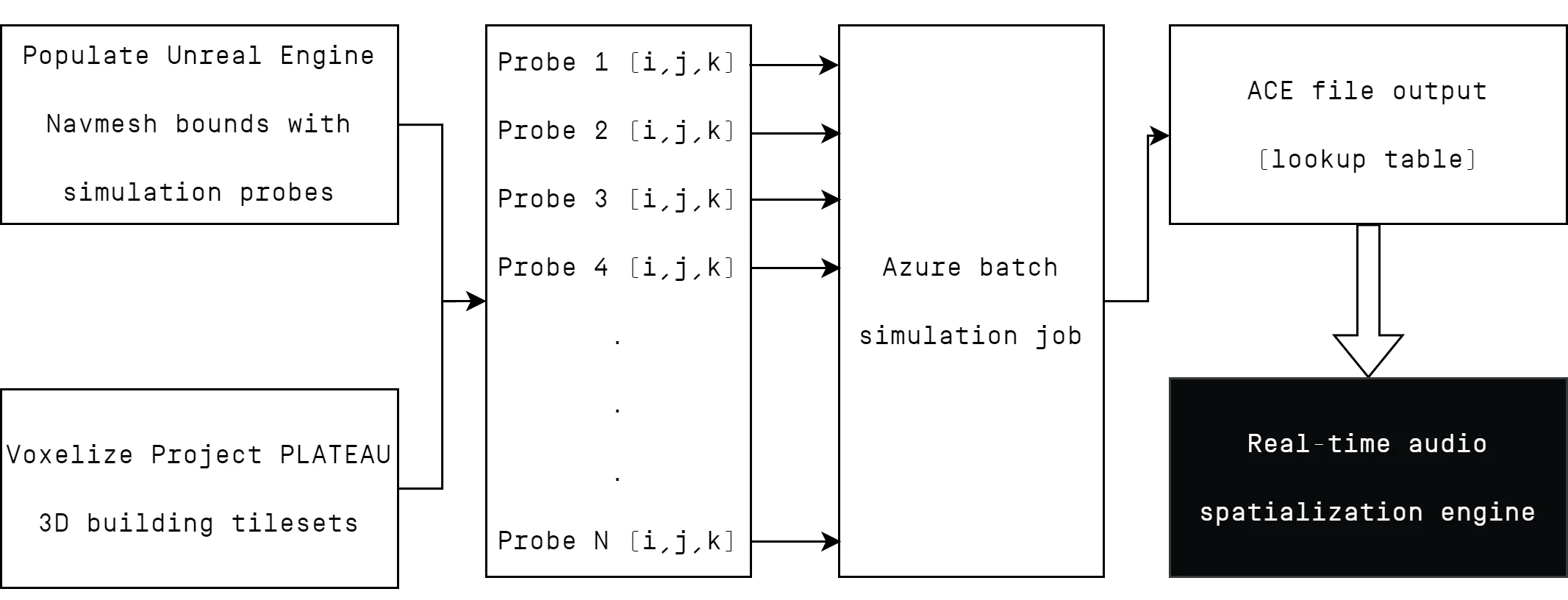
In the rapidly evolving landscape of mixed reality (MR) and spatial computing, the convergence of physical and virtual spaces is becoming increasingly crucial for enabling immersive, large-scale user experiences and shaping inter-reality dynamics. This is particularly significant for immersive audio at city-scale, where the 3D geometry of the environment must be considered, as it drastically influences how sound is perceived by the listener. This paper introduces PLATONE, a novel proof-of-concept MR platform designed to augment urban contexts with environment-dependent spatialized audio. It leverages custom hardware for localization and orientation, alongside a cloud-based pipeline for generating real-time binaural audio. By utilizing open-source 3D building datasets, sound propagation effects such as occlusion, reverberation, and diffraction are accurately simulated. We believe that this work may serve as a compelling foundation for further research and development.
Related research and software
Related news
How to cite
A. Orsholits, Y. Qian, E. Nardini, Y. Obuchi, and M. Tsukada, “PLATONE: An Immersive Geospatial Audio Spatialization Platform,” in 2nd Annual IEEE International Conference on Metaverse Computing, Networking, and Applications (MetaCom 2024), Hong Kong, China, 2024, doi: 10.1109/MetaCom62920.2024.00020.
BibTeX
@inproceedings{Orsholits2024,
  title         = {PLATONE: An Immersive Geospatial Audio Spatialization Platform},
  author        = {Alex Orsholits and Yiyuan Qian and Eric Nardini and Yusuke Obuchi and Manabu Tsukada},
  doi           = {10.1109/MetaCom62920.2024.00020},
  year          = {2024},
  date          = {2024-08-12},
  urldate       = {2024-08-12},
  booktitle     = {2nd Annual IEEE International Conference on Metaverse Computing, Networking, and Applications (MetaCom 2024)},
  address       = {Hong Kong, China},
  abstract      = {In the rapidly evolving landscape of mixed reality (MR) and spatial computing, the convergence of physical and virtual spaces is becoming increasingly crucial for enabling immersive, large-scale user experiences and shaping inter-reality dynamics. This is particularly significant for immersive audio at city-scale, where the 3D geometry of the environment must be considered, as it drastically influences how sound is perceived by the listener. This paper introduces PLATONE, a novel proof-of-concept MR platform designed to augment urban contexts with environment-dependent spatialized audio. It leverages custom hardware for localization and orientation, alongside a cloud-based pipeline for generating real-time binaural audio. By utilizing open-source 3D building datasets, sound propagation effects such as occlusion, reverberation, and diffraction are accurately simulated. We believe that this work may serve as a compelling foundation for further research and development.},
  keywords      = {SDM},
  pubstate      = {published},
  tppubtype     = {inproceedings}
}