
Location-Aided Fast Beam Tracking Algorithm for Millimeter-Wave V2I
ComEX Top Downloaded Letter AwardIEICE Communications Express (ComEX), Feb 15, 2024
DOI: 10.23919/comex.2024XBL0001
Summary in three lines
- The method tracks moving vehicles with millimeter-wave beams informed by road geometry.
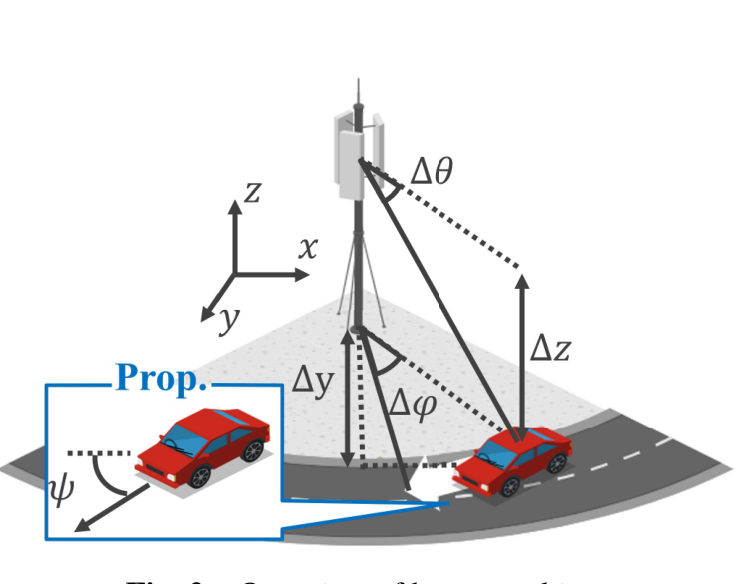
- Driving direction and road shape guide horizontal and vertical beam directions. Forward and rearward candidates determine tracking speed.
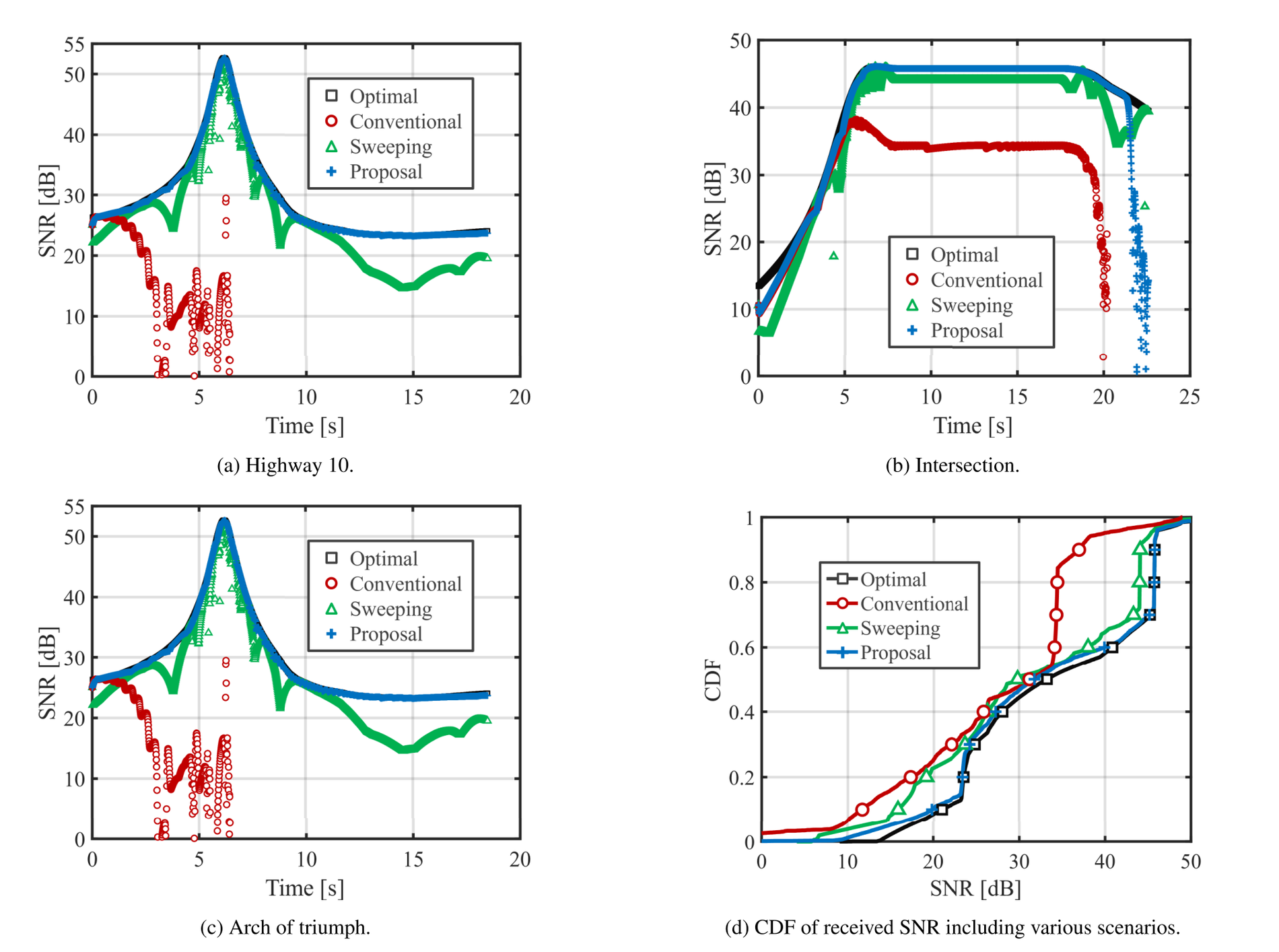
- SUMO simulations test the algorithm on different roads.
Figures from the paper
Abstract
This article proposes a millimeter-wave fast beam tracking algorithm for moving vehicles, considering a geometry of road environment. Focusing on the fact that vehicle movement is constrained on roads, horizontal and vertical beam directions are determined based on obtainable driving direction and road shape. In addition, we perform a two-pattern beam selection for the vehicle’s forward and rearward directions to esti- mate the beam tracking speed. By conducting simulations using SUMO, which emulates vehicle movement on various roads, we verified the effective operation of the proposed scheme and confirmed its superiority over the existing beam sweeping approach.
How to cite
S. Ozawa, T. Ikuta, Y. Sasaki, R. Iwaki, J. Nakazato, M. Tsukada, H. So, and K. Maruta, “Location-Aided Fast Beam Tracking Algorithm for Millimeter-Wave V2I,” IEICE Communications Express (ComEX), 2024, doi: 10.23919/comex.2024XBL0001.
BibTeX
@article{Ozawa2024c,
  title         = {Location-Aided Fast Beam Tracking Algorithm for Millimeter-Wave V2I},
  author        = {Sojin Ozawa and Tokio Ikuta and Yuki Sasaki and Ryo Iwaki and Jin Nakazato and Manabu Tsukada and Hideya So and Kazuki Maruta},
  doi           = {10.23919/comex.2024XBL0001},
  year          = {2024},
  date          = {2024-02-15},
  urldate       = {2024-02-15},
  journal       = {IEICE Communications Express (ComEX)},
  abstract      = {This article proposes a millimeter-wave fast beam tracking algorithm for moving vehicles, considering a geometry of road environment. Focusing on the fact that vehicle movement is constrained on roads, horizontal and vertical beam directions are determined based on obtainable driving direction and road shape. In addition, we perform a two-pattern beam selection for the vehicle’s forward and rearward directions to esti- mate the beam tracking speed. By conducting simulations using SUMO, which emulates vehicle movement on various roads, we verified the effective operation of the proposed scheme and confirmed its superiority over the existing beam sweeping approach.},
  note          = {ComEX Top Downloaded Letter Award},
  keywords      = {Award, ITS},
  pubstate      = {published},
  tppubtype     = {article}
}