
Where Do You Go? Pedestrian Trajectory Prediction using Scene Features
International Conference on Intelligent Computing and its Emerging Applications (ICEA 2024), Tokyo, Japan, pp. 123–128, Nov 28, 2024
arXivDOI: 10.1145/3732437.3732751
Summary in three lines
- The model predicts pedestrian paths from social interactions and the surrounding scene.
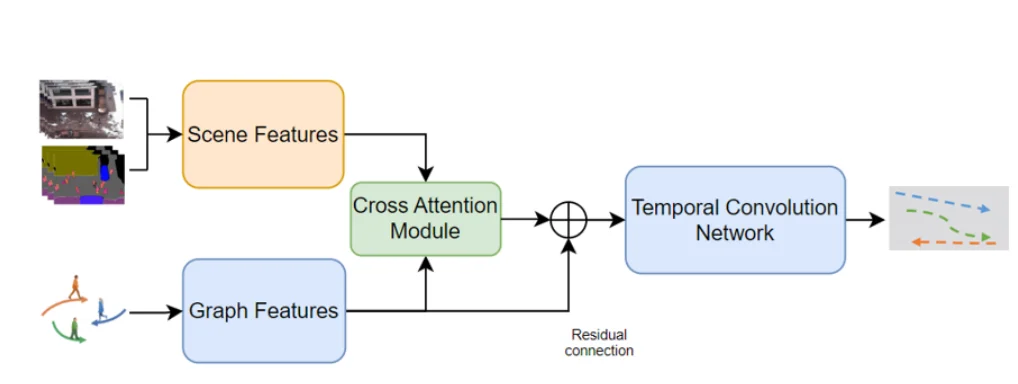
- Cross-attention combines features from a sparse pedestrian graph and semantic scene segmentation before temporal prediction.
- Experiments report average and final displacement errors of 0.252 m and 0.372 m.
Figures from the paper
Abstract
Accurate prediction of pedestrian trajectories is crucial for enhancing the safety of autonomous vehicles and reducing traffic fatalities involving pedestrians. While numerous studies have focused on modeling interactions among pedestrians to forecast their movements, the influence of environmental factors and scene-object placements has been comparatively underexplored. In this paper, we present a novel trajectory prediction model that integrates both pedestrian interactions and environmental context to improve prediction accuracy. Our approach captures spatial and temporal interactions among pedestrians within a sparse graph framework. To account for pedestrian-scene interactions, we employ advanced image enhancement and semantic segmentation techniques to extract detailed scene features. These scene and interaction features are then fused through a cross-attention mechanism, enabling the model to prioritize relevant environmental factors that influence pedestrian movements. Finally, a temporal convolutional network processes the fused features to predict future pedestrian trajectories. Experimental results demonstrate that our method significantly outperforms existing state-of-the-art approaches, achieving ADE and FDE values of 0.252 and 0.372 meters, respectively, underscoring the importance of incorporating both social interactions and environmental context in pedestrian trajectory prediction.
How to cite
M. A. Rezaei, F. Ayar, E. Javanmardi, M. Tsukada, and M. Javanmardi, “Where Do You Go? Pedestrian Trajectory Prediction using Scene Features,” in International Conference on Intelligent Computing and its Emerging Applications (ICEA 2024), Tokyo, Japan, 2024, doi: 10.1145/3732437.3732751.
BibTeX
@inproceedings{Rezaei2024SceneFeatures,
  title         = {Where Do You Go? Pedestrian Trajectory Prediction using Scene Features},
  author        = {Mohammad Ali Rezaei and Fardin Ayar and Ehsan Javanmardi and Manabu Tsukada and Mahdi Javanmardi},
  url           = {https://arxiv.org/abs/2501.13848},
  doi           = {10.1145/3732437.3732751},
  eprint        = {2501.13848},
  archiveprefix = {arXiv},
  primaryclass  = {cs.CV},
  year          = {2024},
  date          = {2024-11-28},
  urldate       = {2024-11-28},
  booktitle     = {International Conference on Intelligent Computing and its Emerging Applications (ICEA 2024)},
  pages         = {123--128},
  address       = {Tokyo, Japan},
  abstract      = {Accurate prediction of pedestrian trajectories is crucial for enhancing the safety of autonomous vehicles and reducing traffic fatalities involving pedestrians. While numerous studies have focused on modeling interactions among pedestrians to forecast their movements, the influence of environmental factors and scene-object placements has been comparatively underexplored. In this paper, we present a novel trajectory prediction model that integrates both pedestrian interactions and environmental context to improve prediction accuracy. Our approach captures spatial and temporal interactions among pedestrians within a sparse graph framework. To account for pedestrian-scene interactions, we employ advanced image enhancement and semantic segmentation techniques to extract detailed scene features. These scene and interaction features are then fused through a cross-attention mechanism, enabling the model to prioritize relevant environmental factors that influence pedestrian movements. Finally, a temporal convolutional network processes the fused features to predict future pedestrian trajectories. Experimental results demonstrate that our method significantly outperforms existing state-of-the-art approaches, achieving ADE and FDE values of 0.252 and 0.372 meters, respectively, underscoring the importance of incorporating both social interactions and environmental context in pedestrian trajectory prediction.},
  keywords      = {ITS},
  pubstate      = {published},
  tppubtype     = {inproceedings}
}