
Toward B5G/6G Connected Autonomous Vehicles: O-RAN-Driven Millimeter-Wave Beam Management and Handover Management
Best Paper AwardIEEE INFOCOM WKSHPS, Next-generation Open and Programmable Radio Access Networks (NG-OPERA 2024), Vancouver, Canada, May 20, 2024
PDFDOI: 10.1109/INFOCOMWKSHPS61880.2024.10620740
Summary in three lines
- The paper uses Open RAN to manage millimeter-wave beams and handovers for connected vehicles.
- Vehicle application data and mobility management are combined to predict positions.
- The method maintained higher signal-to-noise ratios than beam sweeping in the evaluated scenarios.
Figures from the paper
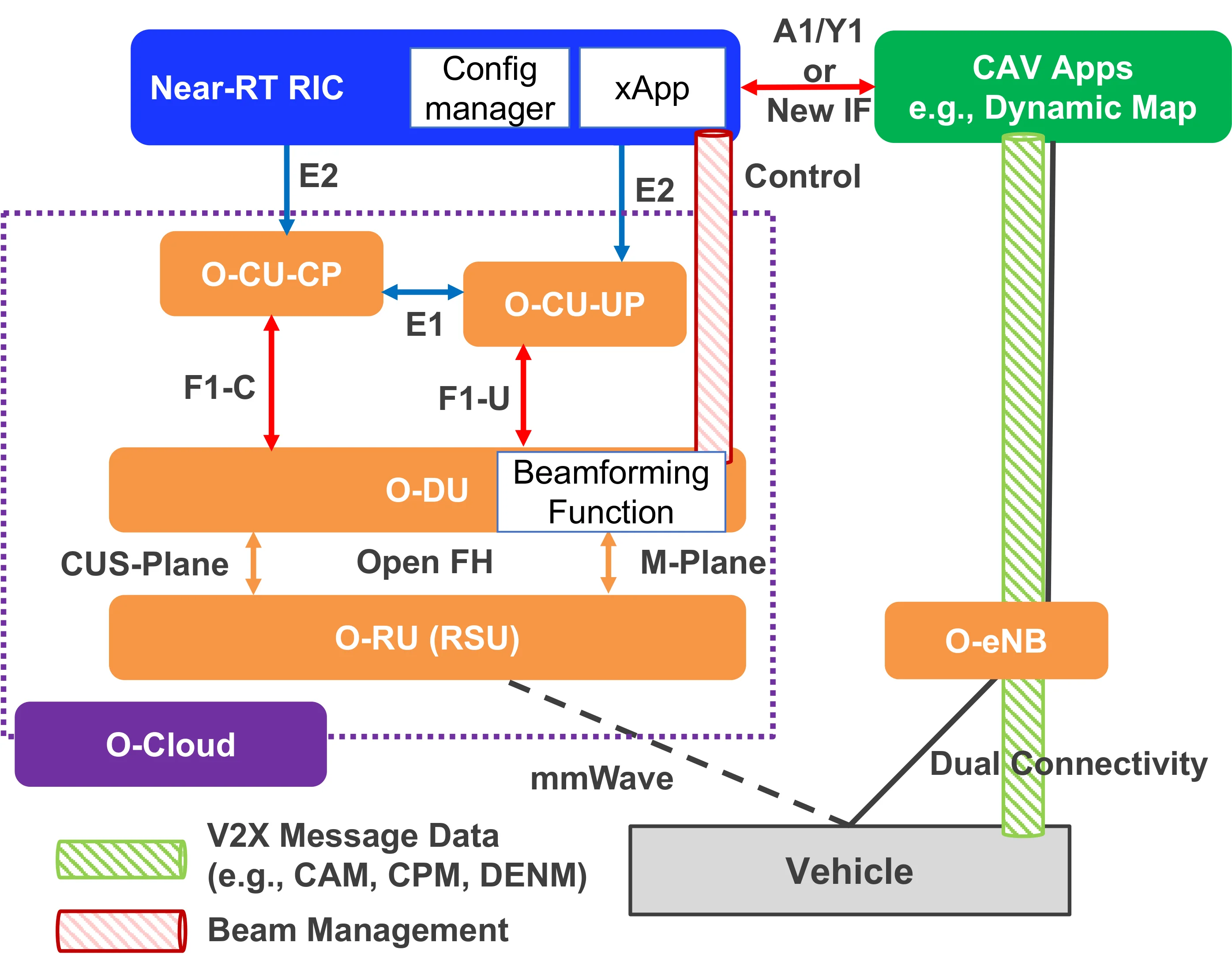
Abstract
Connected autonomous vehicles (CAVs) are crucial to a future society that embraces advanced technologies. For these vehicles to effectively share information with nearby vehicles or infrastructures through vehicle-to-everything (V2X) interfaces, stable mmWave communication is essential yet challenging. This paper presents an innovative approach to millimeter-wave beam management for CAVs, utilizing open radio access network (O- RAN) architecture to improve beam and handover efficiency in diverse road scenarios. Our approach uniquely combines CAV application data with mobility management to predict vehicles’ location. Our findings show that this method substantially surpasses the traditional beam sweeping method by consistently maintaining a higher signal-to-noise ratio (SNR), even in challenging scenarios such as vehicle obstruction at intersections. This research underscores the potential of integrating O-RAN with vehicle-to-infrastructure (V2I) communication in CAVs, paving the way for future advancements in autonomous transportation technology.
Related news
How to cite
K. Suzuki, J. Nakazato, Y. Sasaki, K. Maruta, M. Tsukada, and H. Esaki, “Toward B5G/6G Connected Autonomous Vehicles: O-RAN-Driven Millimeter-Wave Beam Management and Handover Management,” in IEEE INFOCOM WKSHPS, Next-generation Open and Programmable Radio Access Networks (NG-OPERA 2024), Vancouver, Canada, 2024, doi: 10.1109/INFOCOMWKSHPS61880.2024.10620740.
BibTeX
@workshop{Suzuki2024,
  title         = {Toward B5G/6G Connected Autonomous Vehicles: O-RAN-Driven Millimeter-Wave Beam Management and Handover Management},
  author        = {Kengo Suzuki and Jin Nakazato and Yuki Sasaki and Kazuki Maruta and Manabu Tsukada and Hiroshi Esaki},
  url           = {https://www.researchgate.net/profile/Jin-Nakazato/publication/378439256_Toward_B5G6G_Connected_Autonomous_Vehicles_O-RAN-Driven_Millimeter-Wave_Beam_Management_and_Handover_Management/links/664b976f0b0d2845744b1ea8/Toward-B5G-6G-Connected-Autonomous-Vehicles-O-RAN-Driven-Millimeter-Wave-Beam-Management-and-Handover-Management.pdf},
  doi           = {10.1109/INFOCOMWKSHPS61880.2024.10620740},
  year          = {2024},
  date          = {2024-05-20},
  urldate       = {2024-05-20},
  booktitle     = {IEEE INFOCOM WKSHPS, Next-generation Open and Programmable Radio Access Networks (NG-OPERA 2024)},
  address       = {Vancouver, Canada},
  abstract      = {Connected autonomous vehicles (CAVs) are crucial to a future society that embraces advanced technologies. For these vehicles to effectively share information with nearby vehicles or infrastructures through vehicle-to-everything (V2X) interfaces, stable mmWave communication is essential yet challenging. This paper presents an innovative approach to millimeter-wave beam management for CAVs, utilizing open radio access network (O- RAN) architecture to improve beam and handover efficiency in diverse road scenarios. Our approach uniquely combines CAV application data with mobility management to predict vehicles’ location. Our findings show that this method substantially surpasses the traditional beam sweeping method by consistently maintaining a higher signal-to-noise ratio (SNR), even in challenging scenarios such as vehicle obstruction at intersections. This research underscores the potential of integrating O-RAN with vehicle-to-infrastructure (V2I) communication in CAVs, paving the way for future advancements in autonomous transportation technology.},
  note          = {Best Paper Award},
  keywords      = {Award, ITS},
  pubstate      = {published},
  tppubtype     = {workshop}
}