
zk-PoT: Zero-Knowledge Proof of Traffic for Privacy Enabled Cooperative Perception
IEEE 20th Consumer Communications & Networking Conference (CCNC 2023), Las Vegas, NV, USA, Jan 8, 2023
arXivDOI: 10.1109/CCNC51644.2023.10059601
Summary in three lines
- Vehicles receiving a collective perception report need a way to verify observations they cannot see directly.
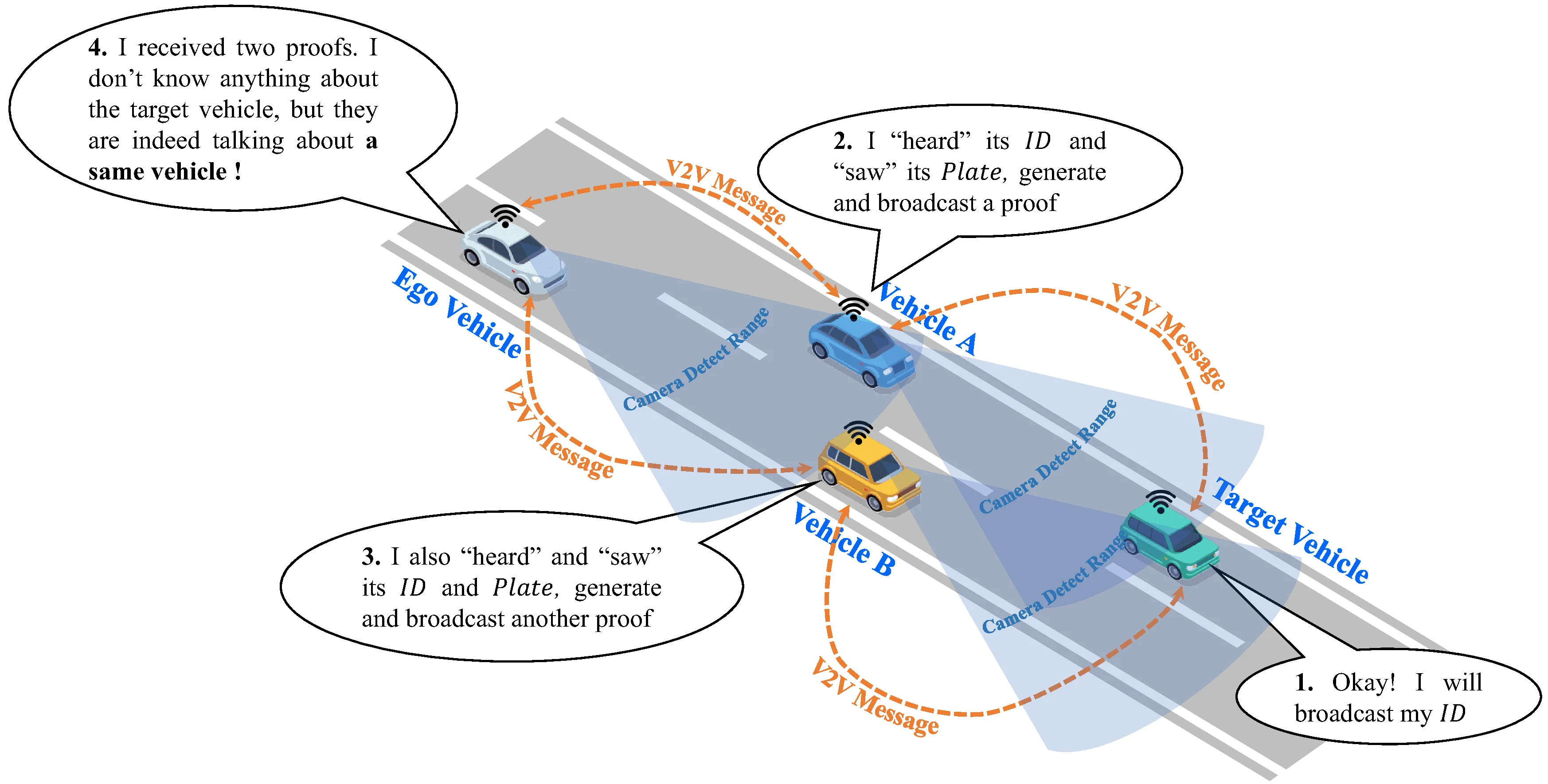
- The proposed zero-knowledge mechanism allows independent witnesses to corroborate a report while keeping sensitive observations private.
- Simulation tests how often independent vehicles can confirm the reported observations.
Figures from the paper
Abstract
Cooperative perception is an essential and widely discussed application of connected automated vehicles. However, the authenticity of perception data is not ensured, because the vehicles cannot independently verify the event they did not see. Many methods, including trust-based (i.e., statistical) approaches and plausibility-based methods, have been proposed to determine data authenticity. However, these methods cannot verify data without a priori knowledge. In this study, a novel approach of constructing a self-proving data from the number plate of target vehicles was proposed. By regarding the pseudonym and number plate as a shared secret and letting multiple vehicles prove they know it independently, the data authenticity problem can be transformed to a cryptography problem that can be solved without trust or plausibility evaluations. Our work can be adapted to the existing works including ETSI/ISO ITS standards while maintaining backward compatibility. Analyses of common attacks and attacks specific to the proposed method reveal that most attacks can be prevented, whereas preventing some other attacks, such as collusion attacks, can be mitigated. Experiments based on realistic data set show that the rate of successful verification can achieve 70% to 80% at rush hours.
How to cite
Y. Tao, Y. Jiang, P. Lin, M. Tsukada, and H. Esaki, “zk-PoT: Zero-Knowledge Proof of Traffic for Privacy Enabled Cooperative Perception,” in IEEE 20th Consumer Communications & Networking Conference (CCNC 2023), Las Vegas, NV, USA, 2023, doi: 10.1109/CCNC51644.2023.10059601.
BibTeX
@inproceedings{Tao2023,
  title         = {zk-PoT: Zero-Knowledge Proof of Traffic for Privacy Enabled Cooperative Perception},
  author        = {Ye Tao and Yuze Jiang and Pengfei Lin and Manabu Tsukada and Hiroshi Esaki},
  url           = {http://arxiv.org/abs/2211.07875},
  doi           = {10.1109/CCNC51644.2023.10059601},
  eprint        = {2211.07875},
  archiveprefix = {arXiv},
  primaryclass  = {cs.NI},
  year          = {2023},
  date          = {2023-01-08},
  urldate       = {2023-01-08},
  booktitle     = {IEEE 20th Consumer Communications & Networking Conference (CCNC 2023)},
  address       = {Las Vegas, NV, USA},
  abstract      = {Cooperative perception is an essential and widely discussed application of connected automated vehicles. However, the authenticity of perception data is not ensured, because the vehicles cannot independently verify the event they did not see. Many methods, including trust-based (i.e., statistical) approaches and plausibility-based methods, have been proposed to determine data authenticity. However, these methods cannot verify data without a priori knowledge. In this study, a novel approach of constructing a self-proving data from the number plate of target vehicles was proposed. By regarding the pseudonym and number plate as a shared secret and letting multiple vehicles prove they know it independently, the data authenticity problem can be transformed to a cryptography problem that can be solved without trust or plausibility evaluations. Our work can be adapted to the existing works including ETSI/ISO ITS standards while maintaining backward compatibility. Analyses of common attacks and attacks specific to the proposed method reveal that most attacks can be prevented, whereas preventing some other attacks, such as collusion attacks, can be mitigated. Experiments based on realistic data set show that the rate of successful verification can achieve 70% to 80% at rush hours.},
  keywords      = {ITS},
  pubstate      = {published},
  tppubtype     = {inproceedings}
}