
Zero-Knowledge Proof of Distinct Identity: a Standard-compatible Sybil-resistant Pseudonym Extension for C-ITS
35th IEEE Intelligent Vehicles Symposium (IV 2024), Jeju Island, Korea, Jun 2, 2024
arXivDOI: 10.1109/IV55156.2024.10588511
Summary in three lines
- Vehicle pseudonyms protect location privacy but can be abused to impersonate multiple vehicles.
- The proposed zero-knowledge protocol proves distinct ownership of local pseudonyms without disclosing identity.
- The design is independent of the underlying pseudonym system and has low communication overhead.
Figures from the paper
Abstract
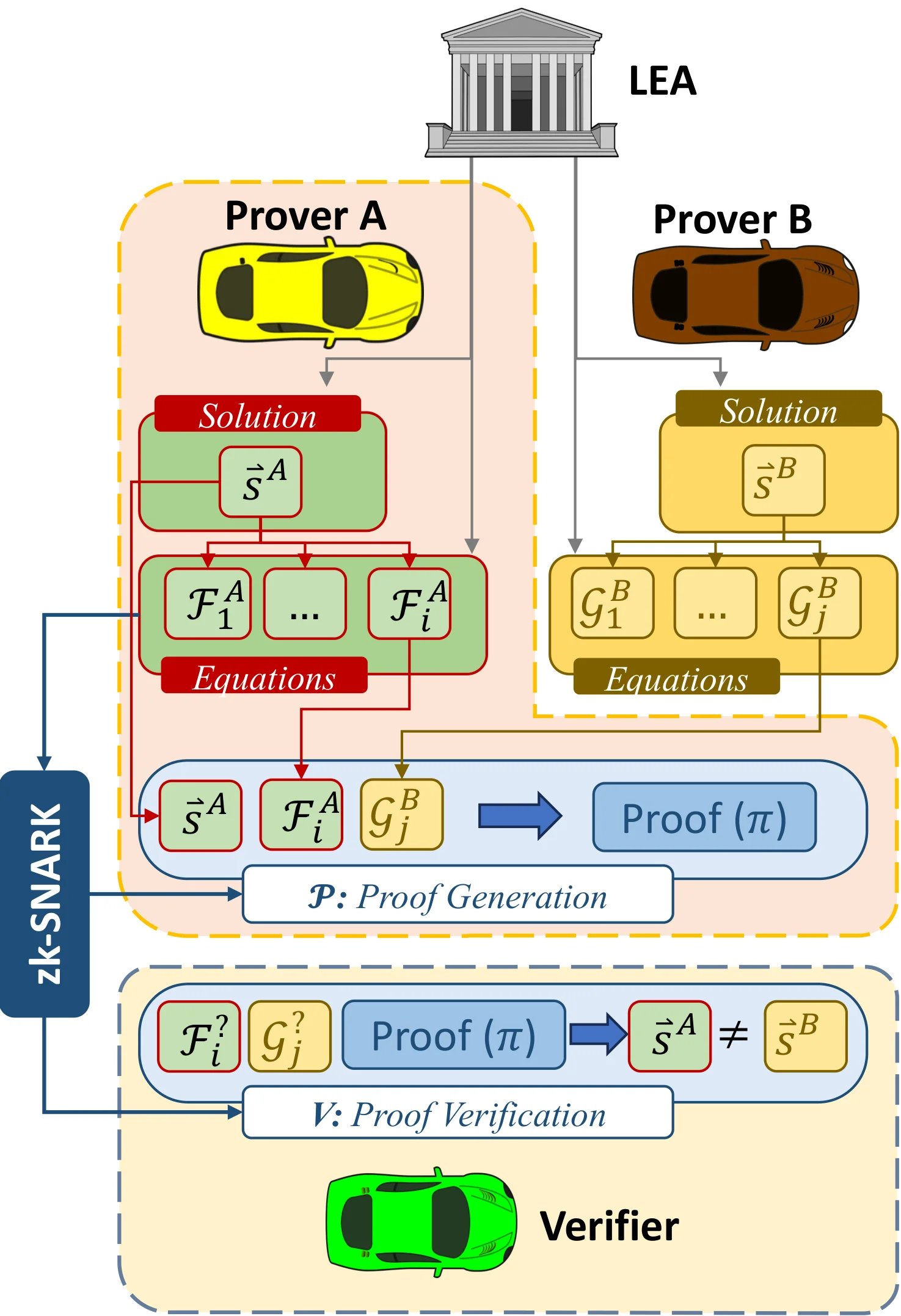
Pseudonyms are widely used in Cooperative Intelligent Transport Systems (C-ITS) to protect the location privacy of vehicles. However, the unlinkability nature of pseudonyms also enables Sybil attacks, where a malicious vehicle can pretend to be multiple vehicles at the same time. In this paper, we propose a novel protocol called zero-knowledge Proof of Distinct Identity (zk-PoDI,) which allows a vehicle to prove that it is not the owner of another pseudonym in the local area, without revealing its actual identity. Zk-PoDI is based on the Diophantine equation and zk-SNARK, and does not rely on any specific pseudonym design or infrastructure assistance. We show that zk-PoDI satisfies all the requirements for a practical Sybil-resistance pseudonym system, and it has low latency, adjustable difficulty, moderate computation overhead, and negligible communication cost. We also discuss the future work of implementing and evaluating zk-PoDI in a realistic city-scale simulation environment.
Related news
How to cite
Y. Tao, H. Wu, E. Javanmardi, M. Tsukada, and H. Esaki, “Zero-Knowledge Proof of Distinct Identity: a Standard-compatible Sybil-resistant Pseudonym Extension for C-ITS,” in 35th IEEE Intelligent Vehicles Symposium (IV 2024), Jeju Island, Korea, 2024, doi: 10.1109/IV55156.2024.10588511.
BibTeX
@inproceedings{Tao2024b,
  title         = {Zero-Knowledge Proof of Distinct Identity: a Standard-compatible Sybil-resistant Pseudonym Extension for C-ITS},
  author        = {Ye Tao and Hongyi Wu and Ehsan Javanmardi and Manabu Tsukada and Hiroshi Esaki},
  url           = {https://arxiv.org/abs/2403.14020},
  doi           = {10.1109/IV55156.2024.10588511},
  year          = {2024},
  date          = {2024-06-02},
  urldate       = {2024-06-02},
  booktitle     = {35th IEEE Intelligent Vehicles Symposium (IV 2024)},
  address       = {Jeju Island, Korea},
  abstract      = {Pseudonyms are widely used in Cooperative Intelligent Transport Systems (C-ITS) to protect the location privacy of vehicles. However, the unlinkability nature of pseudonyms also enables Sybil attacks, where a malicious vehicle can pretend to be multiple vehicles at the same time. In this paper, we propose a novel protocol called zero-knowledge Proof of Distinct Identity (zk-PoDI,) which allows a vehicle to prove that it is not the owner of another pseudonym in the local area, without revealing its actual identity. Zk-PoDI is based on the Diophantine equation and zk-SNARK, and does not rely on any specific pseudonym design or infrastructure assistance. We show that zk-PoDI satisfies all the requirements for a practical Sybil-resistance pseudonym system, and it has low latency, adjustable difficulty, moderate computation overhead, and negligible communication cost. We also discuss the future work of implementing and evaluating zk-PoDI in a realistic city-scale simulation environment.},
  keywords      = {ITS},
  pubstate      = {published},
  tppubtype     = {inproceedings}
}