
Misbehavior Detection Using Collective Perception under Privacy Considerations
IEEE 19th Consumer Communications & Networking Conference (CCNC 2022), Online, Jan 8, 2022
arXivDOI: 10.1109/CCNC49033.2022.9700564
Summary in three lines
- Cooperative perception supplies independent observations for checking whether vehicle messages are plausible.
- The authors design a misbehavior detection method that accounts for privacy constraints.
- Traffic simulations evaluate detection performance under different conditions.
Figures from the paper
Abstract
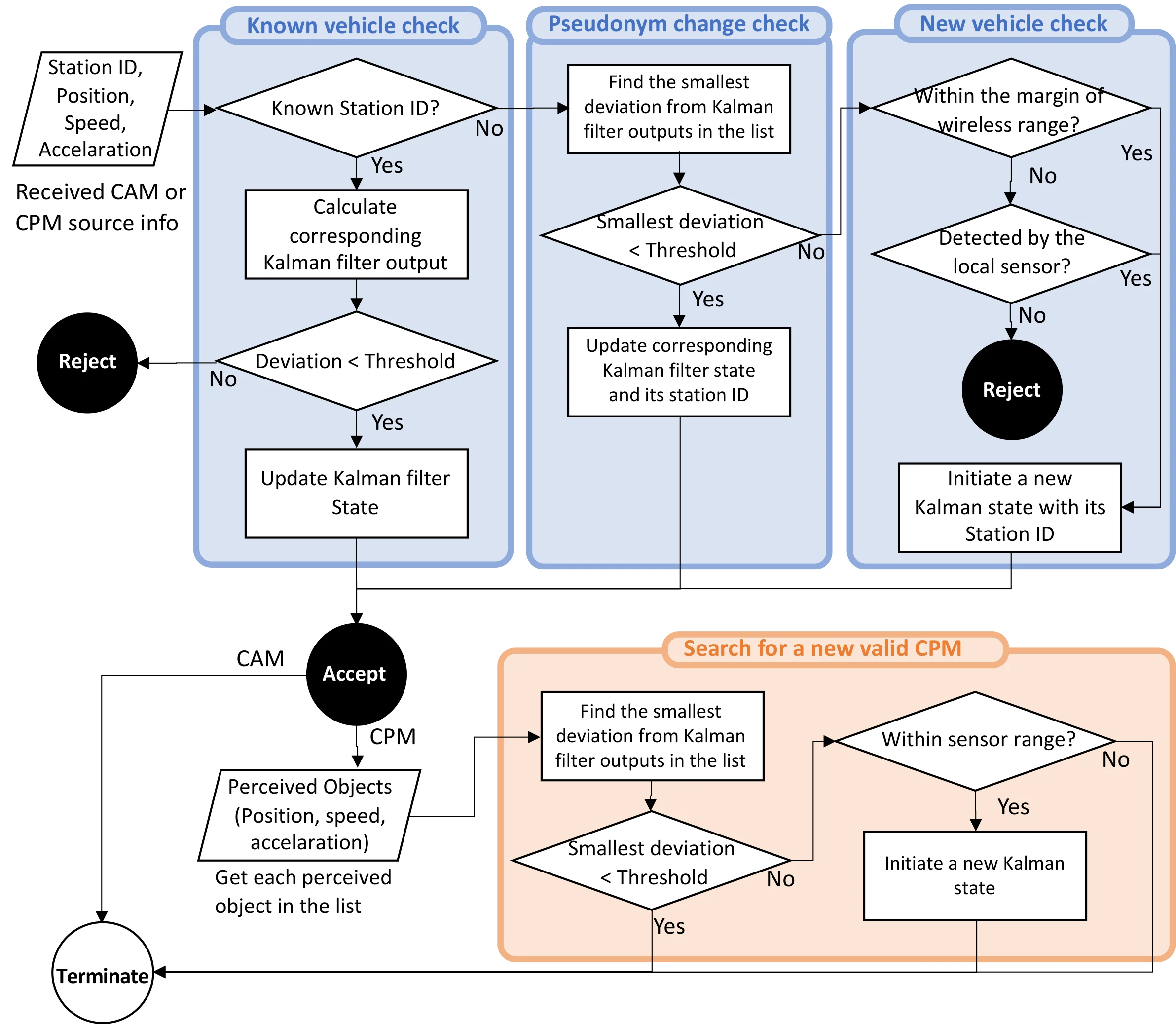
In cooperative ITS, security and privacy protection are essential. Cooperative Awareness Message (CAM) is a basic V2V message standard, and misbehavior detection is critical for protection against attacking CAMs from the inside system, in addition to node authentication by Public Key Infrastructure (PKI). On the contrary, pseudonym IDs, which have been introduced to protect privacy from tracking, make it challenging to perform misbehavior detection. In this study, we improve the performance of misbehavior detection using observation data of other vehicles. This is referred to as collective perception message (CPM), which is becoming the new standard in European countries. We have experimented using realistic traffic scenarios and succeeded in reducing the rate of rejecting valid CAMs (false positive) by approximately 15 percentage points while maintaining the rate of correctly detecting attacks (true positive).
Video
How to cite
M. Tsukada, S. Arii, H. Ochiai, and H. Esaki, “Misbehavior Detection Using Collective Perception under Privacy Considerations,” in IEEE 19th Consumer Communications & Networking Conference (CCNC 2022), Online, 2022, doi: 10.1109/CCNC49033.2022.9700564.
BibTeX
@inproceedings{Tsukada2022,
  title         = {Misbehavior Detection Using Collective Perception under Privacy Considerations},
  author        = {Manabu Tsukada and Shimpei Arii and Hideya Ochiai and Hiroshi Esaki},
  url           = {https://arxiv.org/abs/2111.03461 https://youtu.be/UeHoSv5OAuc},
  doi           = {10.1109/CCNC49033.2022.9700564},
  eprint        = {2111.03461},
  archiveprefix = {arXiv},
  primaryclass  = {cs.CR},
  year          = {2022},
  date          = {2022-01-08},
  urldate       = {2022-01-08},
  booktitle     = {IEEE 19th Consumer Communications & Networking Conference (CCNC 2022)},
  address       = {Online},
  abstract      = {In cooperative ITS, security and privacy protection are essential. Cooperative Awareness Message (CAM) is a basic V2V message standard, and misbehavior detection is critical for protection against attacking CAMs from the inside system, in addition to node authentication by Public Key Infrastructure (PKI). On the contrary, pseudonym IDs, which have been introduced to protect privacy from tracking, make it challenging to perform misbehavior detection. In this study, we improve the performance of misbehavior detection using observation data of other vehicles. This is referred to as collective perception message (CPM), which is becoming the new standard in European countries. We have experimented using realistic traffic scenarios and succeeded in reducing the rate of rejecting valid CAMs (false positive) by approximately 15 percentage points while maintaining the rate of correctly detecting attacks (true positive).},
  keywords      = {ITS},
  pubstate      = {published},
  tppubtype     = {inproceedings}
}